Xeon 6 Workstation Leak Hints at Extreme Core Counts
▼ Summary
– The ADLINK ISB-W890 motherboard indicates Intel’s W890 platform for the upcoming Granite Rapids-WS Xeon workstation processors is nearing readiness.
– The platform supports high memory capacity with eight DDR5 slots for up to 1TB of ECC RAM and extensive storage options including SATA, SlimSAS, and M.2.
– It features substantial PCIe 5.0/4.0 lane allocation for expansion, with the board providing seven PCIe slots and support for high-speed GPU-accelerated workloads.
– The Granite Rapids-WS processors for this socket will scale up to 86 cores with high boost clocks and a 350W power envelope, succeeding the Xeon W-3400 series.
– The W890 ecosystem is designed for advanced, single-socket professional workstations and servers, not for consumer or mini-PC use cases.
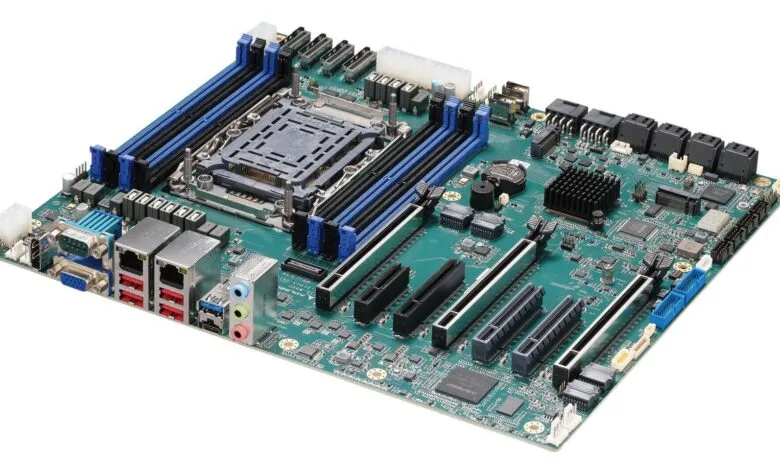
A newly surfaced motherboard from ADLINK provides the clearest signal yet that Intel’s next-generation workstation platform is nearing completion. The ISB-W890 board, built to the SSI-CEB standard, is designed for the upcoming Granite Rapids-WS Xeon processors. This platform is engineered to deliver extreme core counts and massive memory bandwidth for the most demanding professional workloads, from complex simulations to AI development and high-end content creation.
The board confirms the use of Intel’s new Socket E2 layout, which supports a single processor with a thermal design power up to 350 watts. Memory support is a key highlight, with eight DDR5 RDIMM slots aligned to a quad-channel controller. This architecture enables system configurations to reach a full terabyte of ECC memory, placing it firmly in the realm of advanced computational workstations.
For storage, the hardware design is equally robust. It includes eight SATA III connectors, two SlimSAS interfaces, and two M.2 slots with NVMe support. This extensive connectivity ensures professionals can build systems with vast, high-speed storage arrays directly on the motherboard.
PCIe lane allocation is a critical feature, split between Expert and Mainstream modes. The Expert configuration exposes up to 128 lanes across PCIe 5.0 and PCIe 4.0 standards. ADLINK’s implementation includes seven PCIe slots, three of which are x16, alongside MCIO connectors for high-speed expansion cards, such as GPUs or specialized accelerators.
Networking is handled by integrated controllers providing one gigabit and 2.5 gigabit Ethernet ports. System management relies on an AST2600 Baseboard Management Controller (BMC). The rear I/O panel includes multiple USB 3.2 ports, VGA and DisplayPort outputs from the management controller, and a legacy COM port for specialized industrial equipment.
The heart of the platform is the Granite Rapids-WS Xeon processor family. These chips are expected to scale up to an impressive 86 cores, with reported boost clocks nearing 4.8 GHz. Additional evidence for the lineup has appeared in a SiSoftware Sandra database entry, which references a “Xeon 696X” model with 64 cores and 128 threads. The entry also notes substantial L2 and L3 cache pools alongside power figures consistent with the W890 platform.
This new segment is set to succeed the older Xeon W-3400 series used in today’s high-end workstation builds. It continues Intel’s focus on powerful single-socket workstations, a category that delivers exceptional performance for specialized professional applications without the complexity of dual-socket systems.
ADLINK has confirmed the ISB-W890 will be used in its own AXE-7420GWA short-depth server, a system tailored for GPU-accelerated workloads in a 4U rack format. The platform supports up to 12 expansion slots, accommodating a single Granite Rapids-WS processor alongside multiple accelerators.
These converging details from leaked documentation and official listings indicate the shift to next-generation Xeon 6 hardware is advancing steadily. In practical terms, the platform’s capabilities introduce performance levels far beyond what is possible in consumer-grade or mini PC systems. The W890 ecosystem is unmistakably designed for the highest tiers of enterprise and professional computing, where maximum core counts, expansive memory, and unparalleled I/O are non-negotiable requirements.
(Source: TechRadar)