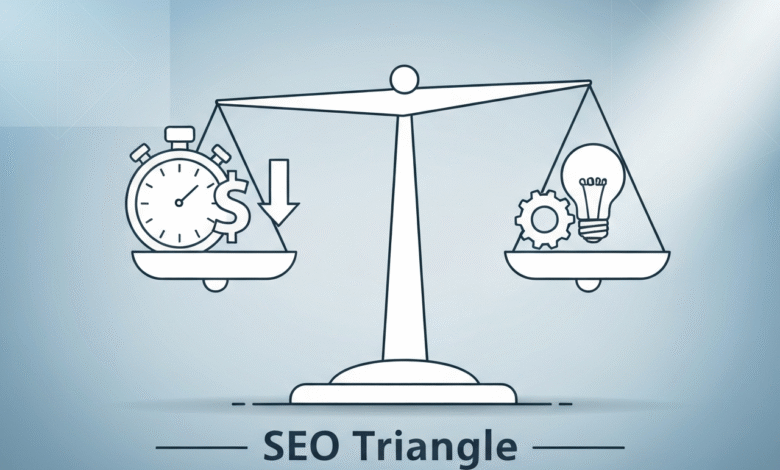
Fast, Cheap, or Good? The SEO Triangle You Can’t Ignore
▼ Summary
– The fast-cheap-good concept illustrates tradeoffs where prioritizing two factors constrains the third, such as high quality and speed leading to higher costs.
– In SEO, time impacts success as achieving top rankings often takes months to years, with older pages typically ranking higher and faster results requiring more investment.
– Low-cost SEO services are risky, potentially causing penalties and revenue loss, while quality SEO requires skilled professionals and justifies higher pricing.
– A quality-first approach in SEO ensures sustainable growth, builds authority, and reduces rework, making it more efficient long-term despite initial constraints.
– Instead of sacrificing one element, prioritizing quality as non-negotiable allows time and cost to adjust, leading to better and more reliable SEO outcomes.
The age-old adage of “fast, cheap, or good, pick two” holds profound implications for search engine optimization. This project management principle directly shapes the outcomes and sustainability of any SEO campaign, forcing businesses to make strategic trade-offs between speed, budget, and excellence. Understanding how these constraints interact helps set realistic expectations and prevents costly mistakes down the line.
At its core, the fast-cheap-good framework illustrates the inherent compromises in any project. When you prioritize two elements, the third inevitably suffers. For instance, high quality delivered quickly comes with a premium price tag. Achieving excellent results on a tight budget requires ample time. Opting for rapid, low-cost solutions almost always means sacrificing quality. While some interpretations suggest you can only “pick two,” the original concept emphasized that time, cost, and quality are deeply interconnected, adjusting one inevitably impacts the others.
In the world of SEO, these trade-offs take on specific meanings. Time in SEO isn’t just about speed; it’s about strategic pacing. While the desire to outpace competitors is natural, effective SEO resembles a marathon far more than a sprint. Significant results often take six months to a year to materialize, and in highly competitive fields, achieving top rankings can require years of effort. Research indicates that most pages ranking in the top ten are over three years old, though new pages can sometimes capture high-volume search terms quickly if conditions are right. Being nimble, anticipating search trends, making swift decisions, and implementing changes faster than rivals, can provide a competitive edge even without a massive budget.
Cost considerations in SEO should never be taken lightly. True expertise commands fair compensation, and bargain SEO services often deliver only the illusion of value. What appears to be a cost-saving measure initially can lead to severe penalties from search engines, loss of visibility, and expensive recovery efforts. The initial savings are quickly erased when you factor in lost revenue and the higher costs of fixing subpar work.
Quality forms the bedrock of any successful SEO initiative. It encompasses the depth of strategy, the skill of execution, the efficiency of project management, the knowledge level of the team, the caliber of content produced, and the precision of technical implementation. In the intensely competitive search environment, cutting corners on quality almost guarantees poor results. Properly vetting your SEO team is crucial to ensuring you receive services that actually move the needle.
Real-world SEO scenarios clearly demonstrate how these trade-offs play out. Choosing fast and cheap SEO typically leads to risky, low-quality tactics that might offer short-term gains but often result in long-term penalties. These approaches usually involve automation, lack strategic depth, and focus only on surface-level optimizations.
When you need high-quality SEO delivered quickly, prepare for a larger financial investment. This path requires skilled professionals, strategists, developers, and content creators, working with intense focus and priority. Even quick wins must align with a sustainable long-term strategy, which inherently takes time to develop and implement.
For organizations working with limited budgets but committed to quality, the cheap-and-good approach remains viable but demands patience. Progress happens incrementally, with results building gradually to create a compounding effect over time. This route suits businesses focused on sustainable, long-term growth rather than immediate returns.
Some critics argue that the traditional project constraint model oversimplifies complex, creative work like SEO. The better question might be whether we must sacrifice any element at all. A more effective approach makes quality the non-negotiable foundation. Since quality fundamentally determines ranking potential and long-term visibility, it makes sense to build everything else, time, cost, and scope, around this central pillar.
Adopting a quality-first strategy often makes SEO programs more efficient and cost-effective over time. There’s less wasted effort, fewer revisions, and minimal need to undo poor work. Quality content builds genuine authority, websites earn greater trust from both users and search engines, and organic traffic grows steadily. The bottom line is that quality SEO represents the only approach that delivers lasting value without creating future problems.
While traditional project constraints will always influence SEO initiatives, the most reliable path to results comes from consistent, quality work performed by knowledgeable professionals. Rather than asking which element to sacrifice, the smarter question is how to protect quality above all else. When you make quality the priority, everything else naturally falls into place.
(Source: Search Engine Land)