Treyarch’s Black Ops: The Rabbit Hole That Changed Call of Duty
▼ Summary
– Treyarch was initially viewed as the “B-team” compared to Infinity Ward in the Call of Duty franchise before Black Ops’ release.
– Black Ops broke from series conventions with a nonlinear Cold War espionage thriller featuring a voiced, unreliable protagonist.
– The game introduced new settings like Vietnam and real-life figures but lacked meaningful political commentary on the era.
– Black Ops established Treyarch’s signature complex, twist-filled narratives, leading to a long-running subseries.
– It expanded Zombies mode into a franchise staple and proved Treyarch could produce game-changing entries for Call of Duty.
Fifteen years after its debut, Call of Duty: Black Ops remains a landmark title that fundamentally altered the trajectory of the entire franchise. Developed by Treyarch, this entry broke from established conventions and carved out a distinctive identity that would influence the series for years to come.
In the early days of the Call of Duty franchise, Treyarch was often viewed as the secondary development team compared to Infinity Ward. Discussions among fans and industry observers frequently positioned Treyarch as the “B-team,” a perception solidified by the release cycles. While 2006’s Call of Duty 3 was a solid World War II shooter, it was completely eclipsed the following year by Infinity Ward’s genre-defining Modern Warfare. Treyarch’s next project, 2008’s World at War, felt in many ways like a World War II-era adaptation of Modern Warfare’s core mechanics.
Everything changed in 2010. With the release of Call of Duty: Black Ops, Treyarch executed a dramatic pivot that redefined both the studio’s role and the franchise’s creative boundaries.
The game’s narrative was a radical departure. For the first time, the series left the familiar terrain of World War II and plunged into the shadowy world of the Cold War. This new setting provided a rich backdrop for a complex espionage thriller, a significant shift from the straightforward military campaigns of earlier titles. The story was deliberately nonlinear, jumping across different time periods and perspectives to weave a tale of conspiracy and psychological manipulation.
Protagonist Alex Mason broke the mold of the typical, silent Call of Duty hero. He was a fully voiced character, and the entire campaign revolved around his fractured psyche. The central plot device involved Mason trying to reconstruct his memories after being subjected to intense brainwashing. This placed players in the role of an unreliable narrator, constantly questioning the reality of the events unfolding on screen. Visual and audio distortions during interrogation scenes would bleed into mission flashbacks, creating a pervasive and effective atmosphere of uncertainty and paranoia.
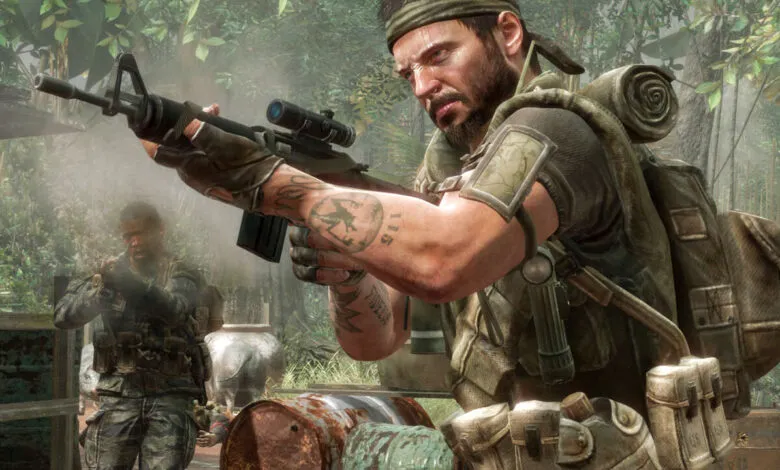
One of the most memorable settings introduced was the jungles of Vietnam, which provided a stark, brutal contrast to the sterile rooms where Mason was being questioned. The narrative also shifted control to other characters, leading players through a harrowing prison escape from a Soviet gulag and intense firefights in Southeast Asia. The plot was packed with twists, all converging in a explosive finale that tied its many threads together.
The game’s cinematic influences were clear. It merged the high-octane, blockbuster action of Infinity Ward’s campaigns with the paranoid tension of political thrillers like The Manchurian Candidate. Visually, it drew heavily from Vietnam War films such as Apocalypse Now and Platoon, even recreating the infamous Russian roulette scene from The Deer Hunter.
However, for all its ambition, Black Ops often used its historical setting as mere set dressing. Real-life figures like President John F. Kennedy and Fidel Castro appeared, but the narrative offered no substantive commentary on the Cold War or the complex politics of the era. Kennedy simply assigned missions, while Castro was reduced to a one-dimensional villain. The Vietnam sequences, while visually striking, served primarily as another backdrop for combat, glossing over the historical atrocities of the conflict.
The campaign, which featured story contributions from The Dark Knight writer David S. Goyer, was filled with over-the-top action, gratuitous violence, and clichéd moments that leaned into its B-movie sensibilities. It was less a thoughtful historical drama and more a thrilling, if sometimes silly, theme park ride through a stylized version of the 1960s.
Despite these criticisms, the release of Black Ops was a pivotal moment for Treyarch. It demonstrated the studio’s capacity for innovation and established a new narrative template that it would continue to refine. While other studios hopped between different sub-series, Treyarch committed to the Black Ops universe, releasing multiple sequels that further explored complex, twist-filled stories. Black Ops 3 ventured into a confusing sci-fi narrative, while 2020’s Black Ops Cold War returned to the sub-series’ espionage roots. The latest installment is once again pushing into futuristic territory with mind-bending visuals.
Beyond the campaign, Black Ops introduced a wealth of content to the multiplayer suite. It featured the beloved map Nuketown, the top-down shooter Dead Ops Arcade, the franchise’s first theater mode, and innovative Wager Matches like One in the Chamber and Gun Game. Player customization through emblems and weapon camos, features that would later vanish, made their debut here.
The Zombies mode was also significantly expanded from its origins in World at War. Treyarch filled these cooperative experiences with intricate Easter eggs, establishing Zombies as a permanent and essential pillar of the Call of Duty experience. The mode’s popularity was so immense that it was incorporated into games developed by other studios, including Infinite Warfare and the rebooted Modern Warfare 3. In a notable role reversal, Infinity Ward even adopted the advanced movement system from Black Ops 3 for its own title.
The launch of Black Ops occurred during a period of major upheaval for Activision. Between the release of Modern Warfare 2 and Black Ops, Infinity Ward’s studio heads were fired, leading to lawsuits and a mass exodus of talent. This crisis left a significant void in the franchise’s leadership. Whether by design or circumstance, Treyarch’s success with Black Ops proved the studio was more than capable of steering the Call of Duty ship, delivering a critical and commercial hit that reassured fans and stakeholders alike.
Call of Duty: Black Ops gifted the community with enduring icons like Nuketown, the cryptic numbers, and the unforgettable Frank Woods. Its true legacy, however, lies in its fearless ambition. It was a game that threw countless new ideas at the wall, and in doing so, redefined what a Call of Duty game could be.
(Source: Gamespot)