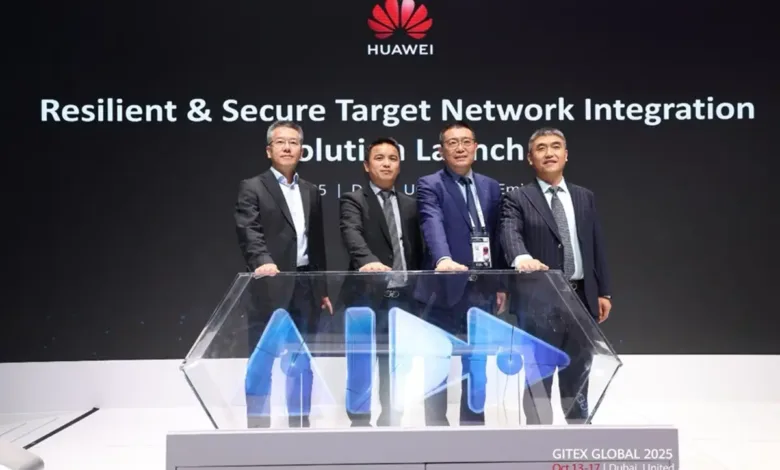
Huawei Debuts AI-Driven Resilient Network Solution at GITEX 2025
▼ Summary
– Huawei launched its Enterprise Network Integration Service 6.0 at GITEX Global 2025 to help enterprises build resilient, secure, and intelligent network infrastructure.
– The solution provides financial institutions with secure, distributed multi-center networks achieving 99.999% availability and full compliance with security standards.
– In transportation, it supports reliable railway communication networks with 99.999% reliability across over 40 scenarios, integrating FRMCS and intelligent optical-visual systems.
– For government use, the solution offers full lifecycle cybersecurity services, achieving 100% detection of known risks and zero major incidents over one year.
– In mining, it enables smart, unmanned operations through 5G and AI integration, leading to 100% unmanned surface operations and improved efficiency.
Huawei has introduced its groundbreaking Enterprise Network Integration Service 6.0: Resilient & Secure Target Network Integration Solution at GITEX Global 2025. This advanced offering is engineered to support organizations in building robust, secure, and intelligent network systems. By leveraging network connectivity, cross-domain planning, artificial intelligence, and unified scheduling, the solution provides a complete lifecycle of services—from initial design and construction to ongoing optimization and future upgrades. It is designed to meet the demanding requirements of industries such as finance, transportation, government, and mining.
For the financial sector, the solution makes it possible to establish secure, distributed multi-center networks that achieve 99.999 percent availability and full compliance with security standards. Through precise network planning, resilience evaluations, and optimized integration processes, it guarantees zero errors during system modifications and zero service interruptions during migration. This allows financial institutions to upgrade their networks smoothly and without disruption.
In the transportation industry, particularly for railway systems, Huawei’s offering combines cross-domain network planning with FRMCS wireless technology, backbone network evolution, and intelligent optical-visual systems. This integrated method helps build next-generation railway communication networks that are dependable and ready for future demands. The solution addresses more than 40 complex railway scenarios, delivering 99.999 percent reliability and consistent performance for essential operations such as train control and dispatching.
For government agencies, Huawei delivers end-to-end services that include cybersecurity consulting, risk analysis, operational assistance, and system assurance. These services help create stable and secure communication networks for the public sector. The system is capable of identifying 100 percent of known risks and filtering out 95 percent of redundant security alerts, which has resulted in zero major cybersecurity incidents over a one-year period.
In the mining industry, the solution incorporates cutting-edge ICT technologies like 5G, AI, drones, and four-dimensional modeling to modernize and automate operations. Through intelligent monitoring and AI-based scheduling, mining companies have achieved fully unmanned surface operations, improved digital measurement efficiency by five to eight times, and reduced fluctuations in ore quality and grade by 2 percent.
Looking forward, Huawei is dedicated to ongoing collaboration with industry partners to push the boundaries of integration services. The company plans to continue strengthening its core technologies to assist in the intelligent transformation of key production networks. This effort aims to help a broader range of industries establish secure, resilient, and forward-looking digital infrastructure.
(Source: Economy Middle East)

