iPhone Air’s Secret Weapon: A Battery That Lasts All Day
▼ Summary
– The iPhone Air’s battery is considered revolutionary due to its completely arbitrary two-dimensional shape, which is a significant breakthrough in battery technology.
– Apple uses a patented metal can battery casing, which adds strength and durability compared to traditional pouch cells with soft plastic casings.
– Metal can batteries allow for more efficient use of space within the device, enabling the battery to fit into odd shapes and close to the edges.
– This battery technology is expected to be adopted widely in phones and will be crucial for smaller devices like AR and VR glasses due to improved energy density.
– The switch to metal can construction may facilitate future adoption of silicon anodes, which store more energy but require better swelling management.
While the iPhone Air’s sleek, thin profile immediately captures attention, its most significant innovation might be hidden from view. According to Gene Berdichevsky, co-founder and CEO of battery materials firm Sila, the device’s revolutionary battery technology represents a true leap forward in power management and design flexibility.
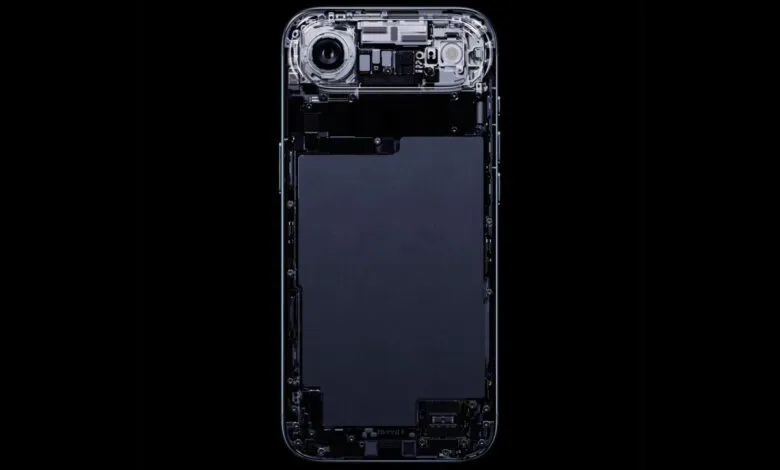
Berdichevsky, who previously led battery engineering for Tesla’s original Roadster, recently had the opportunity to examine these new cells firsthand. He describes them as “pretty remarkable,” emphasizing their completely arbitrary two-dimensional shape as a major advancement. This unconventional design is made possible by Apple’s patented metal can battery construction, which replaces the typical soft plastic pouch found in most consumer electronics.
The key advantage of this metal casing lies in its enhanced strength and durability. Unlike traditional pouch cells, which can swell over time, the rigid metal enclosure prevents deformation and eliminates potential pinch points, especially critical in complex shapes like the L-configuration Apple has used for years. “This basically makes it bulletproof,” Berdichevsky notes. “You can now build batteries in any two-dimensional shape you want.”
This design freedom allows Apple to maximize every millimeter of available space within the iPhone Air’s compact frame. The battery can be molded to fit precisely around other internal components, snaking into gaps that would otherwise go unused. While metal can batteries come at a higher cost, Berdichevsky believes the gains in energy storage will make them worth the investment, not just for smartphones but also for emerging wearable technologies like AR and VR glasses.
Interestingly, this shift in physical battery design may also pave the way for future chemistry improvements. Although Apple has not yet transitioned to silicon-heavy anodes, which can store up to 50% more energy than graphite, the stability offered by metal can construction could facilitate that move. Silicon anodes are known for significant swelling, but the robust metal casing provides a controlled environment to manage that expansion.
Berdichevsky sees this as a critical enabler for next-generation battery materials. “It lets us push the performance limits more,” he explains. “We’ve always had these trade-offs, and we have to manage the swell. You still have to do that, but you can push it a little bit more.” For consumers, this could eventually translate into even longer battery life and more powerful portable devices, all without sacrificing form factor or reliability.
(Source: TechCrunch)