SEO in 2027: What Still Needs to Change
▼ Summary
– Search engine optimization is shifting focus from channel-specific tactics to comprehensive user understanding across AI and social platforms.
– Google has integrated conversational AI like Gemini into its search interface, while users increasingly turn to external LLMs for information.
– Recent data indicates that AI-referred traffic is growing rapidly with high conversion rates, though organic search remains the primary volume driver.
– Effective strategies now require answering core user questions and establishing brand authority where both search engines and chatbots find credible sources.
– The author advocates treating answer engine optimization as an extension of traditional SEO rather than a separate discipline.
The Shift from Keywords to User Intent
Search engine optimization is undergoing a fundamental transformation. The focus is moving away from merely optimizing for specific channels toward deeply understanding the user, regardless of where they seek information. AI Overviews are no longer experimental features; they launched in the U. S. in May 2024 and have since evolved through public testing phases into refined tools that Google tightly controls. This evolution includes the introduction of AI Mode, which integrates Gemini directly into the search experience as a conversational layer rather than just a side-bar chatbot.
Simultaneously, users are increasingly turning to external platforms like ChatGPT, Grok, Claude, and Perplexity for queries they previously reserved for traditional search boxes. Consequently, having clean rankings, an organized content calendar, and a functional keyword map is no longer a guarantee of success. A synthesized answer that retains the user within the interface or a trusted Reddit thread can outperform your blog in referral metrics. However, this shift raises a critical question: did you win the brand battle even if you lost the click?
Data-Driven Insights on AI Traffic
While millions of words discuss AI Overviews, traditional SEO remains vital because Google continues to drive significant volume. Recent data highlights the rapid growth of AI-referred traffic. In August, an analysis by Shopify revealed that AI-referred sessions to merchant storefronts surged 197% year over year in Q2. These shoppers converted at approximately twice the rate of organic visitors in research-heavy categories. Although organic search still delivered more total traffic than all tracked AI platforms combined, growing by 12% on a much larger base, the AI segment represents a faster-growing, higher-intent slice of the market.
Shopify’s CTO, Mikhail Parakhin, said AI-referred sessions roughly tripled while organic search continued to grow on a larger base. AI is a faster-growing, higher-intent slice, while Google organic remains the lead engine. In taste-led categories, AI also brought in about 1.3 times more first-time customers, even when organic remained the bigger discovery channel.
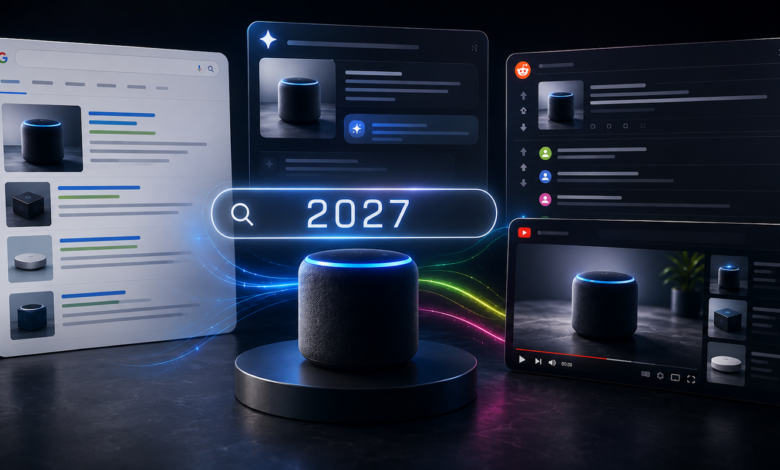
This data suggests that answer engine optimization should not be treated as a separate project but as an extension of user understanding deployed across more surfaces. This approach encompasses Google, Large Language Models (LLMs), and the human-generated platforms those models digest, such as Reddit, YouTube, and LinkedIn. What drives citations from these chatbots changes rapidly and varies by category, so rather than chasing undefined ranking factors, strategies should start with three core questions: What does the user need to know? What can only we say? And where do people and models go to believe it?
LLM Answers vs. Social Search Dynamics
Large Language Models compress numerous sources into a single, synthesized answer. In contrast, social and community search surface specific human voices with distinct points of view within threads or videos. Users consume both types of content depending on their needs. They prefer synthesized answers for orientation but turn to Reddit threads, TikToks, or YouTube walkthroughs when they want to understand the user experience, identify potential failures, or verify who actually ships products.
Content from these social platforms appears in classic SERPs and leaks into LLM answers. This makes brand SEO and community presence essential components of strategy, not secondary marketing tasks. They ensure visibility even when clicks do not occur. Non-brand keywords remain important, but combining brand strength with community engagement creates durability. If a model can easily assemble a summary from ten generic posts, it struggles to fake a named individual who has used the product and can speak to its flaws.
Strategic Priorities for 2027
Effective SEO in 2027 requires mapping a three-dimensional journey across multiple platforms. While Google remains the strongest indicator of demand, it is not the sole place for discovery or evaluation. The primary question has shifted from “Which keywords should I rank for?” to more nuanced inquiries about brand visibility and citation worthiness across different interfaces. Marketers must ask what users want to consume on Reddit, YouTube, and LinkedIn, and whether they possess primary-source answers rather than mere summaries.
It is crucial to evaluate whether there is still a reason to click after a model provides an answer. If not, the query may not be an acquisition opportunity. Sorting keyword lists into buckets helps prioritize effort:
- Still a click: Comparison, pricing, and implementation guides.
- Answer-only: Definitions and ‘what is’ queries.
- Community-owned: Questions like ‘has anyone used X’.
Strategies should avoid thin articles for answer-only buckets and instead focus production time on high-intent topics. Simultaneously, marketers must show up as real people in community-owned spaces. Engaging in forums, Discords, and comment threads where buyers gather is an SEO-adjacent function, not just brand marketing. Building imperfect but authentic brand discourse is superior to astroturfing soulless threads that repeat marketing copy. Deep dives on topics often result in clusters being cited across related prompts, which is the version of topic authority that yields results. A 2,000-word definition article resolved by AI Overviews will not achieve this.
Key Trends Clarifying the Future of SEO
Three areas provide clear evidence of where SEO is heading: AI search expansion, community engagement, and video content.
AI Search Beyond Google
Community Engagement Drives Growth
Video as a Standout Medium
The core job remains unchanged: understanding the user. With more surfaces, algorithms, and ways to get answers without clicking, planning documents must adapt, but the role’s essence stays the same. Losing blue-link traffic is acceptable if conversions, pipeline, and customer acquisition costs improve. The most impactful step is to rewrite planning questions, starting with the user and the surface rather than the keyword list.
(Source: Search Engine Land)