OpenAI’s Brockman Praises Kimi K3, Skips Distillation Question
▼ Summary
– OpenAI president Greg Brockman called Moonshot AI’s Kimi K3 “pretty good” but said it is too early to tell if the model was trained by distilling OpenAI’s outputs.
– The White House accused Moonshot of accessing banned Nvidia chips through intermediaries and conducting large-scale distillation against American AI models.
– Anthropic alleged in February that Moonshot, DeepSeek, and MiniMax used fraudulent accounts to extract knowledge from its Claude models.
– Brockman argued the US has a “huge advantage” due to infrastructure investments, and estimated China remains about four months behind the US in model development.
– Kimi K3, a nearly three-trillion-parameter open-weight model, topped Arena’s coding leaderboard within 24 hours and is priced at a fraction of US labs’ rates.
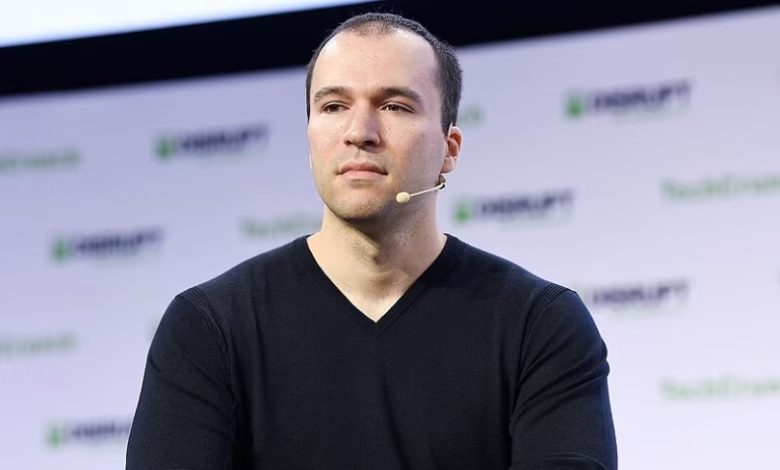
OpenAI president Greg Brockman offered a rare, measured compliment to a Chinese competitor this week, calling Moonshot AI’s Kimi K3 model “pretty good” during a Bloomberg interview on Tuesday. While acknowledging the system’s quality, he stopped short of confirming whether Moonshot relied on distillation from OpenAI’s own models to build it. Brockman said it is “too early” to know if the startup trained K3 by extracting knowledge from OpenAI’s outputs, a practice the company has long accused Chinese labs of employing. His tone contrasted sharply with the White House, which earlier that day leveled its most specific accusations yet against the startup.
Michael Kratsios, director of the White House Office of Science and Technology Policy, accused Moonshot of accessing banned Nvidia chips through intermediaries in Thailand and conducting large-scale distillation against American AI models, according to Bloomberg. The allegations came on the same day Treasury Secretary Scott Bessent warned that the administration would scrutinize Chinese open-source models for stolen intellectual property and could impose sanctions within weeks. Nvidia CEO Jensen Huang pushed back against the alarm, calling Chinese open models “excellent” and urging the government to let American firms use them.
The distillation charge has been building for months. In February, Anthropic accused Moonshot, DeepSeek, and MiniMax of running roughly 16 million exchanges through about 24,000 fraudulent accounts to extract knowledge from its Claude models. OpenAI has made similar complaints, and the White House now appears to treat the allegations as a matter of national security rather than a commercial dispute between rival labs.
Brockman framed OpenAI’s position around its massive infrastructure investments, arguing that the US has a “huge advantage” because of the billions it has poured into compute. He said open-weight models like K3 are not truly free because running them at scale still requires expensive hardware, a point that undercuts the narrative that Chinese labs can simply give away frontier-level AI. He estimated that China remains roughly four months behind the US in overall model development.
K3 is a nearly three-trillion-parameter open-weight model that Moonshot released on July 16, and it has rattled Washington and Wall Street by matching or beating the best American systems on several benchmarks. The model topped Arena’s frontend coding leaderboard within 24 hours of launch, placing ahead of both Anthropic and OpenAI’s flagship offerings. Moonshot is pricing K3 at a fraction of what US labs charge, accelerating the commoditisation of the model layer that investors have been warning about since DeepSeek’s price cuts earlier this year.
Brockman, who donated to a Trump-aligned super PAC, declined to wade into the debate over whether Chinese models should be banned. He instead stressed that OpenAI believes open models are important for “democratizing access to AI,” a position that aligns him more closely with Huang than with the White House officials pressing for sanctions.
(Source: The Next Web)