SEO and PPC: Why the Debate Is Over
▼ Summary
– The traditional SEO vs. PPC debate is outdated because the search results page is now a dynamic synthesis engine, and zero-click searches have risen to 68.01% of U.S. Google searches in early 2026.
– AI Overviews significantly reduce clicks for both organic and paid listings, but brands cited within an AI Overview earn 35% more organic clicks and 91% more paid clicks than uncited brands.
– SEO and PPC are no longer substitutes but two parts of a single system where organic visibility helps a brand become the answer, and ads convert that recommendation.
– AI is reshaping the customer journey by providing direct answers, making influence and brand visibility more important than the click itself as the primary unit of value.
– The debate is now about integrating SEO, PPC, and AI, as a brand’s organic footprint directly supports AI citations, ad targeting (e.g., AI Max), and overall visibility across multiple platforms.
For nearly two decades, the question of whether to invest in SEO or PPC has dominated marketing conversations. The answer has always been the same: it depends. But in 2026, that answer is no longer just insufficient,it’s irrelevant.
The debate itself is built on a foundation that has crumbled. The search results page is no longer a stable list of slots; it’s a dynamic synthesis engine. The click is no longer the primary unit of value; influence now matters more. And search no longer happens exclusively on a search engine; it’s a behavior spread across commerce sites, social platforms, and AI tools.
Consider two recent clients. An architect ranked first for several seemingly important keywords, but their SEO agency’s celebration was premature. A closer look revealed that four ads, a “Find Results on Page” feature, and four local listings (one paid) pushed their organic result roughly 20 links down the page. Search Console showed those keywords generated only 300 monthly searches with a 1% click-through rate. Three clicks a month. The solution was to shift budget from SEO to paid search, and performance improved quickly.
The second client, a clinical psychologist specializing in childhood bereavement, needed only two or three quality inquiries per week. With no budget for ads, we focused on a well-optimized Google Business Profile, clear website content, and local citations. She gained visibility in Maps, localized organic search, and AI results. Her competition was dominated by large, impersonal therapy directories; positioning her as a local, experienced expert made all the difference.
These two examples show why the “SEO or PPC?” question is the wrong one. It assumes a search results page that no longer exists and a market where the click is no longer the thing you’re actually buying.
Four assumptions that once underpinned the debate no longer hold. First, the results page is not a stable list of slots; it’s a synthesis engine that assembles a different answer for each query. AI Overviews now appear on a large and growing share of queries, powered by Gemini 3 since January. Second, the click is not the unit of value; in the first four months of 2026, 68.01% of U. S. Google searches ended without a click anywhere, up from 60.45% in 2024. Third, SEO and PPC are not substitutes competing for the same visitor; organic visibility measurably lifts paid performance. Fourth, search is not confined to a search engine; Amazon, Bing, and YouTube each handle more search activity than ChatGPT.
AI has fundamentally changed the equation. Seer Interactive found that across queries with AI Overviews, average organic click-through rates fell 61%, from 1.76% to 0.61%. PPC took an even bigger hit, falling about 68%, from 19.7% to 6.34%. AI Overviews did more damage to ads than organic results, reducing clicks overall rather than redistributing them in the long-running battle between SEO and PPC.
However, brands cited inside an AI Overview earned 35% more organic clicks and 91% more paid clicks than uncited brands. The AI citation functions as an endorsement, priming the click elsewhere on the page. It’s like a personal referral arriving through a branded search.
The conversation is no longer SEO vs. PPC. It’s SEO, PPC, and AI. Google’s new AI Max ad format reads your website content and landing pages to expand final URLs and match queries. Your SEO assets are now direct inputs for your paid campaigns. Clear pages, structured content, and a value proposition machines can understand now feed your organic rankings, Quality Score, AI Max query matching, AI Overview citations, and LLM visibility.
Paid search is becoming more expensive per click but more effective per outcome. WordStream’s 2026 benchmarks put average search CPC at $5.42, more than double the 2016 figure. Yet conversion rates improved across 87% of industries, and cost per lead fell for the first time in five years. The remaining clicks carry higher intent.
The trend toward zero-click searches has been remarkably consistent: roughly 45% in 2016, 49% in 2019, 60% in 2024, and 68% today. AI Overviews simply accelerated a trend that was already underway. Google has spent a decade building features that keep people on Google, gradually transforming search from a list of signposts into a platform that provides answers.
SEO still matters because AI Overviews are grounded in Google’s index. Your search visibility still drives your AI visibility. YouTube is a particularly strong opportunity because videos often rank for the subqueries that support broader AI-generated answers. Keywords aren’t what they once were, but topical visibility across search remains highly important.
The “SEO is dead” crowd is trying to sell you GEO, but Google still drives nearly 90% of referral traffic. All AI chatbots combined account for less than 1%. Yet AI increasingly shapes the decisions behind those clicks. By the time someone reaches your website or clicks your ad, they’re often a warm prospect. AI-referred traffic converts several times better than traditional organic traffic.
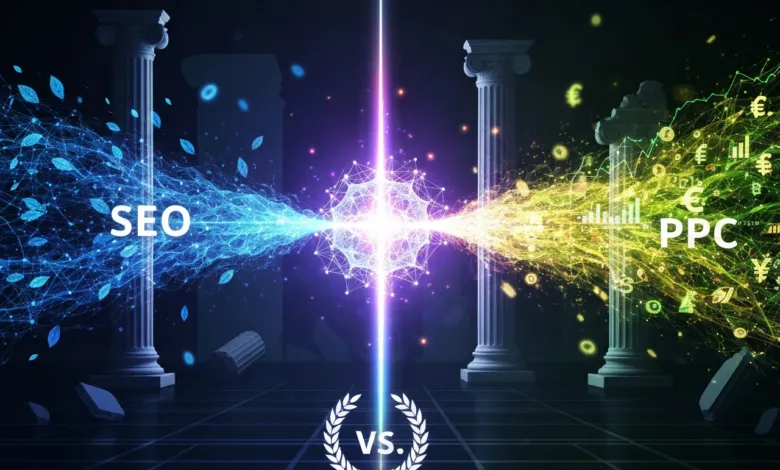
SEO and PPC are no longer just acquisition channels. They’re the mechanisms that help you become the answer. Your organic footprint helps you become the answer across search and AI. Your ads help you get chosen once you are. One earns the recommendation. The other converts it.
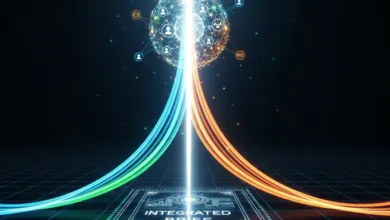
The debate is dead. Long live integrated SEO, PPC, and AI.
(Source: Search Engine Land)