SpaceX’s IPO fueled by 3 hard-tech moonshots
▼ Summary
– SpaceX’s $75 billion stock offering is deeply oversubscribed, driven by investor excitement despite skepticism over the company’s losses and Elon Musk’s behavior.
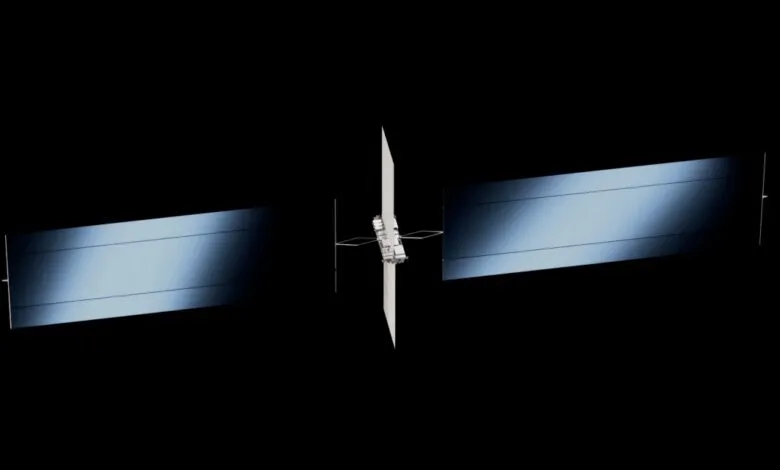
– The company’s financial plan centers on orbital data centers, requiring three engineering feats: a reusable rocket, a new US chip foundry, and faster satellite production.
– Independent analyses from Morningstar and Aswath Damodaran value SpaceX at $825 billion and $1.2 trillion, respectively, far below the $1.8 trillion assessment from its bankers.
– SpaceX’s AI business, framed as a $22.7 trillion opportunity, is the most uncertain part, with the company acting as both a compute provider and model builder.
– Key challenges include scaling Starship reusability, building a chip foundry, and ramping satellite production to 6,666 per year, all of which are unprecedented in scope and timeline.
SpaceX is finally taking its act to the public markets this Friday, and the frenzy is real. The $75 billion IPO is reportedly massively oversubscribed, with institutional investors already committing to $10 billion blocks of Elon Musk’s sprawling enterprise.
There are plenty of reasons to raise an eyebrow. Big IPOs often stumble out of the gate. The company is still losing money. And Musk’s unpredictable public persona would be a liability for almost any other tech leader. None of that seems to matter. The investing world has learned one rule: never bet against Elon, even when the numbers don’t add up.
But if you strip away the hype and look at SpaceX’s actual financial roadmap, a clearer picture emerges. What investors are really buying into is a bet on orbital data centers , a concept that took shape over the last 18 months as Musk searched for a unifying vision ahead of the IPO.
True to form, it’s a audacious plan that hinges on three near-impossible engineering feats: a fully reusable rocket, a new American chip foundry, and a breakneck satellite production sprint.
That kind of ambition is hard to price. This week, two sober analyses attempted just that. Morningstar, the financial research firm, and Aswath Damodaran, a NYU finance professor known for his valuation work, both concluded SpaceX is worth far less than the $1.8 trillion its bankers are floating. Morningstar lands at roughly $825 billion, while Damodaran puts the figure closer to $1.2 trillion.
The gap is largely explained by one thing: SpaceX is essentially a world-beating space monopoly strapped to a highly speculative AI business. Morningstar’s analyst frames the difference between their $63 fair value and SpaceX’s $135 offering price as a $72 call option on the company’s ability to deliver orbital data centers at the speed and scale Musk envisions.
In both analyses, the real value lies in SpaceX’s high-margin launch business and its satellite internet network. The AI side is where things get fuzzy.
So what exactly is SpaceX’s AI business? According to its S-1 filing, the biggest opportunity is in enterprise AI , powering coding tools from the team it acqui-hired from Cursor, and its Macrohard project, which aims to give digital agents the ability to perform white-collar work. SpaceX pegs that total addressable market at $22.7 trillion, compared to $2.4 trillion for AI infrastructure and under $2 trillion for space.
But that narrative doesn’t fully align with recent deals to sell massive compute capacity to Anthropic and Google, both direct competitors in the model-building space. That’s not unusual for a Musk company , SpaceX often launches satellites for rivals to its Starlink network. The difference is that usually comes from a position of strength, not while playing catch-up.
Acting like a neocloud provider might make sense in the short term, but it raises a fundamental question: where does value accrue in the AI stack? Is it better to be a compute provider or a model builder when you can’t be both?
The scaling logic driving the AI industry demands that frontier labs constantly train bigger, better models , or, as Musk admitted in his recent lawsuit against Sam Altman, by distilling capabilities from others. Any player that doesn’t keep pace risks falling behind, though the rise of cheaper open-source models could disrupt that dynamic.
Space data centers offer a potential solution: enough compute to let SpaceX do both at once.
In a video released by SpaceX this week, Musk laid out his reasoning. The core argument: SpaceX is the only company that can cheaply put large mass into orbit, build vast solar arrays, and produce chips at scale. Most industry experts say space data centers are about a decade away. Musk, with plenty of caveats, says they’re much closer.
“This is not a promise of what we’ll do,” Musk said. “This is what we are going to try to do, and think we probably can do, which is to get to roughly an annualized rate of a gigawatt per year by the end of next year, in terms of space AI compute.”
Based on his estimated 150kW per satellite, that means producing 6,666 satellites a year , or about 556 per month. That’s roughly double the current Starlink production rate of 70 per week. Musk says the AI satellites are simpler in design, but that still demands a production facility that doesn’t exist yet. The company is also still building out its solar panel manufacturing.
Then there’s Terafab, the much-discussed chip foundry Musk sees feeding into later stages of the plan as SpaceX tries to scale to a terawatt of annual compute production. Chip fabs are among the hardest industrial projects on Earth, typically costing billions of dollars and taking up to a decade to build.
And then there’s the biggest question of all: Starship. It’s the key to putting all those chips in orbit economically. A recent test flight went reasonably well, but it didn’t suggest rapid reusability is just around the corner. SpaceX may only reuse the booster at first, which would raise costs significantly. The company is still under a mishap investigation by the FAA after the booster failed to make a controlled reentry. SpaceX hasn’t said when Starship will fly again, though it has indicated it expects to start launching Starlink satellites with it by year’s end.
Take that timeline with caution. NASA, which has a nearly $4 billion contract with SpaceX to use Starship as a Moon lander, still won’t commit to a test mission before late 2027.
As public investors get their hands on SpaceX shares, they’re buying a near-monopoly on US and European space access, a global communications network, and a bet on the most ambitious infrastructure project of the AI era.
That bet depends on SpaceX achieving something that has never been done: a fully reusable rocket. It also requires building a high-rate AI satellite factory in 18 months, not the decade it took to develop Starlink manufacturing. And finally, it demands a US chip foundry, something even dedicated silicon companies are reluctant to attempt.
Musk is right that SpaceX is the only company positioned to attempt any of this anytime soon. But that says as much about the magnitude of the challenge as it does about the company’s chances of pulling it off.
Musk used to say he wouldn’t take SpaceX public until he reached Mars, because fickle investors might lose faith along the way. Those Mars plans may be on hold, but the road he’s laid out for the IPO might be just as hard.
(Source: TechCrunch)