▼ Summary
– Revolut co-founder and CTO Vlad Yatsenko will step down in July 2026, moving to a non-executive director role on the board.
– Donato Lucia, an eight-year engineering veteran and current head of technology, will replace Yatsenko as vice president of technology.
– Revolut is targeting a US IPO potentially valued at up to $200 billion, with a recent secondary share sale valuing it at $75 billion.
– The company generated £4.5 billion in revenue in 2025, up 46% year on year, and serves over 70 million customers.
– Yatsenko was Revolut’s first employee and was given the co-founder title by CEO Nik Storonsky to aid engineering recruitment.
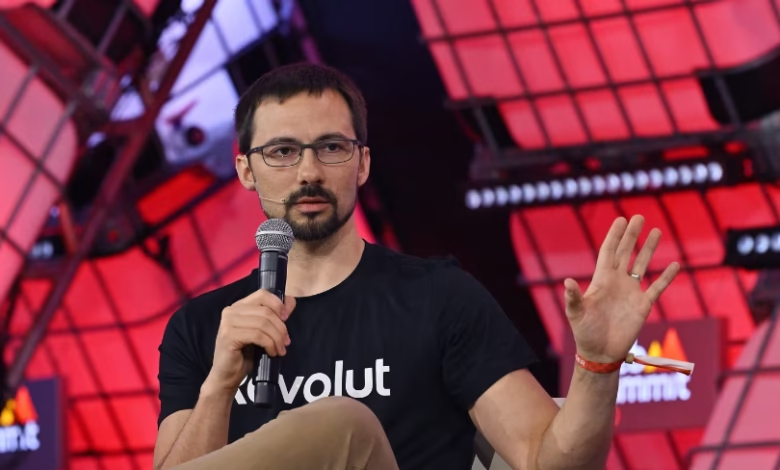
Revolut co-founder and chief technology officer Vlad Yatsenko is leaving his operational role this July, transitioning to a board position as the digital bank prepares for a potential $200 billion US IPO. Taking his place is Donato Lucia, an eight-year engineering veteran who will assume the newly titled role of vice president of technology.
Yatsenko was actually Revolut’s first employee, joining before CEO Nik Storonsky had even launched the company. Storonsky later granted him the co-founder title, not for conventional founding duties, but because, as he told David Rubenstein earlier this year, “it was easier for him to recruit engineers if he had the title co-founder.”
That pragmatic arrangement has now run its course. Yatsenko will formally step down as CTO on 1 July 2026, moving to a non-executive director role on the Revolut board, according to Sifted and an official company statement.
“I feel content with this decision, as Revolut has grown from a young, ambitious startup into a mature, highly impactful global company,” Yatsenko said.
Donato Lucia, currently Revolut’s head of technology, will step into the newly renamed vice president of technology position. He joined the company in 2018 as a senior software engineer and has spent the last eight years building Revolut’s core banking infrastructure. He was promoted to his current role in April 2025.
This succession signals continuity over disruption. Lucia is an insider who has constructed the systems enabling Revolut’s expansion, suggesting the company views its technology leadership challenge as one of scaling existing infrastructure rather than reinventing it.
The timing of Yatsenko’s departure is critical. Revolut is targeting a US IPO that could value the company at up to $200 billion, roughly two years from now. Its most recent secondary share sale in November valued it at $75 billion, already making it Europe’s most valuable private technology company.
The financials support the ambition. Revolut generated £4.5 billion in revenue in 2025, up 46% year on year, with pre-tax profit of £1.7 billion. It now serves more than 70 million customers across over 100 countries and holds banking licences in the UK, Lithuania, and Mexico. It recently launched a private banking unit and has filed for a US bank charter.
Founder departures before IPOs are common in tech, and Yatsenko’s move to the board rather than a clean exit suggests an amicable transition. But the timing also underscores that the company built from a WeWork desk is now a regulated financial institution with serious B2B ambitions and a path to public markets demanding institutional-grade governance.
Storonsky’s candid admission about the co-founder title is revealing, not because it undermines Yatsenko’s contribution, but because it captures the improvised, whatever-works pragmatism of Revolut’s early years. Yatsenko was employee number one. He built the technology that a $75 billion digital bank now runs on. Whether the title was always technically accurate matters less than the fact that the infrastructure he created still underpins every transaction.
The real question for Revolut is not whether it can survive without Yatsenko in the CTO chair. It is whether an eight-year internal promotion is enough to carry the technology organisation through an IPO, a US bank charter application, and the intense regulatory scrutiny that comes with both. Lucia has the institutional knowledge. Whether he has the mandate to reshape the engineering culture for what comes next is something only the next two years will reveal.
(Source: The Next Web)