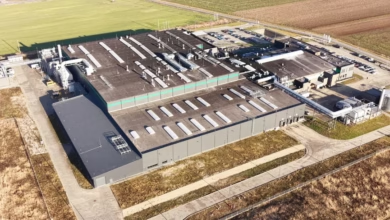
AtlasEdge secures $1.2B debt to expand European data centres

▼ Summary
– AtlasEdge secured approximately $1.2 billion in debt financing, its largest single raise since 2021, to scale its European data-centre footprint.
– The financing brings AtlasEdge’s cumulative debt to over $2 billion in 12 months, following a €725 million facility in 2024 and a €253 million package for Lisbon.
– AtlasEdge targets over 150MW of European capacity with active projects in six countries, focusing on smaller edge facilities near enterprise customers.
– The company’s edge-focused thesis benefits from European cloud-capacity constraints and a political shift toward tech sovereignty, including EU restrictions on US cloud providers for sensitive data.
– The $1.2 billion facility provides roughly five years of build-out runway, but the commercial viability of the edge thesis against cheaper hyperscale infrastructure remains untested.
AtlasEdge, the European data-centre operator co-owned by Liberty Global and DigitalBridge, has raised approximately $1.2 billion in debt financing to rapidly expand its capacity across the continent. The deal, reported by Bloomberg on Thursday, marks the largest single financing event since the company was formed in 2021 and arrives during a period of unusually high capital deployment in the European data-centre sector.
This latest facility extends a pattern of progressively larger debt raises over the past 18 months. In 2024, AtlasEdge secured a €725 million facility, and earlier this month it obtained a €253 million green-financing package specifically to support its expansion in Lisbon. With today’s $1.2 billion injection, the company’s total cumulative debt raised has now surpassed $2 billion within roughly twelve months, underscoring the aggressive appetite of its investor base to fund European-edge infrastructure.
The specific structure of the financing was not disclosed, but it follows AtlasEdge’s established approach of using senior secured term-bond facilities arranged with European bank syndicates. The justification for the loan lies in the company’s capacity targets: AtlasEdge plans to bring more than 150 megawatts of European capacity online in the coming years, with active projects already underway in Portugal, the Netherlands, Germany, Spain, Switzerland, and the UK.
Positioned at the edge end of the market, AtlasEdge focuses on smaller, more numerous facilities located closer to enterprise customers, rather than competing directly with hyperscalers on gigawatt-scale campuses. The core thesis is that AI inference, video streaming, and latency-sensitive enterprise workloads will increasingly favor distributed European-edge capacity over centralized hyperscale alternatives. Operators that can serve that demand, the thinking goes, will capture meaningful margins in the gap.
The broader European data-centre demand picture supports this financing logic. Hyperscalers AWS, Microsoft Azure, and Google Cloud collectively account for roughly 70% of European cloud-infrastructure revenues and are visibly capacity-constrained across multiple regions. European-headquartered alternatives such as OVHcloud, Scaleway, and Deutsche Telekom’s T Cloud Public are scaling but have not yet reached hyperscale parity. Edge-focused operators like AtlasEdge sit in a related-but-distinct part of the market, benefiting from the same underlying European-capacity squeeze.
Gartner forecasts that European spending on sovereign cloud infrastructure will reach $12.6 billion in 2026, an increase of 83% from 2025. The political environment also plays a role. Over the past 18 months, European policymakers have actively reconsidered their dependence on US hyperscalers for cloud infrastructure. The European Commission’s Tech Sovereignty Package, published yesterday, explicitly restricts US cloud providers from processing sensitive public-sector data.
AtlasEdge, as a European-operated platform under Liberty Global and DigitalBridge ownership, is well-positioned as sovereignty-procurement preferences take effect. While its edge-focused thesis predates the sovereignty wave, it now lands inside that trend usefully.
The DigitalBridge side of the cap table is also significant. The US-listed digital-infrastructure investor has been one of the most aggressive global data-centre capital deployers over the past three years, with stakes in operators across the US, Europe, Asia, and Latin America. Its co-ownership gives AtlasEdge access to a global financing and operations network that pure-European alternatives lack. Liberty Global, parent company of Virgin Media O2 and other European telecoms operators, brings the customer and real-estate side. Together, the pairing has produced one of the most visible European edge platforms operating today.
What remains to be tested is whether the European edge thesis actually pays out at the scale AtlasEdge is now funding. AI inference does favor distributed deployment, but whether the price-per-megawatt economics support edge-tier returns against the gravitational pull of cheaper hyperscale infrastructure is the open commercial question. The $1.2 billion facility provides roughly five years of build-out runway, depending on capital intensity per megawatt. The next 24 months of utilisation data will indicate which way the thesis cuts.
AtlasEdge did not separately disclose the lead bank or syndicate composition for the new facility. Liberty Global and DigitalBridge declined to comment beyond confirming the financing.
(Source: The Next Web)