TNW, Oneflow & Flexas Amsterdam event speaker lineup
▼ Summary
– A panel on June 3 in Amsterdam will address the question: when everyone has AI, what will make a SaaS company win?
– Generative AI has become a substrate, not a feature, so success depends on rebuilding product, go-to-market, and operations around AI as part of the company.
– The conversation will cover which SaaS functions get redesigned first or last, what becomes a competitive moat versus a commodity, and how AI changes pricing and unit economics.
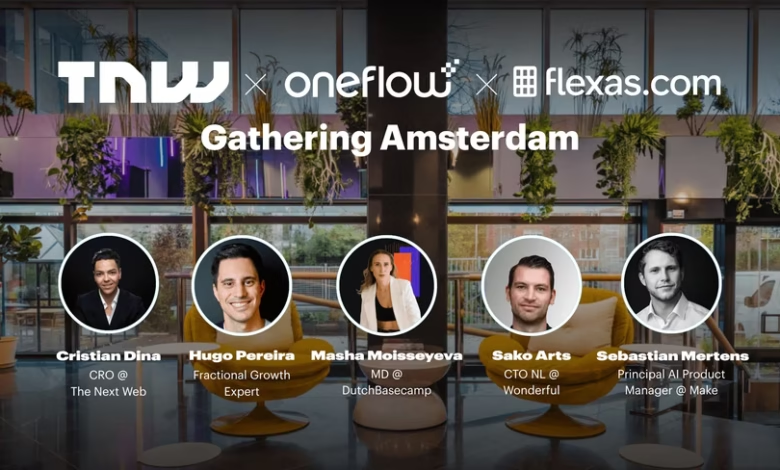
– The panel includes Sebastian Mertens (Make), Masha Moisseyeva (DutchBasecamp), Hugo Pereira (fractional CGO/CMO), and Sako Arts (Wonderful), covering product, growth, operations, and technical architecture.
– Founders now focus on which parts of their company to rebuild and in what order, rather than whether to use AI at all.
Four speakers, one central question: when AI is everywhere, what actually separates winning SaaS companies from the rest? That’s the challenge a panel will take on at the TNW, Oneflow & Flexas Gathering in Amsterdam on 3 June.
There comes a moment , somewhere between a company’s third and fourth AI feature launch of the quarter , when even the most optimistic founder starts to wonder if anyone is truly buying what they’re selling.
That moment is exactly why this panel is built around a single, pointed inquiry: when every competitor has AI, what determines who wins in SaaS? Cristian Dina, co-founder of Tekpon and CRO at TNW, will moderate. Having interviewed hundreds of SaaS founders, he seems to know everyone in the room before they even walk in.
The core premise is straightforward. Generative AI has shifted from a feature to a foundation. The work that will determine which companies survive the next two years is no longer about adding a chatbot to a sidebar. It’s about redesigning product, go-to-market, and operations around the reality that the model is part of the company, not an add-on.
Three themes will guide the discussion. First, which functions inside a SaaS company get redesigned first, which get redesigned last, and which quietly become obsolete. Second, what becomes a competitive moat in an AI-native world, and what slides into commodity territory. Third, how AI changes pricing, packaging, and unit economics , the numbers founders still present to investors in board decks.
Threaded through all of it is a fourth, quieter question: how do you avoid shipping demo AI , the kind that impresses in a thirty-second video but disappoints in production , instead of delivering real customer value?
Here’s who will tackle these questions on stage.
Sebastian Mertens, Principal AI Product at Make, brings deep product insight. Make is the no-code automation platform that has quietly become one of the most-used tools for non-technical teams building with large language models. Mertens leads its applied AI work , the agents, toolkits, and systems that turn a model into something a sales operations lead can actually deploy on a Tuesday. Before Make, he co-founded Wemakefuture, a German automation consultancy. He offers the panel’s closest read on what an AI-native product surface actually looks like once the novelty wears off.
Masha Moisseyeva, Managing Director of DutchBasecamp, anchors the operations and expansion perspective. DutchBasecamp helps founders enter new markets , a challenge that becomes far more complex when every product you compete against has shipped its own version of the same AI feature in the past six months. Moisseyeva is a two-time founder herself, and her work at DBC, which recently merged with ACE, gives her a unique view of the European startup landscape: who’s hiring, who’s consolidating, and who’s quietly running out of runway.
Hugo Pereira, fractional CGO/CMO and former Chief Growth Officer at EVBox, brings the growth and go-to-market perspective. He spent seven years at EVBox, taking the business from roughly €5 million in revenue to over €100 million, and growing the team from ten to seven hundred people. Now a fractional operator advising B2B SaaS and deep-tech founders, he’s also author of Teams in Hell, a book about organizational dysfunction that scales faster than revenue. On a panel about AI-native go-to-market, he’s the one most likely to say something unflattering about pipeline coverage ratios.
Sako Arts, CTO at Wonderful, provides the technical voice. Wonderful is the enterprise agent platform that raised a $150 million Series B in March at a $2 billion valuation, deploying AI agents across voice, chat, email, and back-office systems for telecom, financial services, manufacturing, and healthcare in over thirty markets. Before Wonderful, Arts co-founded FruitPunch AI, a global AI-for-Good community that pairs engineers with applied problems in conservation, healthcare, and climate , working with partners including the World Wildlife Fund and the European Space Agency. He has spent years building production AI systems for organizations that can’t afford hallucinations, giving him a sharp perspective on the gap between what AI can demo and what it can actually ship.
Together, the four speakers cover the surfaces an AI-native company must rebuild: product (Mertens), growth (Pereira), operations and expansion (Moisseyeva), and technical architecture (Arts). Dina’s role as moderator will be to keep them from agreeing too quickly.
Two years on from the first wave of generative AI launches, the SaaS conversation has shifted. The early debate , whether incumbents or a new generation of AI-native companies would win , has given way to something more granular. Founders are no longer asking whether to use AI. They’re asking which parts of their company to rebuild, in what order, and on what timeline.
That conversation is easier to have in a room of forty than in a room of four hundred. The 3 June gathering is designed for the smaller room. The panel runs from 6 pm to 7:30 pm, after food and drinks, and before the evening returns to open conversation. The venue, Flexas.com on Weesperstraat, is intimate enough that the audience and speakers will likely still be talking at nine.
(Source: The Next Web)