I tried Amazon’s Bee wearable and felt both intrigued and creeped out
▼ Summary
– Bee is an AI wrist wearable acquired by Amazon that records, transcribes, and summarizes conversations throughout the day, and can send calendar-based reminders.
– The device records when its button is clicked, indicated by a green light, and the app provides both a full transcript and an automated summary of each conversation.
– In professional settings, such as business calls, Bee effectively summarized conversations, but its transcripts sometimes omitted sections and required manual speaker identification.
– For personal use, the author found Bee too invasive due to its need for extensive mobile permissions (location, contacts, calendar) and cloud data storage.
– Bee claims strong privacy protections like encryption and security audits, but the author notes Amazon’s past data security issues and a lack of updates on a promised fully local device.
I recently strapped on the Bee wearable, an AI-powered wrist device acquired by Amazon last year and recently updated with new capabilities. After spending some time with it, I came away feeling both intrigued and a little creeped out.
Like other AI wearables on the market, Bee functions as a kind of digital personal assistant. It records, transcribes, and summarizes your conversations throughout the day, offering an ongoing note-taking system that can help if you tend to forget things or just want to bring more organization to your life. When synced with your calendar, it can also send alerts and reminders about your scheduled tasks.
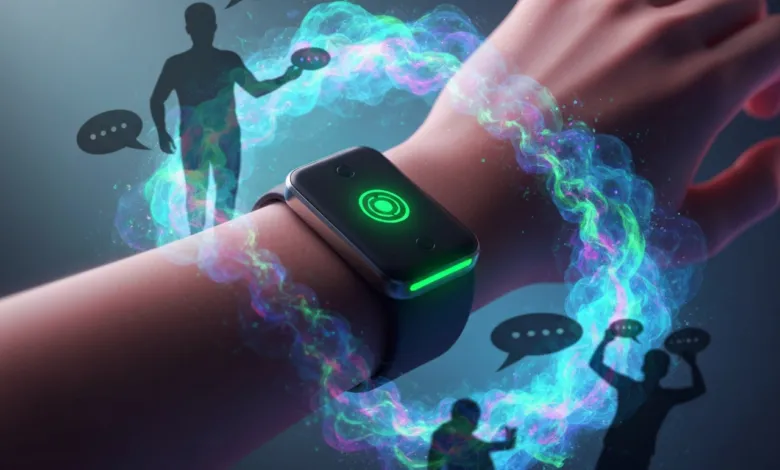
The device itself is straightforward to use. You power it up, put it on, sync it with the Bee mobile app, and enter some basic personal data. A built-in recorder turns on and off with a click of the wearable’s button. When recording, a green light flashes; when it stops, the light goes out. After a conversation ends, the app generates an easy-to-read summary along with a full transcript.
How exciting you find this concept likely depends on your personal tolerance for surveillance. For me, the challenge is that I tend to guard my privacy closely. In a world where digital monitoring surrounds us constantly, I value any chance to avoid being recorded. So the idea of walking around with an eavesdropping gadget strapped to my wrist around the clock didn’t exactly thrill me.
Still, even I have to admit that in the right setting, Bee could offer real value for organizing your life.
The device truly shines in professional contexts. If your day is packed with meetings and you struggle to keep everything straight, Bee can serve as a moderately capable assistant. During a recent business call, I activated the device after getting permission to record. Afterward, the app faithfully produced a summary of our conversation, breaking down each segment so I could review it without listening to the entire call again. That was genuinely helpful, though it’s worth noting that other transcription services like Otter or Granola offer similar features.
That said, you can imagine a professional who moves between multiple meetings throughout the day finding this device quite useful. You could simply keep Bee running all day and later review the summaries for anything you missed.
Bee does a decent job summarizing conversations, but the actual transcripts can be a bit messy. Previous reviewers have pointed out that you often have to manually enter the names of other speakers, since the device doesn’t always know who is talking. During my test, I noticed it also omitted certain sections of our chat , nothing major, but it wasn’t a complete record of everything said.
I also brought Bee to my semi-weekly movie night with friends and left it running throughout. Since we were watching Reservoir Dogs, I half-expected the wearable to mistake the film’s graphic violence for real bloodshed and trigger some kind of alarm. But Bee figured out what was happening. In the summary afterward, it labeled the conversation “Tarantino Film Scene Analysis.”
While Bee shows early promise as a professional tool, I wouldn’t want it recording my personal life. Strangely, the company has largely marketed it as a product for personal use. To feel comfortable with that, you’d have to be okay with Bee accessing most of your offline and digital activities.
To function properly, Bee requires extensive mobile permissions , including access to your location, photos, contacts, calendar, and notifications. You can also share your health data with it if you want it to track your sleep or heart rate.
The large amount of data Bee collects is stored in the cloud, which raises concerns for anyone focused on digital privacy. In a message to tech YouTuber Becca Farsace, Bee apparently demonstrated a version of the device running entirely locally. If the company could actually produce such a device, I would be thoroughly impressed , and might even consider buying one. So far, though, Amazon hasn’t provided any updates on those plans.
As for privacy protections, Bee says it uses encryption to secure user data both at rest and in transit. According to its privacy policy, the company has “implemented technical and organizational security measures designed to protect the security of any personal information” it processes. Bee also claims to undergo “rigorous third-party security audits” and maintain continuous security monitoring. That all sounds good, though it’s worth noting that Amazon , like many large tech companies , has experienced the occasional data security issue. That’s not exactly surprising for a company that manages so much of the global cloud infrastructure, but it still matters.
In the end, Bee is a curious piece of hardware that, with more time and refinement, could find promising professional applications down the road. As a digital assistant for your personal life, however, it may prove a little too invasive for many users.
(Source: TechCrunch)