Why Nuro’s ‘second mover’ status gives it a robotaxi advantage
▼ Summary
– Nuro, founded by Waymo veterans, pivoted from delivery to robotaxis in 2024 and secured a deal with Uber and Lucid to deploy tens of thousands of robotaxis across the US.
– Nuro’s co-CEO Dave Ferguson advocates a “second mover” strategy, believing Nuro can learn from Waymo’s successes and mistakes to improve its own system.
– Nuro plans to launch a broad, useful robotaxi service in San Francisco later this year, starting with a wide operational domain rather than incremental scenarios.
– The Uber-Lucid-Nuro partnership involves Nuro integrating its autonomy tech into Lucid Gravity SUVs on the production line, which Uber then owns and operates as a fleet.
– Nuro aims to build public trust by being transparent with driving statistics, following Waymo’s model, while balancing detail to make data understandable.
Waymo operates more than 3,000 driverless vehicles across at least 10 U.S. cities, making it the clear frontrunner in the robotaxi industry. Meanwhile, contenders like Tesla, Zoox, Avride, and Motional are scrambling to close the gap with the Alphabet-owned powerhouse. But what if finishing second offers a distinct advantage?
Nuro, a delivery robotics firm founded by former Google self-driving car engineers, believes it can claim that runner-up position , and benefit from it. After shifting focus from delivery to robotaxis in 2024, Nuro partnered with Uber and Lucid to roll out tens of thousands of autonomous taxis nationwide, securing hundreds of millions in Uber investment. The company plans to launch its service in San Francisco later this year, and earlier this month received the first of several required permits.
For Nuro, watching Waymo scale at its current pace is almost a blessing, according to cofounder and co-CEO Dave Ferguson. Waymo’s successes, along with its mistakes and setbacks, give Nuro’s engineers a chance to examine and improve their own systems. The goal is to ask: Could we have done better?
“There is a lot of value in this sort of classic second mover perspective,” Ferguson said in a recent interview. “We have a huge amount of respect for Waymo … In some of the rare cases where they’re having challenges, [Nuro is] using those to kick the tires on our system and make sure that it would behave in a way that we’re comfortable and proud of as well.”
Ferguson’s respect for Waymo comes naturally. He and cofounder Jiajun Zhu both started at Google’s self-driving car project, which eventually became Waymo. They left in 2016 to found Nuro, initially a robot delivery service, now pivoting to robotaxis. Nuro also plans to license its autonomous technology to other companies, including automakers seeking advanced driver-assist systems or personally owned autonomous vehicles, though no deals have been announced yet.
Nuro is undeniably late to the robotaxi race. While Waymo was moving passengers, Nuro was handling groceries. But Ferguson argues that its technology transfers easily to passenger service, even if its track record with riders is nonexistent.
That’s where the second mover strategy comes in. Instead of discovering operational hurdles firsthand like Waymo, Nuro expects to learn from the Alphabet-owned company’s large-scale robotaxi deployment before fully launching its own.
Ferguson wants Nuro’s initial robotaxi service to be broadly useful from the start. Some features, like freeway driving, may arrive later, but the launch won’t follow an ultra-incremental approach where the company handles only simple scenarios before gradually adding complexity. That said, Nuro doesn’t plan to cover “the entire South Bay on day one,” Ferguson noted.
“The plan is very much on day one for this to be a very useful service,” he said. “This is not going to be only protected intersections, and then slowly we add unprotected … It’s going to be a very broad [operational design domain] to begin with.”
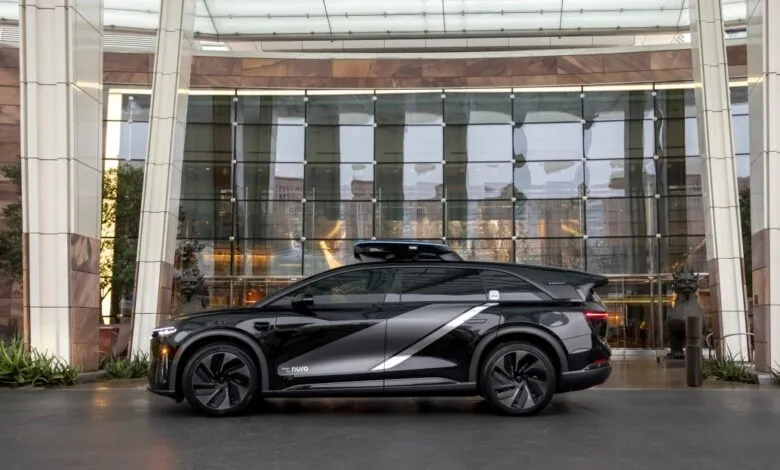
The Uber-Lucid-Nuro partnership is unusual because it involves three distinct companies: a rideshare network, an automaker, and an autonomous vehicle startup. Under the deal, Nuro develops the sensing and compute stack and works closely with Lucid to integrate that technology into the Lucid Gravity SUV. Integration happens directly on Lucid’s production line, so vehicles leave the factory already equipped with Level 4 autonomy. These completed vehicles are then sold to Uber, which owns and operates the fleet, managing depots and operational infrastructure.
Uber will also handle remote assistance for the vehicles, Ferguson said. Remote assistance has drawn scrutiny recently, with some members of Congress demanding that Waymo and others be more transparent about their use of offsite workers to oversee vehicles. Ferguson said this has led to misinformation about companies using remote workers to actively control robotaxis. In reality, remote workers answer questions and provide prompts when vehicles get confused.
“The view that the public probably jumps to when they’re told remote assistance of self-driving vehicles is someone in a dark room driving a car around like they’re playing a video game,” he said. “I think that is pretty far from how remote assistance typically works.”
Nuro’s long-term goal is to build the most capable AI driving system possible, with applications in delivery and beyond, Ferguson said. The company’s longevity in the field allows it to apply lessons from older, rules-based machine learning systems as well as current end-to-end learning models that produce a more naturalistic driving style. According to Ferguson, that legacy is critical even as the industry shifts toward more AI-heavy approaches.
“You can think of this as sanity checking to make sure that what we’re doing doesn’t get too close to pedestrians, doesn’t get too close to other vehicles, isn’t violating any traffic rules,” he said.
Ferguson acknowledged that robotaxis suffer from a lack of public trust, especially around edge cases and incidents where autonomous vehicles block traffic. Nuro plans to follow Waymo’s model of being transparent with some driving statistics to build trust with customers.
“The more evidence we have of Nuro and Uber and Lucid providing a product that is dramatically safer and better for our streets than a human-driven vehicle … the better that is for everyone,” he said. The company is still working to “strike the right balance of how much detail do we provide, such that it’s actually understandable and relatable to the general public.” But Ferguson said he’s confident they’ll find that balance.
(Source: The Verge)