Google’s Universal Cart tracks your entire shopping journey across the web
▼ Summary
– Google introduced Universal Cart, a centralized shopping hub that lets users add products from Search, Gemini, YouTube, and Gmail, and then tracks deals, price drops, and stock.
– Universal Cart uses AI to help shoppers, such as flagging PC part compatibility issues and surfacing hidden savings through Google Wallet.
– Google announced updates to its Agent Payments Protocol (AP2), which allows AI agents to make secure purchases on behalf of users within defined limits like spending caps and brand preferences.
– Google plans to integrate AP2 into its own products in the coming months, giving the company direct insight into consumers’ entire shopping journey from discovery to purchase.
– The Universal Commerce Protocol (UCP) is expanding to categories like hotels and food delivery, and will roll out in Canada, Australia, and the U.K. after launching in the U.S.
At Google I/O on Tuesday, Google unveiled Universal Cart, a centralized hub designed to manage the entire online shopping journey. Alongside this, the company announced updates to its Agent Payments Protocol (AP2) and hinted at integrating the technology into Google products soon, allowing users to authorize AI agents to handle payments autonomously.
These moves underscore Google’s ambition to transform AI assistants from passive recommendation tools into active participants in e-commerce. By launching a unified shopping system and building infrastructure for autonomous agent-driven purchases, Google is positioning itself to control more of the consumer experience, from discovery to checkout, potentially reshaping the relationship between shoppers and merchants.
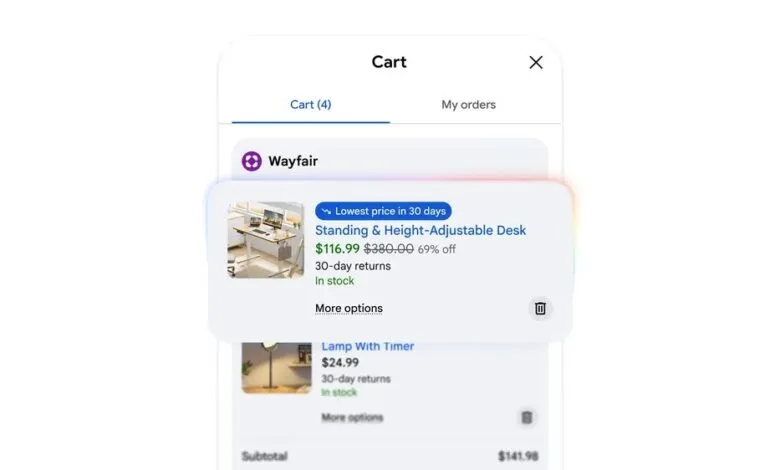
Universal Cart lets users collect items they’re considering from across Google’s ecosystem , while searching the web, chatting with Gemini, watching YouTube, or reading Gmail. Once items are added, the cart tracks deals, monitors price drops, displays price history insights, and notifies users when products are back in stock. This feature acknowledges a key reality: most people shop across multiple devices, retailers, and over several days.
The cart also leverages AI to improve decision-making. For instance, if you’re assembling a custom PC, you can add parts from different merchants into one cart, and Google might flag compatibility issues, like a processor that doesn’t match your chosen motherboard, and suggest alternatives. For frequent travelers or rewards enthusiasts, the cart can uncover hidden savings and optimize points usage, thanks to its integration with Google Wallet.
Using Google’s open-standard Universal Commerce Protocol (UCP), shoppers can check out directly through Google with participating merchants or transfer their selections to a merchant site to complete the purchase. Universal Cart launches in the U. S. today, with the Gemini app getting it this summer, followed by YouTube and Gmail later.
Google also confirmed that UCP is expanding to new categories, including hotels and local food delivery. UCP-powered experiences will extend beyond the U. S. to Canada and Australia in the coming months, with the U. K. to follow.
Perhaps the most significant development for the commerce industry is AP2, Google’s protocol for enabling AI agents to securely make payments on behalf of users within defined limits. At I/O, Google outlined the controls users can set, such as specifying preferred brands and products, along with a spending cap. When those conditions are met, the agent automatically completes the purchase.
Google says it will bring AP2 to its own products in the months ahead. This integration would give Google direct insight into what consumers discover, consider, and ultimately buy , a level of commercial influence that retailers and payment processors will watch closely.
Under the hood, AP2 establishes a transparent, verifiable link between the user, merchant, and payment processor, with encryption protecting data throughout. The protocol also includes tamper-proof digital records to ensure the agent acts solely on the user’s behalf, plus a permanent audit trail for returns or disputes.
Catch up on the rest of Google I/O 2026’s big news: Google Search as you know it is over; Google updates Gemini app to take on ChatGPT and Claude; Google introduces Gemini Spark, a 24/7 agent assistant with Gmail integration; and how to use Google’s new information agents.
(Source: TechCrunch)