3 Essentials for Successful AI-Powered SEO Audits
▼ Summary
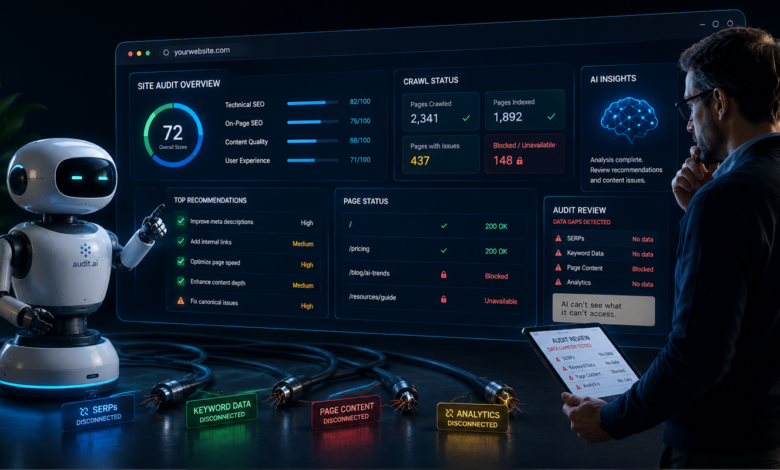
– AI-generated SEO audits often fail because the model cannot read full webpage content, lacks access to real keyword search volumes, and cannot retrieve top SERP results, leading to invalid recommendations.
– A “naive audit” example showed Claude inferred page content from search snippets, suggested a keyword with no search volume, and could only read five of nine provided URLs.
– For GEO/AEO audits, AI is especially unreliable due to a lack of established practices, prevalence of hallucinated information, and no evidence to support common “best practices” like using FAQs.
– The CaML framework for effective AI audits requires: Context/data (pre-scraped content, real metrics), Methodology (defined work process and data sources), and Human in the loop (explainable output, expert review, feedback loop).
– SEO professionals add value by providing strategy, conducting unique experiments, measuring results, and updating AI workflows, as AI cannot self-optimize or produce breakthrough techniques.
Running an SEO or GEO/AEO audit is one of the most practical uses for modern AI, especially with models that now handle multi-step tasks like extracting webpages, analyzing data, and generating recommendations. But before you drop a URL into Claude or ChatGPT and ask for a full audit, pause. Does the model actually have the tools it needs to give you something useful?
You might be surprised to learn that even the most advanced language models can produce detailed recommendations without ever accessing Google SERPs, keyword volumes, or even the full content of your page. These are what I call “naive audits.” They look thorough and impressive on the surface, but they fall apart the moment you ask simple questions: What was this based on? Where did the data come from? What methodology was used?
As CEO of a B2B tech SEO and GEO agency, I see these naive audits from clients and prospects daily. This article isn’t meant to discourage you from using AI for audits , far from it. Instead, I want to share a framework built around three critical elements that ensure your AI audits are grounded in reality and deliver real, actionable value.
What goes wrong with a naive SEO audit
Let’s walk through a concrete example. I asked Claude Opus 4.7 to audit a client’s blog post about flash storage shortages. The topic was timely, and with proper optimization, the article could attract real traffic.
Claude responded with a detailed 1,600-word report full of recommendations. It looked promising. But here’s the first red flag: Claude admitted it had to “infer” the article’s structure. When I pressed further, it turned out the model hadn’t actually read the post. It relied on search snippets instead of the full content. That means many of its findings were likely irrelevant.
Then I asked Claude to suggest a main keyword. It recommended “intelligent data tiering.” Does that phrase have search volume? Claude admitted it didn’t know , and when I checked with Semrush, the keyword had essentially zero search volume. So the entire audit was based on an inferred page and a keyword nobody searches for.
Even if the keyword were valid, Claude didn’t have access to the top 10 SERPs for it. It guessed. And when I handed over the actual top URLs, Claude could only retrieve about half of them , the rest were blocked.
In our testing, AI chatbots typically retrieve only 30% to 40% of the URLs we provide. That’s why pre-scraping content or using a specialized library is essential.
The result? A long, detailed report that was largely useless. It recommended changes based on guesswork, and the 1,600-word analysis was longer than the blog post itself. Few writers would read it, let alone implement it.
This isn’t unique to one model or one post. Try it yourself with any state-of-the-art AI and your own content. Push back on the findings. You’ll be shocked at how often the model is guessing.
How to build a page audit agent that works
When we build an agent for SEO content recommendations, we make sure it’s self-sufficient. Here’s the process we follow:
- Pre-scrape the page content and provide the full HTML to the model.The output from this kind of agent is accurate, insightful, and immediately useful. It’s a world apart from the naive audit that guessed its way through the task.
The GEO/AEO challenge: Even more dangerous
If naive audits are bad for SEO, they’re catastrophic for GEO/AEO. There are no established, data-backed best practices here. Much of the information online is speculative, AI-generated, or outright hallucinated. Lily Ray calls this the AI slop loop , AI generating advice on how to optimize for AI, which is then regurgitated by other AIs.
For example, I tried to find research proving that FAQs improve AI visibility. There is none. Worse, some so-called best practices can actually harm your organic presence. As Ray notes, “Your GEO strategy might be destroying your SEO.”
And here’s a critical point: AI is not self-aware. Asking Claude how to optimize for Claude is a fallacy. The model doesn’t know its own inner workings. It can’t tell you what it “likes.” Everything it says is based on world knowledge, which in GEO/AEO is extremely thin.
If you want to succeed in GEO/AEO, you need real experimentation and hands-on expertise. AI is a great execution tool, but don’t use it to learn how to optimize for AI engines.
The CaML framework: Three things your AI agent needs
Think of a properly built AI agent as a camel , self-sufficient and able to survive in the desert. A naive audit is a donkey , it dies without the basics. Here’s what your agent needs:
C: Context and data Your agent can’t make good decisions without the right information. That means:
- Crawl data and full webpage content , don’t let the agent guess.
- Relevant SEO metrics like SERPs, keyword volumes, ranks, clicks, and sessions. Connect tools via MCP.
- GEO/AEO visibility data from platforms like Profound, Semrush AIO, or Ahrefs Brand Radar.
- Operational data , what’s already on your task board? Avoid suggesting the same fixes twice.
- Business context , share the size of your organization, approval processes, and technical infrastructure.
M: Methodology Don’t let the agent pick its own approach. Define the process clearly:
- Specify the work flow , read content, find keywords, approve with user, analyze top results, then recommend.
- Define data sources and decision rules , tell the agent exactly how to use data.
- Think about the end user , what makes recommendations actionable for a busy writer or developer?
- Update the methodology as algorithms change. SEO and GEO/AEO aren’t static.
- Create guardrails , never let the agent update your site directly. And watch token costs.
L: Human in the loop Even the best AI makes mistakes. You need a human to validate every decision.
- Make the agent explainable , it should briefly show how it arrived at recommendations.
- Create a review process , tasks go to a board, get reviewed by an expert, and only then go to clients.
- Ensure reviewers have relevant expertise , editors for content, SEO pros for technical recommendations.
- Use feedback to improve the agent , tweak instructions based on recurring issues.
What SEO pros bring to the table
If AI can run audits, why hire an SEO professional? Because strategy, direction, and unique analysis can’t be automated.
An expert determines which agents to build, what problems to focus on, and what will actually move the needle. They design AI systems that execute on those insights. They conduct experiments, read studies, and develop breakthrough techniques , like our new AI Overview optimization method based on the latest Google Core Update.
And most importantly, they measure results. Analytics is hard. Data can be misleading. An experienced professional knows how to collect the right data, interpret it, and make the hard call: Did it work? What should we do differently?
Then they build those lessons back into the AI workflows.
The agent-first future
Our agency is transforming into an agent-first enterprise. We’re building a platform of over 60 AI agents that handle all major SEO and GEO tasks. Our team uses them to deliver more value, and we hand them over to clients for their own analysis.
Our role hasn’t changed , we still provide strategy and expert guidance. But instead of doing the heavy lifting manually, we build, maintain, and optimize AI systems that do the work at scale. We review their output, ensure they deliver results, and keep them aligned with real-world performance.
That’s the future of SEO agencies. And it’s already here.
(Source: Search Engine Land)