Iceotope secures $26m as AI racks outpace air cooling limits
▼ Summary
– Iceotope raised a $26 million Series B round led by Two Seas Capital and Barclays Climate Ventures, with all existing backers participating, to expand product lines and its patent portfolio.
– The company’s chassis-based precision liquid cooling replaces air with dielectric fluid in sealed chassis, eliminating fans and water-intensive cooling towers for high-density AI hardware.
– Iceotope cited projections that liquid-cooled AI accelerators will grow from 3 GW to 40 GW in two years, driven by hyperscalers and colocation operators needing cooling for workloads air systems cannot handle.
– The company holds a 219-patent portfolio and offers products KUL BOX for edge/AI and KUL AI for high-density racks, with near-silent operation and minimal water use.
– The funding is allocated to product engineering, patent extension, and ecosystem partnerships, not a major headcount increase, bringing cumulative disclosed funding over $80 million.
Barclays Climate Ventures and Two Seas Capital have co-led a $26 million Series B for Iceotope, a British company specializing in precision liquid cooling for data centers. Existing investors ABC Impact, Northern Gritstone, Edinv, and British Patient Capital all returned for the round, which the company announced on Wednesday.
The funding arrives as the AI hardware cycle drives rack power densities beyond the limits of traditional air cooling. Next-generation Nvidia accelerator platforms are pushing per-rack power toward and past 1 MW, a threshold where both conventional air systems and direct-to-chip liquid loops struggle to remove heat fast enough to keep processors at safe operating temperatures.
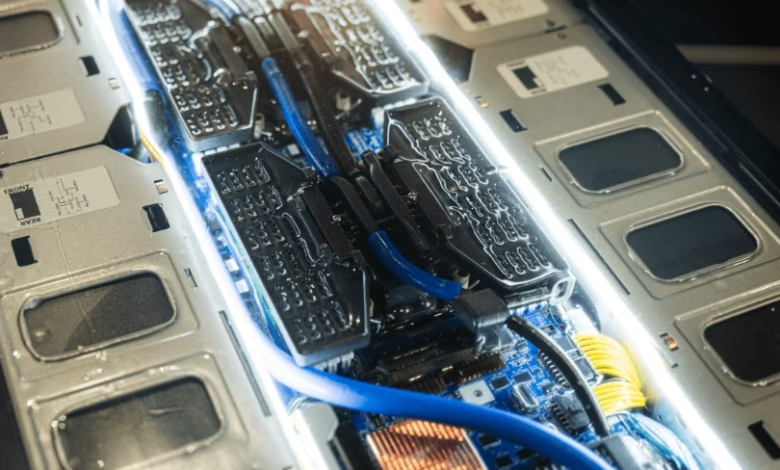
Iceotope’s solution, which it calls chassis-based precision liquid cooling, replaces air with a dielectric fluid circulated directly around server components inside a sealed enclosure. This design eliminates fans, hot aisles, and water-intensive cooling towers, the foundational elements of legacy data-center architecture.
The market dynamics behind the round are more telling than the dollar figure itself. Iceotope cited research from SemiAnalysis projecting that the installed base of liquid-cooled AI accelerators will surge from roughly 3 GW today to 40 GW within two years. That more-than-tenfold expansion is driven by hyperscaler and colocation operators who must adopt liquid cooling for AI workloads that conventional architectures cannot sustain.
Signs of this shift are already visible at the operator level. Nvidia-backed Firmus is building modular, fully liquid-cooled AI factories across Australia to host 36,000 GB300 Grace Blackwell chips, financed in part by a $10 billion debt facility from Blackstone.
Iceotope’s commercial advantage rests on a 219-strong patent portfolio, both granted and pending, and a claim to early leadership in chassis-level liquid cooling, a technology the company has been refining since 2005. Its current product lineup includes KUL BOX, aimed at edge and AI deployments where space and noise constraints rule out conventional cooling, and KUL AI, designed for high-density rack installations at the core of new AI data centers.
The technology operates with near-silent performance and uses what the company describes as minimal water. That second point is increasingly critical: data-center water consumption has become a politically charged metric in regions including the US Southwest, Ireland, and the Netherlands.
“Securing such high-caliber investors validates both our technology and our market timing,” said Simon Jesenko, Iceotope’s chief executive and chief financial officer. “We’ve spent years developing a robust, differentiated IP portfolio and products purpose-built for AI infrastructure, and we’re ready to scale at precisely the moment the industry demands more advanced, sustainable cooling technology. The opportunity ahead, both directly with customers and through our partner ecosystem, is significant.”
Barclays Climate Ventures framed its participation in climate-policy terms. “With AI adoption rapidly increasing globally, Iceotope’s liquid-cooling technology offers a timely and innovative solution to the mounting limitations of traditional cooling systems,” said Steven Poulter, head of Barclays Climate Ventures. “Its approach not only meets the escalating demands of AI and high-performance computing but also materially advances datacenter sustainability.”
The competitive landscape is growing crowded. LiquidStack, Submer, JetCool, GRC, and Asperitas are all targeting different layers of the liquid-cooling stack, while major hyperscalers including Amazon, Microsoft, Google, and Meta run internal cooling-architecture programs alongside their external supplier rosters.
Iceotope’s edge lies in its chassis-level approach and patent depth. The company has positioned itself as more deployable than open-bath immersion and more thermally capable than direct-to-chip cold-plate systems, holding the second-largest IP portfolio in the precision-cooling category after Equinix.
Iceotope previously raised £30 million ($38 million) in 2022, led by ABC Impact. The Series B brings cumulative disclosed funding to comfortably over $80 million. The new capital is earmarked for product and engineering, patent expansion, and ecosystem partnerships rather than a dramatic headcount increase, which the company has grown more steadily through 2025 and 2026.
(Source: The Next Web)