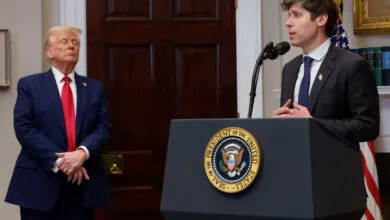
Sam Altman Shines on Stand, but Risks Losing the Case
▼ Summary
– Sam Altman testified that Elon Musk wanted total control of OpenAI and that Musk’s insistence on control conflicted with OpenAI’s mission to prevent any single person from controlling AGI.
– Altman portrayed himself as bewildered and credible on the stand, contrasting with other witnesses like Musk and Shivon Zilis, whose testimony was contradicted by documents or behavior.
– Evidence showed Altman kept Musk informed about OpenAI’s for-profit plans, and Musk did not object, despite later public claims about Microsoft investments.
– Musk’s legal team presented weak arguments, such as comparing OpenAI’s nonprofit fundraising to Stanford’s, which the reporter noted actually supported the defense’s case.
– The reporter argued the trial’s purpose is not to win but to punish Altman, Brockman, and OpenAI, as Musk’s vengeance continues through public scrutiny and investigations.
After two weeks of testimony painting him as a habitual deceiver, the jury finally heard directly from the man at the center of the allegations: Sam Altman. Wrapping up his direct examination, his attorney William Savitt asked how it felt to be accused of effectively stealing a charitable organization.
“We created, through a ton of hard work, this extremely large charity, and I agree you can’t steal it,” Altman replied. “Mr. Musk did try to kill it, I guess. Twice.”
Altman slipped into his familiar persona of the “nice kid from St. Louis,” projecting a sense of genuine bewilderment at the legal battle unfolding around him. As he stepped down from the witness stand, clutching a stack of evidence binders, he had an almost schoolboyish demeanor. While visibly nervous at the start of his direct testimony, he quickly settled into a rhythm, delivering what many observers considered credible testimony. At several points, it even seemed the jury was warming to him.
As a reporter covering this trial, my familiarity with the key players makes it difficult to gauge the jury’s perspective. I’ve heard some audacious statements under oath. Elon Musk claimed he doesn’t lose his temper,only to lose it on cross-examination. Shivon Zilis, the mother of Musk’s children, testified she didn’t know he was starting xAI, a statement that seemed contradicted by her own text messages. And Greg Brockman, who once asked what it would take to reach a billion dollars, insisted he was purely mission-driven. I certainly don’t find Altman inherently trustworthy,The New Yorker published over 17,000 words detailing his deceptions. However, unlike Musk, Altman has contemporaneous documents that largely support his version of events.
“My belief is he wanted to have long term control.”
Following OpenAI’s Dota 2 victory, serious discussions about a for-profit structure began. Altman testified that Musk felt strongly that if a for-profit entity were formed, “he needed to have total control over it initially. He only trusted himself to make non-obvious decisions that were going to turn out to be correct.”
Altman said he was uneasy with Musk’s demand for control, not just because Musk had been less involved than others, but because OpenAI was founded precisely to prevent any single person from controlling AGI. Drawing on his experience as president of Y Combinator, Altman noted he had seen many control disputes; founders rarely want to relinquish power when things succeed. Structures like supervoting shares allow founders to retain control indefinitely. Curiously, Altman didn’t cite the most famous example (Mark Zuckerberg at Meta) but instead pointed to Musk and SpaceX. When Altman asked Musk about succession plans for OpenAI, he received a particularly unsettling answer: in the event of his death, Musk said, “I haven’t thought about it a ton, but maybe control should pass to my children.”
I recall a 2017 email from Altman to Zilis where he wrote, “I am worried about control. I don’t think any one person should have control of the world’s first AGI , in fact the whole reason we started OpenAI was so that wouldn’t happen.” He added that he wasn’t opposed to immediate control and was open to “creative structures,” which I interpreted as a willingness to give Musk temporary control up to certain milestones to placate him.
“I read a vague, like, a lightweight threat in there.”
“My belief is he wanted to have long term control and that he would’ve had that had we agreed to the structure he wanted,” Altman stated. This assessment seems accurate. Later, during Sam Teller’s deposition testimony, we learned that Musk no longer invests in anything he doesn’t control. This aligns with Musk’s long-standing fear of being ousted from his own company, as happened to him at PayPal.
Musk also attempted to recruit Altman to Tesla. Text messages between Altman and Teller revealed that Teller informed Altman of Musk’s commitment to expanding Tesla’s AI capabilities, hoping Altman, Brockman, and Ilya Sutskever would eventually join. “I read a vague, like, a lightweight threat in there, that he’s gonna do this inside of Tesla with or without you,” Altman said. However, he believed Tesla was primarily a car company, and allowing it to acquire OpenAI would betray the organization’s mission.
Teller’s testimony included texts sent to Zilis at 12:40 AM on February 4th, 2018: “I don’t love OpenAI continuing without Elon. Would rather disable it by recruiting the leaders.”
When Musk stopped his quarterly donations, OpenAI was operating on a “shoestring” budget with an “extremely short runway of cash.” While OpenAI had other donors, none have sued or joined Musk’s legal action. (One donor listed in the exhibit, Alameda Research,owned by the now-imprisoned Sam Bankman-Fried,was not mentioned in court.) Musk’s board resignation led people to wonder “if he was gonna try to take, uh, vengeance out on us or something.” Conversely, Altman said Musk had “demotivated some of our key researchers” and caused “huge damage for a long time to the culture of the organization.” It appears many were relieved to see him go.
I’ve seen some fairly shoddy lawyering from Musk’s side throughout this trial.
Evidence showed that throughout the process of establishing OpenAI’s for-profit arm, Altman kept Musk informed, either directly or through Zilis or Teller. Musk never objected, and despite his public statements about Microsoft investments, private evidence indicates he was fully aware.
On cross-examination, Steven Molo spent over ten minutes listing people who have called Altman a liar: Sutskever, Mira Murati, Toner, McCauley, the Amodei siblings (founders of Anthropic), former Loopt employees, The New Yorker article, and a book titled The Optimist. Molo scored points by asking Altman about trial testimony, which Altman admitted he hadn’t followed closely. Molo acted as if this was implausible, suggesting someone must have informed Altman.
The exchange was both amusing and tedious. Altman remained composed, appearing hurt and confused by the focus on his honesty. This was the strongest part of the cross-examination, which quickly lost focus. Musk’s legal team has displayed questionable strategy throughout this trial, and today was no exception. At one point, when Molo tried to criticize Altman for being both CEO and board member, Altman correctly noted that CEOs are almost always on their company’s boards.
(My notes simply read: “Boy, Molo is not very good at this.”)
The point of this trial isn’t to win , it’s to punish Altman, Brockman, and OpenAI.
An unconvincing argument arose about nonprofit fundraising, suggesting that if Stanford could raise $3 billion annually, OpenAI should have remained a nonprofit. Let’s consider that: Stanford has a donor network of thousands of alumni. It’s an educational institution with different capital needs and no competition from reputable for-profit companies. Even if a fundraising genius took over the OpenAI Foundation, $3 billion represents just the initial two Microsoft investments,insufficient to scale OpenAI to its current size. If compute power is the primary bottleneck for AI development, Molo’s argument implies OpenAI could never have succeeded as a nonprofit alone. He’s effectively making the defense’s case.
But Molo doesn’t need to win. The trial’s real purpose is to damage Altman, Brockman, and OpenAI. Musk has succeeded in that regard, reinforcing the public perception of Altman as a liar. This morning, The Wall Street Journal published an exclusive about Republican attorneys general and the House Oversight committee investigating Sam Altman’s investments, with references to the trial throughout.
So yes, Altman was convincing on the stand. He may even win the lawsuit. But it’s clear that Musk’s vengeance has only just begun.
(Source: The Verge)