Ouster’s color lidar aims to replace cameras
▼ Summary
– Ouster announced a new line of lidar sensors called “Rev8” that capture color imagery and 3D depth data simultaneously in one sensor, aiming to replace separate lidar and camera systems.
– The sensors use digital lidar architecture with SPAD detectors to capture both data streams, offering 48-bit color, 116 dB dynamic range, and a pre-fused 3D colorized point cloud.
– The Rev8 lineup includes the OS1 Max sensor, which can see 500 meters in all directions and is smaller than other long-range lidars, targeting high-speed applications like robotaxis and robo-trucking.
– Ouster CEO Angus Pacala claims the approach differs from competitors by integrating lidar and imaging on the same chip, reducing calibration work for customers and potentially obviating cameras.
– The release comes amid industry consolidation and growing demand from robotics and autonomous vehicle companies, with Ouster already shipping samples and taking orders.
For nearly a decade, the autonomous vehicle industry has debated a fundamental question: lidar, cameras, or both? Now, Ouster claims to have an answer that renders the argument moot by merging both into a single sensor. The San Francisco-based company just unveiled its new Rev8 sensor lineup, featuring what it calls “native color lidar” , technology that simultaneously captures full-color imagery and precise 3D depth data, effectively eliminating the need for separate camera hardware.
Ouster CEO Angus Pacala described the Rev8 platform as a long-sought breakthrough. In an exclusive interview, he called it the “holy grail of what a roboticist has always wanted.” Historically, engineers have had to purchase a lidar sensor and a separate camera, then invest enormous effort in calibrating and fusing the two data streams. “Companies only get really halfway there,” Pacala said. “The goal is to obviate cameras. There’s no reason one sensor can’t do both.”
The timing of the Rev8 launch is significant. The lidar industry has undergone a major consolidation wave, with Ouster acquiring Velodyne and Luminar’s assets recently changing hands in bankruptcy proceedings. Meanwhile, demand for perception sensors is surging. Waymo and other robotaxi operators are scaling commercial fleets, and robotics companies , from humanoid to industrial , are hungry for better environmental awareness. Even new entrants like Boston-based Teradar are exploring alternative modalities like terahertz imaging.
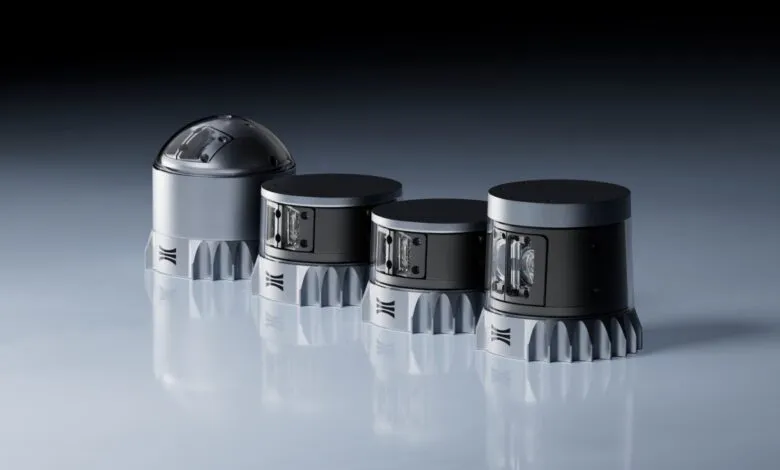
Pacala believes Ouster’s color lidar will be especially valuable for robotics. To ensure camera-quality performance, the company collaborated with Fujifilm and imaging authority DXOMARK. The result, Pacala claims, is a sensor that improves on modern cameras in several ways. Ouster’s proprietary digital lidar architecture uses single photon avalanche diode (SPAD) detectors on a custom chip, capturing both lidar and color data through the same hardware. This enables 48-bit color, 116 dB dynamic range, and megapixel resolution , numbers that rival standalone cameras. The output can be used as a pure lidar stream, a pure camera stream, or a pre-fused 3D colorized point cloud, depending on the customer’s perception pipeline.
Pacala also highlighted the OS1 Max, which he calls “the industry’s best long-range lidar.” It achieves 500-meter range in all directions while remaining significantly smaller than competing long-range sensors. He expects it to find use in high-speed applications like robo-trucking, robotaxis, and drones. The Rev8 platform also includes the OS0, OS1, and OSDome models.
Ouster is not alone in pursuing color lidar. Chinese rival Hesai recently announced a similar platform slated for mass production by year’s end, and companies like Innoviz have pitched their own versions. But Pacala argues that most competitors simply package a lidar and a camera in the same box rather than integrating them on a single chip. Ouster’s approach , shared by Hesai , places both technologies on the same silicon, dramatically simplifying calibration and lowering costs.
“This is fundamentally changing the value proposition of what we’re selling to a customer from this stage forward,” Pacala said. Ouster has already shipped samples to existing customers and is now accepting orders. For Pacala, the message is clear: the era of buying two sensors and praying they align is over.
(Source: TechCrunch)