China’s smartphone supply chain shifts to humanoid robots, Lingyi iTech eyes 500K by 2030
▼ Summary
– Chinese smartphone component manufacturers like Lingyi iTech, Lens Technology, and AAC Technologies are repurposing their factories to produce humanoid robots, leveraging existing supply chains.
– The Honor D1 humanoid robot won a Beijing half-marathon using liquid-cooling tech and components from smartphone suppliers, demonstrating the crossover.
– Morgan Stanley doubled its 2026 forecast for China’s humanoid robot sales to 28,000 units, with production costs falling 20% annually due to smartphone-era efficiencies.
– Foxconn is planning humanoid robot manufacturing lines in Vietnam, while UBTech’s Walker S2 has entered mass production with orders exceeding 800 million yuan.
– China controls an estimated 90% of the global humanoid robot market, driven by its mature supply chain rather than technological superiority, with Shenzhen’s robotics output hitting 242.6 billion yuan in 2025.
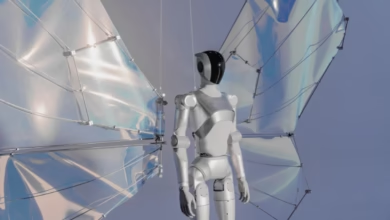
In April, a humanoid robot named the Honor D1 crossed the finish line of the Beijing half-marathon in 48 minutes and 19 seconds under remote control, then shaved nearly two minutes off that time by completing the course in 50 minutes and 26 seconds fully autonomously. It beat every other machine in a field of 112 teams. The secret to its victory? Liquid-cooling tech originally engineered for Honor’s flagship smartphones, paired with structural parts from Lens Technology and AAC Technologies , two of the biggest precision component suppliers in China’s mobile phone ecosystem. The company that assembled those pieces into a bipedal runner capable of covering 21 kilometers without thermal failure was, until recently, best known for attaching glass screens to phones.
This is the reality of China’s humanoid robot industry in 2026. It is not being invented from scratch. It is being assembled from the supply chain that already exists.
The shift in focus
Lingyi iTech, a Shenzhen-based precision component supplier to Apple, Samsung, and Xiaomi, declared in early 2026 that it was going “all in” on embodied intelligence. The company is now building a super factory near Beijing with the goal of producing 10,000 humanoid robots per year by the end of 2026 and scaling to 500,000 per year by 2030. Lens Technology, which makes cover glass for iPhones and Galaxy devices, supplied structural components for the Honor D1. AAC Technologies, the world’s largest maker of miniature acoustic parts for smartphones, provided additional precision elements. These are not robotics startups. These are the firms that built the physical backbone of the smartphone era, and they are retooling that infrastructure for the next big category.
The logic here is industrial, not speculative. China’s smartphone market shipped roughly 280 million units in 2025, but growth has flatlined. The components inside a phone , precision motors, sensors, thermal management systems, lightweight structural materials, battery cells , are the same ones needed for a humanoid robot. The factories that produce them at scale are already running. The engineers who designed them are already on payroll. The pivot is not from phones to robots. It is from one form factor to another, using the same supply chain.
On the factory floor
UBTech, one of China’s largest humanoid robot companies, partnered with Foxconn in 2025 to deploy its Walker S1 robots on iPhone assembly lines. The Walker S2, the next-generation model, entered mass production in early 2026 with orders exceeding 800 million yuan. Foxconn itself is now planning humanoid robot manufacturing lines in Vietnam, with production trials scheduled for September 2026 and official production beginning in November. The company that has assembled more iPhones than any other factory on earth is preparing to build the robots that will assemble the next generation of consumer electronics.
Tesla has described its Shanghai Gigafactory as a “golden key” to mass-producing its Optimus humanoid robot, pointing to China’s dominance in the components that humanoid robots require. But Tesla’s ambitions in China are running into a market that is already further along than many Western observers realize. Morgan Stanley doubled its forecast for China’s humanoid robot sales in 2026 to 28,000 units, a 133 percent year-on-year increase, and expects material costs to fall 16 percent as supply chain efficiencies from smartphone manufacturing carry over into robotics production.
The numbers behind the shift
Shenzhen’s robotics industry output hit a record 242.6 billion yuan in 2025, up 20 percent year on year. The city now accounts for 43 percent of China’s total service robot output. Production costs for humanoid robots are falling roughly 20 percent annually, a rate that mirrors the early years of smartphone manufacturing when component costs dropped as volumes scaled and suppliers competed on efficiency rather than novelty.
Morgan Stanley projects the global humanoid robot market will reach $5 trillion by 2050, with 25.4 million robots working globally by 2036. Tesla has raised its 2026 capital expenditure to $25 billion, with a significant portion directed at Optimus production and AI chip fabrication. But Tesla is planning hundreds of units in 2026. Chinese manufacturers are planning tens of thousands. The difference is not ambition. It is supply chain readiness.
The global competition
The race to commercialize humanoid robots is global, but the manufacturing advantage is concentrated. Siemens and Humanoid deployed an Nvidia-powered humanoid robot in a live factory trial in Erlangen, Germany, in January 2026, proving the technology works in real production environments. Meta acquired Assured Robot Intelligence to build what it calls the Android of humanoid robots , an open platform for robot intelligence that other manufacturers can use. Neura Robotics in Germany has attracted investor interest from those betting on European alternatives to Chinese and American robotics companies.
But manufacturing at scale is a different problem from manufacturing a prototype. China controls an estimated 90 percent of the global humanoid robot market, not because its robots are more advanced but because its supply chain is more mature. The same factories that drove smartphone component costs down by orders of magnitude over a decade are now applying the same process to actuators, sensors, and precision motors for robots. The same logistics networks that ship billions of phone components across Shenzhen, Dongguan, and the Pearl River Delta are being reconfigured to ship robot parts.
The transition in practice
The half-marathon in Beijing was a publicity event, but the industrial logic behind it is serious. Honor did not build the D1 by starting a robotics division from scratch. It took the thermal management system it had developed to keep flagship smartphones from overheating during gaming sessions and adapted it to prevent a bipedal robot from overheating during a 21-kilometer run. The engineering challenge is different in scale but not in kind. Both problems require moving heat away from high-performance processors in a compact form factor under sustained load.
This is the pattern that makes China’s humanoid robot industry structurally different from its Western competitors. The United States has better AI models. Europe has more advanced industrial automation in specific applications. But China has the supply chain, and in hardware manufacturing, the supply chain is the moat. Lingyi iTech’s target of 500,000 robots per year by 2030 sounds ambitious until you consider that the company already manufactures hundreds of millions of precision components annually for smartphones. The factory that built your phone is now building the robot that will build the next one. The transition is not a leap. It is a product line extension, executed at the scale that only China’s manufacturing ecosystem can deliver.
(Source: The Next Web)