Gartner: 40% of agentic AI projects to fail, proving human value
▼ Summary
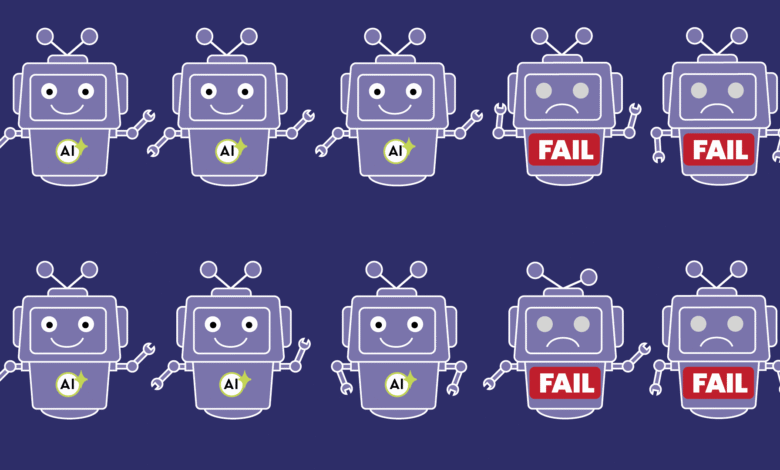
– Gartner predicts that over 40% of agentic AI projects will be canceled by 2027 due to organizations deploying agents without clear strategy, understanding, or governance.
– FOMO (fear of missing out) is driving organizations to deploy agentic AI prematurely, leading to agents built on broken workflows and poor data.
– “Agent washing” is a trend where vendors rebrand existing automation as agentic AI; Gartner estimates only around 130 vendors offer genuine agentic features.
– GenAI usage is atrophying critical thinking skills, leading 50% of global organizations to require AI-free competency evaluations.
– Successful agentic AI requires humans to maintain judgment and accountability, as agents cannot question their inputs or understand brand context.
More than 40% of agentic AI projects will be abandoned by the end of 2027. That stark forecast comes from Gartner, based on a mid-2025 survey of over 3,400 organizations actively investing in the technology. The culprit is not malfunctioning agents. It is flawed human decision-making.
“Most agentic AI projects right now are early-stage experiments or proof of concepts that are mostly driven by hype and are often misapplied,” said Anushree Verma, senior director analyst at Gartner. Companies are rolling out agents without a clear strategy, underestimating complexity, and lacking the governance to handle failures. The agent, in short, is only as good as the human behind it.
This reality is critical for marketing. AI agents are already selecting audiences, generating content, optimizing send times, and orchestrating entire customer journeys autonomously at a scale no human team can match. The capabilities are real and accelerating. But Gartner’s data delivers a warning: marketing leaders who ignore it risk landing on the wrong side of that 40% failure rate.
FOMO drives agent failure. The problem begins with fear. Fear of falling behind competitors. Fear of being the CMO who hesitated. That fear pushes organizations to deploy agentic AI without a strategy, simply because they cannot afford to be last. The result is agents built on broken workflows, fed poor data, and operating without governance. They execute the wrong things, in the wrong ways, at the wrong times. FOMO is not a strategy. In the agentic era, it is an expensive mistake.
Agent washing is another pitfall. Gartner identifies a widespread trend where vendors rebrand existing chatbots and automation tools as agentic AI without delivering genuine autonomous capabilities. Of the thousands of vendors claiming agentic solutions, Gartner estimates only around 130 offer real features. Marketing teams investing in the rest are paying a premium for dressed-up automation. The consequences go beyond wasted budget. Gartner predicts that in 2026, one-third of companies will harm customer experiences by deploying AI prematurely, eroding brand trust and damaging both acquisition and retention.
The dumbing down of marketers is Gartner’s third and most revealing prediction. GenAI usage leads to the atrophy of critical thinking skills. As a result, 50% of global organizations will require AI-free competency evaluations. Half of all organizations are watching their people get dumber because AI is always available to think for them. Quietly. Gradually. Until the day the algorithm is wrong and nobody in the room can tell.
In marketing, that is a crisis. Marketing requires judgment. The ability to ask not just what the data says, but what it means. Not just whether a campaign worked, but why. Not just whether to accept an AI recommendation, but whether it reflects the brand, the moment, and the relationship the company is trying to build. Those questions cannot be delegated to an agent. They require a human being scrutinizing what a machine thinks is right. The most dangerous marketer in the agentic era is not the one who rejects AI. It is the one who accepts everything it produces without question.
Agents cannot be trusted to ask the right questions. An agent can optimize what it has been given. It cannot question whether it has been given the right thing. It can personalize a message based on behavioral signals. It cannot decide that the right move is to say nothing at all, to give a customer space, to protect a relationship rather than extract from it. It can generate a thousand content variations and test them. It cannot feel the difference between a message that converts and a message that connects. It cannot sense when a campaign that performs well in the data is quietly damaging the brand. It can execute a journey flawlessly. It cannot design one that reflects what customers actually want from this brand at this point in their lives. These are not limitations that will be solved by the next model release. They are structural. AI is trained on the past. The irreducible human job in marketing is to bring judgment about what should happen next, even when the data does not yet exist to support it.
The marketer as manager of agents is the right mental model for this era. Not human versus machine, but human plus machine, with the human in charge. This is the foundation of Positionless Marketing. For decades, marketing teams operated as an assembly line with handoffs. Positionless Marketing breaks that model by giving marketers three transformative powers: Data Power to immediately discover customer insights for precise targeting and hyper-personalization without waiting for engineers; Creative Power to create channel-ready assets like copy and visuals without waiting for creatives; and Optimization Power to run campaigns that optimize themselves through automated journeys and testing without waiting for analysts. Handoffs are eliminated.
The Positionless Marketer is a multidisciplinary thinker who deploys AI agents to go beyond traditional positions. Agents handle what used to require waiting for three different teams, eliminating the assembly line. The marketer is no longer waiting on anyone. They are thinking bigger, moving across disciplines while keeping human judgment at the center of every decision the agents make. This is a promotion, not a replacement. But it comes with real demands. Marketers who can think strategically, not just operationally. Who can evaluate AI output critically, not just accept it. Who can take accountability for what the agents do in their name.
Gartner’s Daryl Plummer stated it directly: organizations should prioritize behavioral changes alongside technological changes as first-order priorities. The technology is ready. The question is whether the humans in the marketing organization are.
The window is narrowing. The organizations that will win the next decade of marketing are not the ones that deploy the most agents. They are the ones that build the human capability to direct them well. Gartner’s 40% prediction is not a warning to slow down. It is a warning to be deliberate. The difference between an agentic marketing operation that compounds value over time and one that wastes budget, violates policy, and erodes customer trust is not the technology. It is the human judgment sitting above it. Marketing teams need to face facts in the agentic AI era: the agent is only as good as the indispensable human behind it.
(Source: MarTech)