DeepSeek previews new AI model closing gap with frontier systems
▼ Summary
– DeepSeek has launched two preview versions of its new large language model, DeepSeek V4, a mixture-of-experts model with 1 million token context windows.
– The V4 Pro model has 1.6 trillion total parameters (49 billion active), making it the largest open-weight model available.
– DeepSeek claims the V4 models have nearly closed the gap with leading models on reasoning benchmarks and outperform peers on some tasks.
– The models lag behind frontier models in knowledge tests, trailing state-of-the-art models by approximately 3 to 6 months.
– DeepSeek V4 models are significantly more affordable than frontier models, undercutting competitors like GPT-5.4 and Gemini 3.1 on pricing.
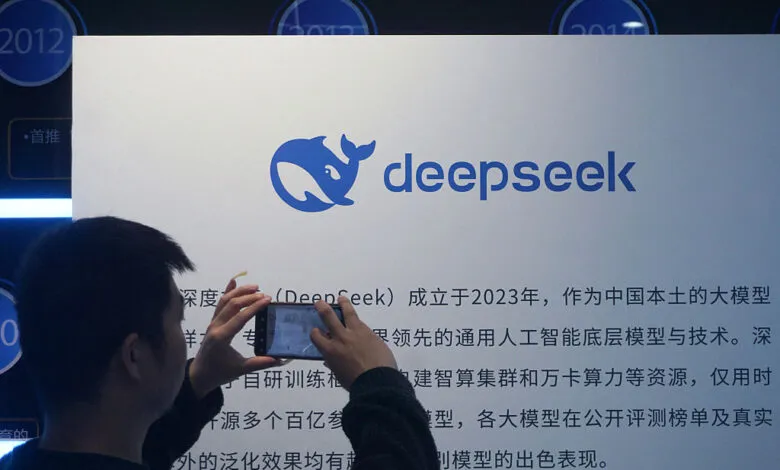
Chinese AI lab DeepSeek has quietly rolled out two preview versions of its next-generation large language model, DeepSeek V4, marking a significant update to last year’s V3.2 and the widely discussed R1 reasoning model that reshaped the competitive landscape.
Both DeepSeek V4 Flash and V4 Pro are built on a mixture-of-experts architecture, each supporting a context window of 1 million tokens. That capacity allows users to feed entire codebases or extensive documents directly into prompts. The mixture-of-experts approach keeps costs down by activating only a subset of parameters for each task, rather than the full model.
The larger V4 Pro contains a staggering 1.6 trillion total parameters, with 49 billion active at any given time. That makes it the largest open-weight model ever released, surpassing Moonshot AI’s Kimi K 2.6 (1.1 trillion), MiniMax’s M1 (456 billion), and DeepSeek’s own V3.2 (671 billion). The leaner V4 Flash comes in at 284 billion total parameters (13 billion active).
DeepSeek claims both models deliver better efficiency and performance than V3.2, thanks to architectural refinements. The company says they have nearly closed the gap with today’s leading open and closed models across reasoning benchmarks.
On coding competition tasks, DeepSeek reports that both V4 models perform at a level comparable to GPT-5.4. The company also asserts that its V4-Pro-Max configuration beats other open-source models on reasoning tests and even edges ahead of OpenAI’s GPT-5.2 and Gemini 3.0 Pro on certain tasks.
Still, the models appear to trail frontier systems in knowledge-based evaluations, particularly OpenAI’s GPT-5.4 and Google’s Gemini 3.1 Pro. DeepSeek acknowledges this lag, describing a “developmental trajectory that trails state-of-the-art frontier models by approximately 3 to 6 months.”
One notable limitation: both V4 Flash and V4 Pro are text-only, unlike many closed-source rivals that already handle audio, video, and image inputs.
On pricing, DeepSeek V4 is dramatically cheaper than any comparable frontier model. The V4 Flash costs just $0.14 per million input tokens and $0.28 per million output tokens, undercutting GPT-5.4 Nano, Gemini 3.1 Flash, GPT-5.4 Mini, and Claude Haiku 4.5. The larger V4 Pro is priced at $0.145 per million input tokens and $3.48 per million output tokens, beating Gemini 3.1 Pro, GPT-5.5, Claude Opus 4.7, and GPT-5.4 on cost.
The release comes just one day after the U. S. government accused China of using thousands of proxy accounts to steal American AI labs’ intellectual property on an industrial scale. DeepSeek itself has previously been accused by Anthropic and OpenAI of “distilling” , essentially copying , their models.
(Source: TechCrunch)