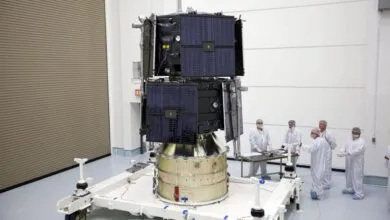
Roman Telescope ready to launch 8 months early, under budget

▼ Summary
– The Nancy Grace Roman Space Telescope, designed for wide-field infrared surveys, is fully assembled and set to launch in September, sending 1.4 terabytes of data to Earth daily.
– The telescope is named after a key figure in Hubble planning and is distinct from Hubble and Webb due to its massive imaging system and wide-field view.
– Infrared astronomy from Earth is difficult due to atmospheric absorption, making space-based infrared telescopes like Roman essential for studying early galaxies and exoplanet atmospheres.
– The telescope originated from NASA’s WFIRST concept, which aimed for a survey telescope capable of imaging large sky areas in infrared.
– NASA repurposed surplus spy satellite hardware from the National Reconnaissance Office, upgrading the telescope from a 1.5-meter to a larger design for higher resolution and more imaging capacity.
On Tuesday, NASA invited the press to view the fully assembled Nancy Grace Roman Space Telescope at the Goddard Space Flight Center in Greenbelt, Maryland. The telescope, named after a pioneering figure in the development of the Hubble Space Telescope, is now prepared to join the ranks of major orbital observatories ahead of its scheduled September launch. What sets the Roman Space Telescope (NGRST) apart from predecessors like Hubble and Webb is its specialized design: a wide-field view paired with a massive imaging system capable of transmitting 1.4 terabytes of data back to Earth each day.
The telescope’s origins are equally distinctive, tracing back to NASA’s strategic planning intersecting with surplus spy satellite hardware. Many atmospheric gases absorb infrared wavelengths, contributing to the greenhouse effect that makes Earth habitable but also complicates ground-based infrared astronomy. This is a significant hurdle because key phenomena, from the earliest galaxies to exoplanet atmospheres, are only detectable in the infrared. While earlier infrared-specific telescopes like Spitzer provided high-resolution imaging of small sky patches, a growing need emerged for a survey telescope that could image broad swaths of the infrared sky simultaneously. Such a tool could reveal the large-scale structure of the early universe and catalog far more asteroids near Earth’s orbit. NASA eventually prioritized this concept as the Wide Field Infrared Survey Telescope (WFIRST) .
Around the same period, the National Reconnaissance Office determined that two of its spy satellites were surplus and offered the hardware to NASA. By the time the news became public, NASA had already recognized the hardware’s potential for WFIRST. Mark Melton of NASA explained to Ars that early WFIRST designs used a 1.5-meter telescope; the NRO hardware was nearly twice that size. This forced a major scaling up of components. The present NGRST now extends well beyond the second story of its assembly building, but the trade-off brings higher-resolution imaging and more room for sophisticated imaging equipment.
(Source: Ars Technica)