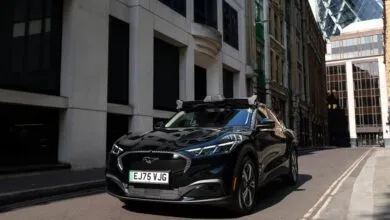
AMD, Arm, Qualcomm Invest in Self-Driving Startup

▼ Summary
– AMD, Arm, and Qualcomm have invested $60 million in Wayve as an extension of its $1.2 billion Series D funding round.
– The investment is strategic, aimed at ensuring Wayve’s self-driving system can work across various automotive computing platforms.
– Wayve’s technology uses an end-to-end neural network that learns from sensor data and is not dependent on specific hardware or pre-mapped environments.
– The company offers both an assisted-driving system requiring driver attention and a fully automated system for specific environments like robotaxis.
– Automaker customers including Nissan, Mercedes-Benz, and Stellantis plan to integrate Wayve’s technology into their vehicles starting in future models.
A major new investment from three leading semiconductor firms is accelerating the development of a unique approach to autonomous vehicle technology. Chip giants AMD, Arm, and Qualcomm have collectively invested $60 million into British startup Wayve. This capital extends the company’s recent $1.2 billion Series D funding round, which already featured a powerful consortium of strategic backers. That list includes automakers Mercedes-Benz, Nissan, and Stellantis, alongside technology leaders like Nvidia, Microsoft, and Uber. Uber has further committed an additional $300 million, contingent on deploying robotaxis equipped with Wayve’s system in London.
The strategic value of this investment extends far beyond the financial infusion. For AMD, Arm, and Qualcomm, it represents a critical opportunity to engage with a flexible self-driving platform designed to operate across diverse hardware. Wayve’s core innovation is a software system that avoids dependence on specific sensors, chips, or pre-mapped environments. Instead, it employs an end-to-end neural network that learns to drive directly from sensor data, regardless of the vehicle’s hardware configuration. This architecture allows the software to run on whatever computing platform an automaker has already chosen for its vehicles, offering unprecedented flexibility.
Wayve commercializes this technology through two primary products. The first is an “eyes on” assisted-driving system that requires driver supervision, while the second is a more advanced “eyes off” automated-driving system capable of handling all driving tasks in designated areas. This technology is already moving toward production. Nissan has announced plans to integrate Wayve’s software into its advanced driver-assistance systems starting in 2027. Mercedes-Benz and Stellantis are also confirmed customers with intentions to deploy the tech in future models.
According to the company, the fresh capital will specifically support deeper integration across various automotive computing platforms and the continued deployment of its AI Driver in production systems. Wayve’s CEO, Alex Kendall, emphasized the strategic importance of this broad silicon partnership. He stated that for embodied AI to achieve global scale, automakers require both design choice and supply chain flexibility, and collaborating with leading chip companies is essential to making that a production reality.
(Source: TechCrunch)