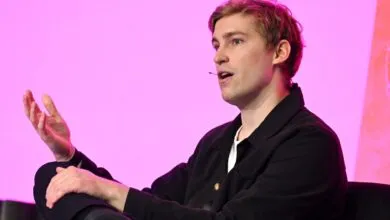
ElevenLabs VP Sets High Sales Quota and Hours Expectations

▼ Summary
– Carles Reina, ElevenLabs’ head of go-to-market, publicly warned sales candidates to expect long hours, constant travel, and a quota worth 20 times their base salary, with termination for missing it.
– The company’s sales compensation model uniquely pays both the account executive and customer success manager for upsells within the first year, treating customer success as revenue-generating.
– ElevenLabs has grown rapidly, reaching $330 million in annual recurring revenue and an $11 billion valuation after a $500 million Series D funding round led by Sequoia Capital in February 2026.
– Its product has evolved from a text-to-speech tool to the enterprise-focused ElevenAgents platform, which supports voice AI agents in over 70 languages for clients like Deutsche Telekom and Revolut.
– The company’s demanding sales culture is built from scratch by Reina, who was an early employee, and reflects a broader AI industry trend of fewer roles with higher individual responsibility and outcome-based pay.
Carles Reina, the head of go-to-market at the $11 billion voice AI firm ElevenLabs, has delivered a remarkably transparent message to prospective sales hires. In a recent podcast interview, the early employee outlined a high-performance sales culture defined by extensive travel, long work hours, and a formidable annual quota set at 20 times an employee’s base salary. Missing this target, he stated plainly, results in termination. This candid disclosure comes as the company, which recently secured a $500 million Series D round led by Sequoia Capital, scales rapidly, having achieved $330 million in annual recurring revenue in just three years.
The quota structure is stark. As Reina explained, a $100,000 salary comes with a $2 million revenue target. This 20x quota multiplier significantly exceeds the five-to-eight-times-salary standard common in enterprise software. Reina positions this not as a punitive measure but as the foundational logic for a company growing at this pace. He argues it serves as an effective filter during recruitment, ensuring alignment from the start. The system appears sustainable internally, with Reina claiming over 80% of sales representatives recently hit their targets, suggesting the bar, while high, is attainable.
This demanding quota is paired with a relationship-intensive sales model. Reina has declared that “outbound is dead unless you do it with humans,” necessitating frequent travel and autonomy in a remote-first structure. The hours, consequently, extend far beyond a traditional schedule. A notable feature of the compensation design further incentivizes this approach: both the account executive and the customer success manager receive payment for any upsell completed within the first year. Reina has publicly criticized the traditional separation of customer success from revenue, calling it “total BS,” and has structured the function as a core revenue driver.
Reina’s perspective is born from building the sales operation from the ground up. As one of the first investors and the fourth employee, he helped construct this culture inside a product-led company that already had strong market pull. ElevenLabs was founded in April 2022 by CEO Mati Staniszewski and CTO Piotr Dabkowski, childhood friends from Poland. Their initial inspiration was the poor quality of dubbed films, highlighting a gap in voice synthesis technology. The company has since pivoted from a text-to-speech research project to a comprehensive enterprise voice platform.
The recent $500 million funding round, which valued the company at $11 billion, saw Sequoia Capital lead with significant participation from Andreessen Horowitz, ICONIQ Growth, and new investors. With $330 million in annual recurring revenue at the end of 2025, ElevenLabs aims to double that figure by the end of 2026. This aggressive enterprise expansion strategy directly informs the intense sales culture Reina champions.
The product itself has evolved considerably. While initially known for consumer-facing voice cloning, the core enterprise offering is now ElevenAgents, a platform for deploying conversational AI. It supports over 10,000 voices across 70 languages for clients like Deutsche Telekom and Revolut. To support this scale, ElevenLabs has forged key infrastructure partnerships, including an expanded deal with Google Cloud to run on NVIDIA Blackwell GPUs and an integration with IBM’s watsonx Orchestrate platform for regulated industries.
The company’s revenue was evenly split between enterprise and consumer segments at the end of 2025, a balance expected to shift to 60/40 in favor of enterprise by year’s end. This trajectory demands a sales force capable of building high-volume relationships quickly, justifying the unconventional quota in leadership’s view.
This model reflects a broader trend in the AI industry, where companies are reconfiguring roles to carry greater responsibility and direct accountability for outcomes. As firms like Meta redirect capital toward massive AI investments while reducing headcount in other areas, the roles that remain often come with heightened expectations. While ElevenLabs is actively hiring, its philosophy aligns with a dynamic of fewer, more impactful positions selected with precision.
The competitive landscape for voice AI is also intensifying. Startups like Ringtime, which recently raised €1.8 million to deploy AI voice agents in blue-collar recruitment, demonstrate the technology’s expanding vertical applications. The market is growing from both the top, through major platform integrations, and the bottom, with niche solutions.
Internal feedback on platforms like Glassdoor corroborates Reina’s public description, citing “abnormally high” quotas and long hours. Some reviews express frustration that exceptional performance beyond the quota is not separately recognized, with leadership sometimes framing employment at the company as its own reward. Reina’s upfront candor with candidates can be seen as a direct response to this known tension, aiming to ensure mutual understanding before a hire is made.
The prevalence of such direct hiring practices may depend on their continued results. ElevenLabs has emerged as a standout in a wave of European AI ambition, with several startups reaching unicorn status early this year. The company’s $11 billion valuation and rapid revenue growth are external markers of its ambition; the exacting standards for its sales team are the internal engine driving it. The model is demanding by design, calibrated for a specific phase of hyper-growth in a fiercely competitive market.
(Source: The Next Web)