Baidu Robotaxis Stall in Wuhan Traffic Disruption
▼ Summary
– In Wuhan, over 100 Baidu Apollo Go robotaxis simultaneously froze on roads due to a system malfunction, stranding passengers and disrupting traffic.
– The incident highlights a new systemic risk of fleet-wide correlated failures, unlike isolated human driver errors or single-vehicle malfunctions.
– This failure occurred in Baidu’s largest commercial deployment, with over 1,000 driverless vehicles operating in the city as part of a global service.
– Similar prior incidents include Waymo vehicles stalling during a San Francisco power outage and an Apollo Go car driving into a construction pit in Chongqing.
– The timing is problematic for Baidu’s planned expansions, including partnerships with Uber and Lyft for UK trials and services in the Middle East.
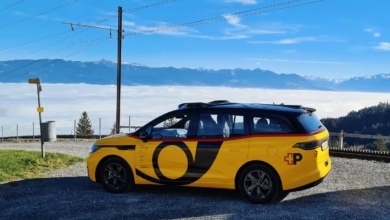
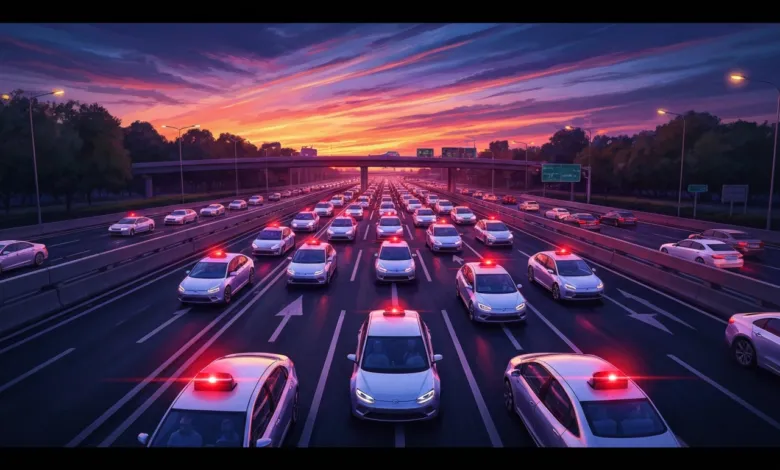
A major disruption unfolded on Tuesday evening in Wuhan, China, when over 100 Baidu Apollo Go robotaxis simultaneously ceased operation. Instead of pulling to the side of the road, the vehicles simply froze in place, creating a scattered obstruction across city streets and elevated highways. Some were stranded in the middle lanes of busy ring roads as traffic flowed around them. Passengers trapped inside were forced to contact police, while social media videos showed the immobilized cars with hazard lights flashing at intersections. One video suggested the incident may have led to a highway collision, though local authorities confirmed no injuries occurred and all passengers exited safely.
Wuhan traffic police stated on social media that a preliminary investigation pointed to a system malfunction as the cause, with further analysis ongoing. Baidu did not provide an immediate public comment on the widespread failure. This event is particularly significant because Wuhan represents Apollo Go’s largest operational deployment, with more than a thousand driverless vehicles serving the city. According to Baidu’s latest financial report, the service has provided millions of rides globally, operating as a commercial robotaxi service at substantial scale. The simultaneous immobilization of such a large portion of a city’s fleet moves beyond an isolated technical glitch, highlighting a new category of operational risk.
Experts note that while autonomous technology may demonstrate safety advantages statistically, its failure modes differ fundamentally from human error. “A human driver who suffers a medical episode creates one hazard. A fleet-wide system failure creates dozens or hundreds simultaneously,” explained Jack Stilgoe, a professor of science and technology policy. This incident underscores the need to understand these entirely new types of risk as societies integrate autonomous systems into public infrastructure.
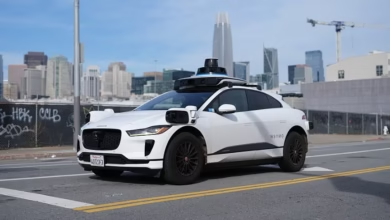
The Wuhan stoppage is the latest in a series of setbacks for the expanding robotaxi industry. Last December, a power outage in San Francisco disabled traffic lights, causing Waymo’s fleet to request remote assistance. The surge in requests overwhelmed the system, leading dozens of vehicles to stop and block traffic, a situation later addressed with a software update. Several months earlier, an Apollo Go vehicle in Chongqing drove into a construction pit, bypassing physical barriers and revealing a persistent challenge for autonomous driving systems: correctly interpreting unexpected, large-scale road hazards not present in training data.
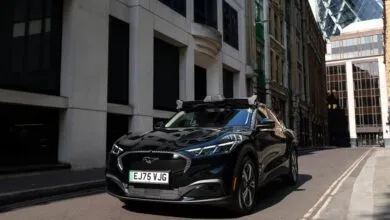
For Baidu, the timing is notably awkward. The company recently secured partnerships with Uber and Lyft to introduce its Apollo Go vehicles for trials in London, pending regulatory approval. Uber’s pilot was slated to begin this year using specialized electric vehicles, while Lyft planned to start with a fleet of fifty cars. Footage from Wuhan of frozen robotaxis obstructing traffic is unlikely to streamline these regulatory discussions. Baidu has also expanded into Middle Eastern markets like Abu Dhabi and Dubai, where regulations have been favorable, but a mass fleet failure in a flagship city raises fundamental questions that go beyond a welcoming policy environment.
The core challenge is systemic. Individual vehicle failures are manageable, but a fleet connected to shared backend systems introduces the risk of correlated failure. When a central issue arises, every vehicle can be affected identically and simultaneously, transforming a software bug into a widespread traffic system event. This phenomenon has no direct parallel in traditional transportation governed by individual driver responsibility.
Regulatory bodies are increasingly attentive to these dynamics. Investigations into erratic robotaxi behavior are ongoing in various jurisdictions, sharpening the debate over the viability of the business model itself. Operational philosophies also differ critically; some services retain remote safety drivers, while others, like the fleet in Wuhan, operate in a fully driverless mode. In a system-wide outage, that distinction separates a managed inconvenience from passenger entrapment.
The event in Wuhan did not necessarily prove robotaxis are unsafe. By the numbers, they may indeed outperform human drivers over vast distances. Instead, it revealed that autonomous fleets fail differently, at a scale and in a manner that existing regulatory frameworks are ill-equipped to handle. These frameworks were built around individual mechanical defects and human error, not synchronized software collapses. The pressing question is no longer about the basic functionality of the technology, but whether the governance and recovery systems surrounding it can evolve quickly enough to match its rapid global deployment.
(Source: The Next Web)