My Experience With the Samsung TriFold
▼ Summary
– The author received a Chinese Galaxy Z TriFold instead of the promised Taiwanese version, which lacked Google services and had concerning pre-installed apps.
– To make the phone usable, they successfully flashed it with a Singapore ROM after a complex process, eliminating the security and functionality issues.
– The TriFold feels awkward in daily use, being too heavy as a phone and overly large as a tablet, leading to a cycle of feeling it’s underutilized.
– Its design has practical flaws, including an all-or-nothing folding mechanism, no built-in kickstand, and cameras that don’t justify its high price.
– The author concludes the TriFold was an impractical concept device, discontinued by Samsung, and they would not recommend it over a standard foldable like the Z Fold 7.
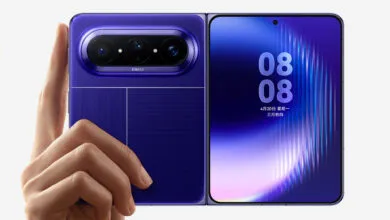
The journey to get a working Samsung Galaxy Z TriFold was far from straightforward. What arrived was a Chinese model lacking Google services, packed with questionable apps. With the official US version discontinued, this flawed unit became my only chance to experience Samsung’s ambitious three-panel foldable. Following a risky software flash to a Singapore ROM, the phone transformed from a security concern into a functional, albeit perplexing, device. This process highlights the niche appeal and significant compromises of this short-lived technological experiment.
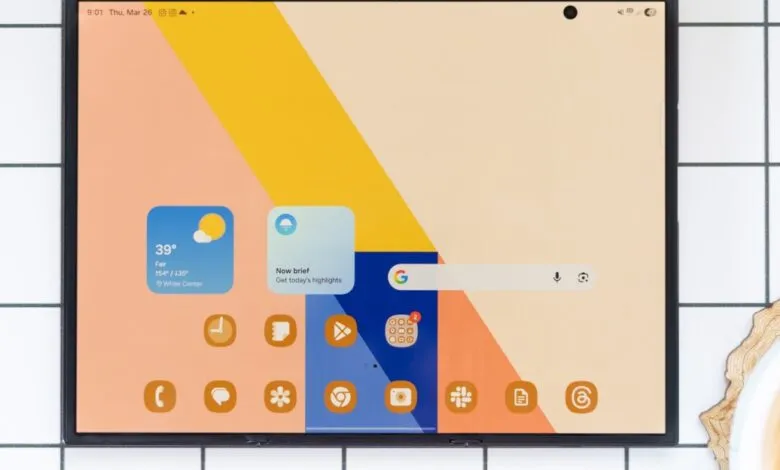
From the moment it powered on, the TriFold’s fundamental identity crisis was apparent. In its compact phone form, the substantial weight feels excessive for simple tasks, a constant nudge that you are not using the device to its full capability. Unfolded into its expansive tablet mode, the vast screen feels almost wasteful for single applications. The impulse is to multi-window aggressively, pairing peripherals to justify the real estate, but this often leads to a cluttered, overwhelming experience. The cycle of opening it for potential and quickly folding it back in frustration became a familiar rhythm.
Its hardware presents a series of intriguing but flawed propositions. The camera system is competent, featuring a 200-megapixel main sensor, but feels underwhelming for the phone’s original astronomical price. Attempting creative shots, like using the rear cameras for selfies while unfolded, is technically possible but awkward in practice. The design philosophy is rigidly binary. Unlike some competitors, it cannot be partially unfolded for a hybrid viewing angle; you must choose either full phone or full tablet mode. The lack of a built-in kickstand or a widely available accessory case further limits its utility as a portable screen.
There are undeniable strengths buried within the bulk. For mobile productivity, the larger screen and robust multi-window support are genuinely compelling. It can replace a laptop for light work, allowing you to keep a video call, a document, and a messaging app visible simultaneously. For watching media, the inner screen’s 4:3 aspect ratio is excellent. Surprisingly, its folded profile is manageable in a loose pocket for short periods, defying some expectations of its heft.
Yet, these advantages struggle to offset the core drawbacks. The extra bulk and weight compared to a standard book-style foldable, like the Galaxy Z Fold 7, is a constant tangible trade-off. It remains a phone at heart, with all the attendant software limitations, mediocre speakers, and battery anxiety. Using it as a primary computer means your entire digital life hinges on that single power cell.
Samsung’s decision to discontinue the TriFold speaks volumes. It ultimately functioned more as a proof-of-concept than a viable consumer product. The experience has shifted my perspective on the trifold format itself, suggesting that alternative designs, like Huawei’s Z-shaped accordion approach, might offer a better balance of screen size and pocketability. While I appreciate what the TriFold attempted, and the effort it took to make my unit usable, its practical shortcomings are too significant. For now, a slimmer, more refined dual-screen foldable remains the superior tool for mobile computing needs.
(Source: The Verge)