Meshtastic: Beyond Simple Communication
▼ Summary
– Meshtastic, an off-grid radio messaging protocol, is gaining popularity for creating mesh networks in various scenarios like disaster response and outdoor activities.
– A user employed Meshtastic to connect a remote garden shed to their home network, not for internet but for a basic intrusion alarm system.
– The alarm uses an infrared beam sensor connected to a Heltec ESP32 module that sends a signal over Meshtastic when the beam is broken.
– Integrating the system with Home Assistant required configuration changes, including switching to the RadioLib library and MQTT for reliable communication.
– The project illustrates how Meshtastic implementations can expand beyond initial plans, similar to broader efforts to build extensive mesh networks.
The Meshtastic protocol is enjoying a significant surge in popularity, moving beyond its core user base to attract a wave of new enthusiasts. This system for off-grid, long-range radio text messaging is now being deployed in diverse scenarios: establishing urban mesh networks, aiding communication during emergencies and protests, keeping hiking groups connected, and supporting search and rescue teams. While it excels at linking people, one innovator decided to explore a different application. He used Meshtastic to bridge a computing gap, connecting a remote garden shed that was well beyond the reach of a conventional WiFi signal.
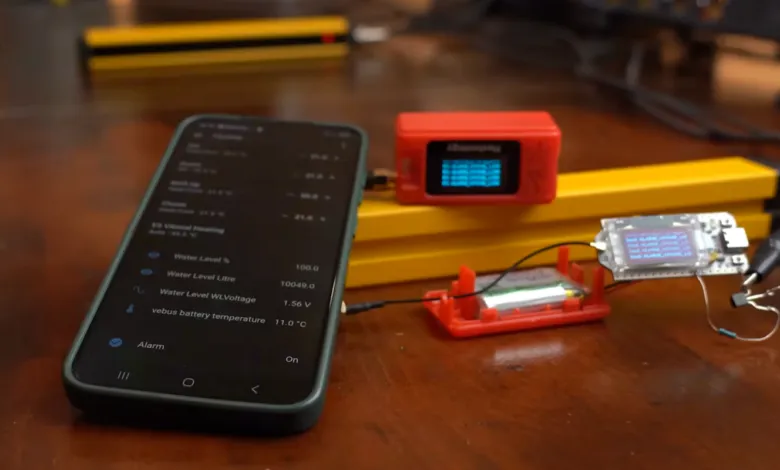
It’s important to understand that this project wasn’t about delivering high-speed internet to the outbuilding. The data throughput of Meshtastic is far too limited for that purpose. The goal was much more specific: to create a simple, reliable alarm system that could alert the homeowner to a potential break-in. The core detection mechanism employs an infrared LED emitter and detector pair. These components are mounted on two separate bars; if the invisible beam between them is interrupted, a 12-volt signal is generated.
This signal is fed into a Heltec ESP32 LoRa module, which is programmed to broadcast a message over the local Meshtastic network whenever the beam breaks. A second, identical module is stationed inside the main house, connected to the local WiFi. This unit receives the alarm message and relays it to a Home Assistant home automation server for processing and notification.
Incorporating Meshtastic devices into a Home Assistant environment can be relatively simple due to existing software integrations. However, tailoring this setup for a specific alarm function required additional configuration. The remote module needed a specific pin configured to monitor the status of the light beam sensor. An initial challenge emerged: while the alarm message transmitted successfully over the radio mesh, it failed to propagate into the Home Assistant system. The builder resolved this issue by switching to the RadioLib library and implementing an MQTT (Message Queuing Telemetry Transport) integration, which successfully bridged the communication gap.
After navigating more configuration steps than initially anticipated, the alarm system became fully operational. This experience highlights a common theme in Meshtastic projects, they often expand in scope and complexity, evolving into something more involved than the original plan. The platform’s flexibility continues to inspire novel uses, from securing a backyard shed to much larger-scale network experiments aiming to connect entire regions.
(Source: Hack A Day)