ASUS Zenbook Duo Review: Intel Core Ultra X9 388H Delivers Power & Efficiency
▼ Summary
– Intel’s new Panther Lake “Core Ultra Series 3” processors, like the flagship X9 388H, aim to unify performance and efficiency in a single chip, succeeding previous generations like Lunar Lake and Arrow Lake.
– The Panther Lake-powered ASUS ZenBook Duo 2026 demonstrates significant performance gains, offering up to a 47.5% boost in multi-threaded rendering and leading in many synthetic and gaming benchmarks over competitors.
– The integrated Arc B390 GPU, based on the Xe3 (Battlemage) architecture, provides a major performance uplift, becoming the fastest iGPU in its class and supporting advanced features like improved ray tracing and XeSS frame generation.
– Panther Lake shows strong AI performance from its updated NPU and GPU, delivering substantial leads in AI benchmarks and real-world tasks like text and image generation over previous Intel chips and AMD’s Ryzen AI.
– The platform delivers impressive power efficiency and battery life, with the ZenBook Duo achieving over 22 hours of productivity use, while maintaining performance that bridges the gap between high-efficiency and high-performance predecessors.
The ASUS Zenbook Duo 2026 represents a significant leap forward for high-performance mobile computing, powered by Intel’s new Panther Lake Core Ultra X9 388H processor. This flagship chip combines impressive multi-threaded muscle with exceptional power efficiency, all while integrating a remarkably capable Arc B390 integrated GPU. The result is a dual-screen laptop that doesn’t just promise productivity but delivers genuine gaming and creative prowess in a sleek form factor.
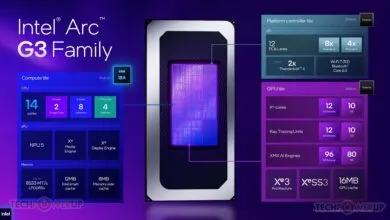
Intel’s Panther Lake architecture arrives with considerable expectations. It aims to unify the performance-oriented goals of Arrow Lake with the efficiency focus of Lunar Lake into a single, versatile system-on-a-chip. Based on the new Intel 18A process node, the Core Ultra X9 388H features a 16-core design with a mix of Cougar Cove performance cores and Darkmont efficiency cores. With a boost clock up to 5.1 GHz and a configurable TDP ranging from 15W to 80W, it is engineered for a broad spectrum of devices. The integrated graphics see a major generational upgrade to the Xe3-based Arc B390, featuring 12 cores and enhanced ray tracing and AI capabilities. An updated NPU5 rounds out the package, targeting the evolving AI PC application space.
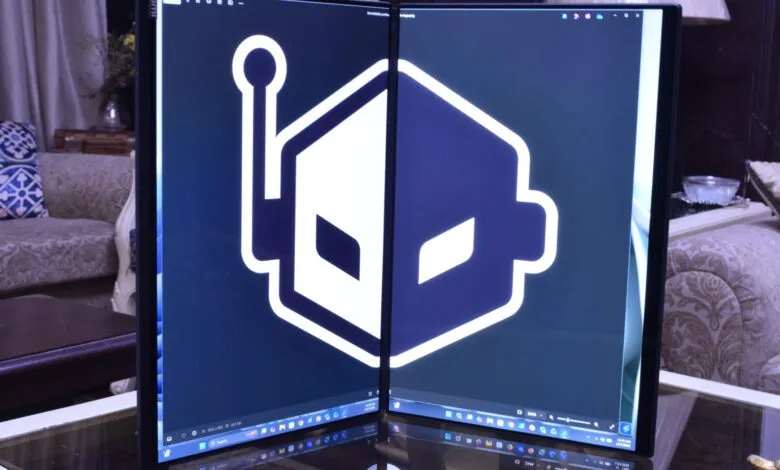
Our review unit, the ASUS Zenbook Duo UX8407, is a showcase for this silicon. It pairs the processor with 32GB of fast LPDDR5X memory and a 1TB SSD. The defining feature is its dual 14-inch 3K OLED displays, each offering a 144Hz refresh rate, HDR True Black 1000 certification, and a clever hinge system. A 99Wh battery and a versatile magnetic wireless keyboard complete the premium package.
In performance testing, the Core Ultra X9 388H consistently outperforms its predecessors. It shows a 24.4% lead in multi-threaded workloads and a solid 14% bump in single-threaded tasks compared to the prior-generation Core Ultra 9 285H. Applications like Blender see render speed improvements of 23% to over 47%. The chip’s efficiency is notable, often operating below 50W while delivering these gains. Its integrated Arc B390 GPU is a standout, posting massive leads in synthetic benchmarks. It more than doubles the performance of AMD’s Radeon 880M in tests like 3DMark Time Spy and Port Royal.
Real-world gaming translates this synthetic advantage into playable frame rates. In Cyberpunk 2077 at 1200p with medium settings and XeSS upscaling, the system averaged 93 FPS, a 68% improvement. Forza Horizon 5 saw over 100 FPS. The GPU also handles ray tracing more competently, enabling a smooth 60 FPS experience in Metro Exodus where previous iGPUs struggled. For AI workloads, the combination of the new NPU and GPU delivers strong results, significantly outpacing older Intel architectures and competing AMD solutions in image generation and text processing benchmarks.
Thermals and battery life are crucial for a mobile device. Under sustained load, the Zenbook Duo’s cooling, rated for 45W, can lead to thermal throttling, with CPU temperatures peaking near 96°C in stress tests. During typical gaming, temperatures hovered in the 70-80°C range. Where Panther Lake truly shines is in battery efficiency. In the UL Procyon Office battery test, the laptop lasted for nearly 23 hours of productivity use. Gaming on battery yielded around 5 hours, and video playback extended beyond 30 hours with the secondary screen off, showcasing the architecture’s excellent balance of performance and power sipping.
The ASUS Zenbook Duo 2026 is more than a compelling laptop; it is a testament to a refined processor platform. Intel’s Panther Lake successfully merges high performance with remarkable efficiency, proving the viability of its 18A process. The Arc B390 iGPU redefines what’s possible with integrated graphics, bringing credible 1080p gaming to thin-and-light laptops. While thermal limits in ultraportable designs can cap peak performance, the underlying technology offers exciting potential for more robust laptops and handheld devices. This combination of silicon and design creates a uniquely powerful and flexible mobile workstation.
(Source: wccftech)