CMOs: Mastering Discovery in the AI-First Era

▼ Summary
– Buyer research has fundamentally shifted from search engine results pages to conversations with AI systems, where prospects ask nuanced, problem-based questions and receive synthesized recommendations.
– Visibility now depends on being cited within AI-generated summaries, requiring brands to be clear reference points rather than just aiming for high search rankings or clicks.
– Marketing leaders must track new metrics like synthetic visibility and answer share of voice, as traditional analytics dashboards do not show performance in AI discovery channels.
– Content must be refactored into clear, problem-defining resources like buyer playbooks, decision frameworks, and evidence-backed guides to be usable and citable by AI systems.
– Achieving AI discovery visibility requires cross-functional ownership, integrating content, SEO, PR, and partnerships to control the narrative signals that AI models learn from across the web.
A fundamental shift is underway in how potential customers find and evaluate solutions, moving beyond traditional search engines to AI-driven conversations. When a buyer asks an AI assistant for the best platform given their specific team size, industry, and constraints, your brand either earns a place in that synthesized answer or disappears from the consideration set entirely. This new reality means marketing leaders must pivot from chasing search rankings to ensuring their brand is a citable reference within these AI-generated narratives. The journey no longer starts with a results page; it starts with a dialogue that frames the entire category.
Prospects are increasingly presenting their challenges to systems like ChatGPT, expecting condensed, trustworthy guidance. They pack nuanced details about budgets, compliance needs, and team structures into single prompts. Buyers are offloading their initial research to a single interface, seeking a narrative that defines their problem and highlights credible options. Queries now resemble detailed questions a consultant would ask, carrying subtleties that simple keyword tools miss. Content crafted solely to rank for search terms often fails in this environment because it lacks the substantive problem definition and comparative insight that AI systems extract and repurpose.
This evolution creates a pressing new challenge. Ranking no longer defines visibility; instead, large language models (LLMs) act as gatekeepers, deciding which brands appear in their summaries. Marketing executives must now understand and influence this selection process. A practical first step is to treat these AI platforms as critical discovery channels. Regularly input the problem statements your ideal customers use into several AI tools. Document which brands are mentioned, the language used to describe them, and any notable omissions. Tracking these responses monthly reveals narrative trends and competitive positioning.
In this LLM era, visibility is about being citable, not just clickable. These systems synthesize information from across the web to provide concise answers, rewarding brands that become consistent reference points. Brands that regularly earn inclusion typically demonstrate three key characteristics: precise positioning that clearly defines their audience, consistent language used across all public content, and domain authority built on original insight. The new top of the funnel is the first paragraph a buyer reads from an AI, which sets the evaluation criteria and shapes their final shortlist.
Consequently, content goals must shift from driving traffic to securing answer inclusion. Review your core category pages and ask a critical question: would an AI system quote this content to explain the space to a buyer? Rewrite any vague or promotional copy. In modern buyer workflows, the logic embedded in a user’s prompt carries as much weight as traditional keyword research.
This shift demands a reset in key performance indicators. Standard dashboards tracking traffic and conversions reveal little about your brand’s presence in AI summaries. New metrics are essential. CMOs should begin tracking synthetic visibility, how often the brand is cited in AI answers for priority prompts. Other vital measures include prompt recall (does your product surface when the category is mentioned without your brand name?) and answer share of voice (your proportion of mentions within responses). Building a monthly AI visibility report is a crucial practical step. Compile 20-30 core buyer research queries, run them across multiple AI platforms, and log the results to share trends with leadership.
Operationalizing this requires new processes. Teams need systems for prompt monitoring, narrative tracking, and content refactoring. AI recall builds gradually; early progress often appears as improved positioning consistency rather than immediate dominance. The first month establishes a baseline. In the following months, refactored content begins to influence recall, with the first measurable shift often being a single earned mention that reinforces category authority. Quarterly reviews of these trends should become a standard performance benchmark.
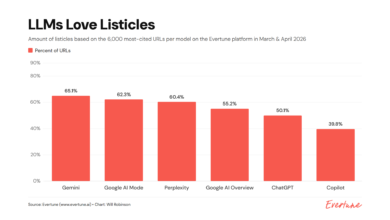
Content that gets cited in AI-driven discovery is fundamentally different. LLMs reference material that supports genuine buying conversations, content that clearly defines problems, outlines evaluation frameworks, and anchors viewpoints in evidence. High-level commentary or trend articles provide little concrete value for AI systems to reuse. Effective content reads more like a practical buyer’s playbook, featuring plain-language definitions, decision frameworks, and data-backed insights.
Improving on-site content clarity is vital, but recall is influenced by signals far beyond your own domain. Public relations coverage, analyst reports, community discussions, and partnership content all contribute to the language patterns LLMs learn to associate with your brand. High-authority backlinks remain important for reinforcing how your use cases are described. This expands responsibility for discovery visibility across the entire marketing organization, requiring tighter integration between content, SEO, PR, and partnerships.
To adapt, CMOs must reorganize with clear ownership for AI discovery. Assign accountability for how the brand appears in AI answers, pairing content strategy with technical SEO expertise. Prioritization should be based on revenue exposure, not content volume. Start with product lines directly tied to pipeline, define the buyer questions for each segment, audit current AI answer inclusion, and focus initial efforts on gaps that pose clear revenue risk.
Revenue dashboards often lag, reflecting past behavior while hiding how demand now forms through AI conversations. A decline in AI citations can impact pipeline months later. The brands poised to win are those building for AI-driven discovery today. In the next 30 days, marketing leaders should baseline their synthetic visibility for key queries, refactor one flagship page into a buyer-focused playbook, secure one earned placement that strengthens category positioning, assign clear ownership for AI visibility reporting, and schedule a quarterly executive review of these new discovery trends.
(Source: MarTech)