First-Touch Analytics: The 2026 SEO Game-Changer
▼ Summary
– In 2025, reported organic traffic declined significantly due to AI-driven search results and zero-click experiences, creating a gap between discovery and measurable visits.
– The core problem is outdated measurement, as traditional last-touch attribution fails to credit organic search’s role in early discovery, especially in an AI-first world.
– Organizations need to adopt first-touch attribution to accurately measure how organic search introduces users to a brand, even without a direct click.
– The key SEO metric for 2026 is visibility through mentions and citations in AI responses, not just clicks or impressions.
– To prove SEO’s value, teams must modernize measurement by cleaning data and analyzing the full customer journey, justifying continued investment despite declining clicks.
Throughout 2025, a consistent and troubling narrative emerged from SEO teams to company leadership: reported organic traffic was falling, clicks were dropping, and traditional attribution models seemed to be breaking down. The rise of AI-driven search results, zero-click answers, and platform-level summaries created a growing disconnect between brand discovery and measurable website visits, making it incredibly difficult to demonstrate the true value of organic search efforts. For numerous businesses, this translated into significant year-over-year declines in their reported organic traffic and lead generation metrics, prompting difficult questions from executives about the effectiveness and return on investment of their SEO programs.
The core issue wasn’t that organic search had stopped functioning. The real problem was that the way most companies measure success is fundamentally outdated, failing to capture how consumers actually find and engage with brands today. We have not been accurately measuring organic search. Many organizations remain tethered to last-touch attribution, a model that only credits the final interaction before a conversion. This approach measures the end of the customer journey but completely ignores the starting point.
Traditional linear attribution models—search, click, convert—no longer reflect complex user behavior. These models operate on the now-flawed assumption that discovery always leads to a trackable click. In today’s landscape, where AI-generated summaries in search results often provide answers without requiring a visit, the gap between influence and revenue credit has widened dramatically. Last-touch attribution rewards the finish line – not the start of the race. This model collapses in an AI-first, zero-click environment, creating massive blind spots specifically for organic search performance. Our measurement isn’t broken; it’s simply obsolete and fails to tell the complete story of marketing impact.
This underscores a critical need for the industry to rethink key performance indicators and definitions of success. To accurately gauge performance, we must understand the entire data narrative from the very first touchpoint all the way through to conversion.
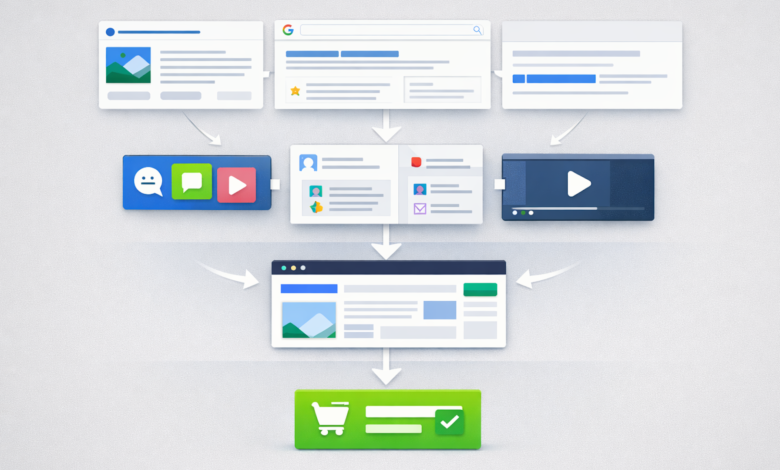
So why is last touch such a significant problem? By design, it only captures the final step. Consequently, it misses every influential interaction that occurred earlier in the journey across channels like Google, YouTube, AI Overviews, social media platforms, email, and paid listings. Most analytics implementations default to this model, which provides a basic baseline but offers an incomplete picture. To tell the full story, you must also identify where your first touches originate. This is increasingly vital as traditional organic click-through rates decline with the proliferation of AI-powered search features.
A major hurdle is data quality. Many companies struggle with messy, siloed data that lacks integrity. It’s essential to audit your own data and ask key questions: How are customers initially entering the funnel through organic channels? Which channel—paid, direct, referral, or AI—should rightly receive conversion credit? Are you tracking AI referrals as a distinct channel? Can you analyze how conversion rates differ based on the first touchpoint? For instance, how does the conversion rate for paid campaigns change when organic search was the initial introduction versus when it wasn’t?
A decline in direct clicks does not automatically mean your SEO program is failing or that organic search is losing value. It often signals that you are measuring it inaccurately. The solution involves cleaning your data, investing time in analyzing every traffic source, and deeply investigating how organic search continues to influence broader marketing efforts.
Why first-touch analytics will prove organic results still matter is clear when you consider modern discovery. If a user searches, sees your brand cited in an AI answer without a link, but later visits your site via social media or walks into a physical store, did SEO fail? Absolutely not. The organic result brought that user into the awareness funnel simply through a mention—creating visibility and top-of-mind presence. But how do you measure that impact when the last touch was a direct visit or social click? Organic search served as the crucial, albeit unclicked, entry point. Without measuring both first-touch and last-touch attribution, marketers cannot answer this question. Organic search often introduces the category, frames the problem, and establishes credibility long before a buyer ever visits a website or engages with another channel.
Visibility is the key SEO phrase of 2026. The new currency isn’t keywords or clicks, but visibility achieved through mentions and citations. If AI systems curate which brands to reference, then being visible becomes a prerequisite for consideration, not just a driver of traffic. The definition of “organic” has expanded. A user can now search, discover, and research brands across YouTube, Reddit, Instagram, TikTok, and AI chatbots, in addition to traditional search engines. They can get summarized answers without ever clicking through. Marketers must adapt their understanding of visibility and find innovative ways to expand it.
2026 is the year to grow SEO, not shrink it. As search becomes more fragmented and AI reduces clicks, SEO’s role hasn’t diminished—it has shifted earlier in the customer journey. The problem isn’t that search stopped working; it’s that post-click measurement no longer captures where influence truly begins. Last-touch attribution systematically undervalues early discovery and under-credits SEO. First-touch analysis corrects this by connecting organic visibility to downstream conversions and revenue. While AI features are accelerating these measurement gaps, the industry has navigated similar challenges before. The teams that will succeed are those that foster collaboration across analytics, SEO, and other channels, and who invest in first-touch measurement. These are the professionals who will definitively prove organic search’s impact, make more informed decisions, and continue to secure and grow investment, even in a landscape of declining clicks.
(Source: Search Engine Land)