Fujifilm’s New Instant Camera Records Vintage-Style Video
▼ Summary
– Fujifilm is releasing the Instax Mini Evo Cinema, a hybrid instant camera that can capture 15-second video clips, with a design inspired by a 1965 8mm film camera.
– The camera retains core functions like taking photos and printing smartphone images wirelessly, but features a top-mounted print ejector and a multifunction shutter button.
– A unique “Eras Dial” on the side allows users to apply one of ten video effects, each representing a different decade from 1930 to 2020 and altering both the visual and audio characteristics.
– Videos can be shared via a mobile app, and still frames from clips can be printed with QR codes that link to the online video.
– The camera launches in Japan on January 30, 2026, but pricing and global availability details are not yet announced.
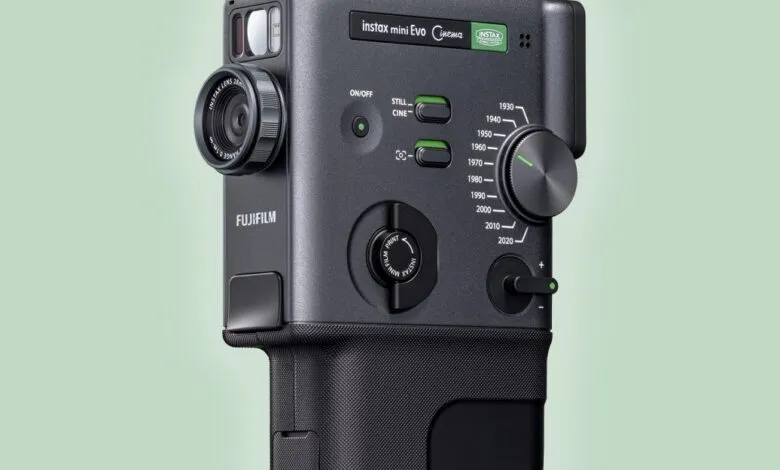
Fujifilm is pushing the boundaries of instant photography with its latest announcement, the Instax Mini Evo Cinema. This innovative device merges the nostalgic charm of instant prints with the dynamic appeal of short-form video, allowing users to capture clips up to 15 seconds long. The camera’s design is a direct homage to the vintage Fujica Single-8 8mm film camera from 1965, blending retro aesthetics with modern functionality. While a release is scheduled for Japan in January 2026, details on global pricing and availability remain forthcoming.
At its core, the Mini Evo Cinema retains the beloved features of Fujifilm’s Instax line. It functions as both a standard instant camera and a wireless printer for smartphone photos. The physical design, however, sees some notable changes. Instant prints now eject from the top of the unit, and a multifunction shutter button sits below the lens. A quick press takes a photograph, while holding the button down initiates video recording for as long as you keep it depressed.
A standout feature is the dedicated Eras Dial on the camera’s side. This control offers ten distinct video effects, each inspired by a different decade of audiovisual technology from the 1930s to the 2020s. Choosing the 1960s setting, for instance, applies a filter that mimics the grainy, authentic look of 8mm film. Selecting the 1970s option recreates the distinctive color bleed and scan lines of a classic CRT television. These effects don’t stop at visuals; they also impart unique audio characteristics to the captured sound. Some even play fitting sound effects during recording, like the whirring click of a mechanical film shutter, to enhance the vintage experience.
Sharing this content is designed to be seamless. Users can transfer videos directly to social media via the companion Instax Mini Evo mobile app. For a more tangible connection, the camera enables the printing of individual video frames. These prints come adorned with decorative, movie poster-style borders and include an embedded QR code. When scanned, this code links directly to the video clip stored online. To enable this, videos must first be uploaded to Fujifilm’s servers through the app. The company will host these clips, keeping them accessible for a period of up to two years at no extra charge to the user.
(Source: The Verge)