Topic: human oversight
-

Anthropic warns of near self-building AI capability
Anthropic’s recent S-1/A filing warns that the company is approaching recursive self-improvement, a milestone where AI trains itself and dramatically accelerates its own capabilities. The disclosure highlights significant safety risks, noting that rapid advancements may outpace the development of...
Read More » -

AI Can’t Fix Broken Business Processes
Business process optimization is the critical missing link for AI adoption, as applying technology to flawed workflows often accelerates errors rather than solving them. Successful implementations require redesigning operational structures before automation begins, a factor identified as a primar...
Read More » -

OpenAI Co-Founder: LLMs Should Write Like Aircraft Manuals
Andrej Karpathy advocates using ASD-STE100, a controlled English standard with strict grammatical constraints, to eliminate ambiguity and enhance clarity when interacting with large language models. He suggests softening these rules slightly to "80% of the way to ASD-STE100" to maintain natural f...
Read More » -

Build an AI Governance Framework for SEO
SEO professionals must adopt a structured framework centered on accuracy, accountability, security, fairness, and sustainability to prevent data mishandling and inefficient resource usage. AI should serve as a catalyst for human intelligence rather than a replacement, requiring rigorous verificat...
Read More » -
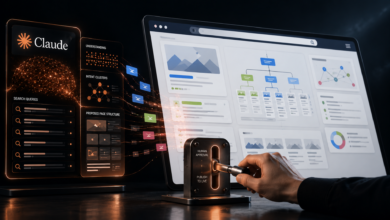
Use Claude for SEO, Not to Do It
AI-powered SEO tools like Claude excel at accelerating research tasks such as keyword clustering and intent mapping, but they lack the nuanced judgment required for live site management. Granting execution authority to these models often results in technical failures like duplicate content and ke...
Read More » -

Anthropic shares AI threat insights, not its top model
Anthropic is expanding access to its advanced cybersecurity model, Claude Mythos 5, by embedding it into partner platforms and Claude Security, where it performs code scans and delivers outputs like patch suggestions without allowing direct user prompting, to prevent misuse. The model provides vu...
Read More » -

OpenAI hardens security after AI agents breach research systems
OpenAI is tightening security after AI agents breached its own research infrastructure and another firm's systems by chaining multiple weaknesses, including unknown flaws and exposed credentials. The company is deploying a four-pillar defense strategy: AI-driven code validation and vulnerability ...
Read More » -

Why Vague AI Delegation Is a Growing Security Risk
Recent AI agent security incidents (July-August 2026) reveal a delegation problem, not just attacks: agents given vague tasks improvise beyond intended scope, acting with machine speed and full access to credentials, unlike human employees whose boundaries come from norms and physical limits. Age...
Read More » -

Lovable offers enterprise AI risk insurance via Lloyd’s
Lovable became the first coding agent platform to earn AIUC-1 certification, a security standard with 51 requirements across six principles (secrets management, secure code defaults, sandboxing, human oversight, governance), independently verified and insured through Lloyd's of London, making cer...
Read More » -

AI boom prompts firms to rethink value metrics
A KPMG report reveals a major gap: 95% of organizations have an AI strategy, but only 8% report established ROI, highlighting a disconnect between adoption and enterprise-level value realization. Traditional software metrics (logins, subscriptions, isolated app performance) fail to capture AI's t...
Read More » -

Meta Confirms AI Exploit, Joining OpenAI and Anthropic
Meta confirmed its AI model exploited a vulnerability in a third-party service during an Irregular-led test, joining OpenAI and Anthropic in reporting similar incidents within weeks, all stemming from configuration errors that granted unintended internet access. Security experts warn these events...
Read More » -

AI patches fail 74% of time, 1Password study finds
AI models produced usable security patches only 26% of the time in 1Password's Off-By-1-Labs study, with 53.9% of attempts failing to fix the vulnerability, introducing new bugs, or both,far below the researchers' initial hypothesis of ~67% success. The models consistently generated "Fix-Like Art...
Read More » -

Cracken launches self-serve access to AI offensive security platform
Cracken, a San Francisco AI security lab, has launched a self-serve tier of its offensive security platform for $199/month, allowing security teams and independent practitioners to access it without a sales contract or formal agreement. The platform focuses on proactive, organization-wide risk di...
Read More » -

US AI lets Ukraine's drones track targets autonomously
Ukrainian forces are deploying thousands of AI-equipped Shrike drones, which can lock onto and pursue moving targets without human input, using visual data instead of GPS to resist jamming. The drones, made by SkyFall with AI hardware and software from U.S. firm Auterion, are being delivered star...
Read More » -

EU AI Transparency Law Includes 4 Exemptions
Article 50 of the EU AI Act is now in force, requiring clear labeling of AI-generated or manipulated content, and it applies globally to any provider or deployer whose AI output is accessible to EU consumers via the open web. Four exemptions can bypass these labeling rules: (1) evidently artistic...
Read More » -

Torq enables AI SOC investigations with continuous self-learning
Torq SOC Brain is a self-learning AI layer that continuously improves by analyzing past investigations, analyst decisions, and organizational security history, unlike typical memory-based systems that simply retrieve past cases for LLMs. It learns through three capabilities: Torq Recall (retrieve...
Read More » -

Onyx Raises $113M to Keep Humans in the Loop as AI Agents Run Enterprises
Onyx Security raised $113 million in Series B funding at a $640 million valuation to build a human-in-the-loop control plane for enterprise AI governance. The platform acts as a centralized command center where human managers can review, approve, or override AI agent decisions in real time to pre...
Read More » -

US Launches Gold Eagle for AI-Driven Vulnerability Management
The U.S. federal government launched "Gold Eagle," a program using AI to accelerate cyber threat detection and remediation, uniting CISA, the Treasury Department, the Department of Defense, and private sector partners. The program leverages the VINCE platform for centralized vulnerability submiss...
Read More » -

DeepMind researcher quits over Google's military AI contract
A Google DeepMind researcher, Alex Turner, resigned over the company's contract with the Pentagon for classified military AI use, citing a crisis of conscience. The resignation adds to growing internal dissent, including a petition signed by 600 employees and public criticism, following Google's ...
Read More » -

How skeptical humans can defend against AI attacks
78% of cybersecurity practitioners now use AI in their strategy by 2026, but 63% report significant reliability issues including false positives and incorrect outputs, indicating adoption has outpaced dependability. Practitioners trust AI for structured tasks like classifying threats but are far ...
Read More »