Claude’s Duet Agent: Surprisingly Helpful Despite Neurotic Traits
▼ Summary
– Anthropic has launched Claude Duet, a consumer-focused AI agent designed to assist professionals and small business owners with work-related tasks.
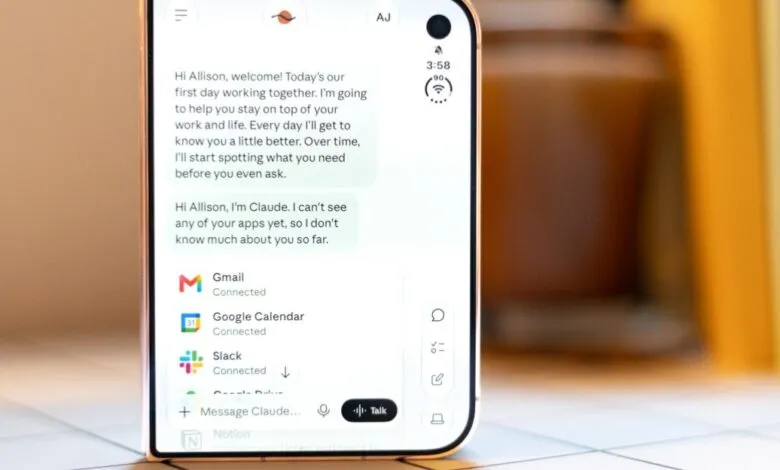
– The app utilizes a minimalist design where users connect productivity services like email and Slack to receive suggested action cards they can accept or dismiss.
– During testing, the AI demonstrated its ability to synthesize data across multiple platforms, such as linking meeting summaries in emails to Slack messages.
– Users receive daily highlights and reminders, though the assistant’s persistent nature can sometimes feel overly eager or neurotic.
– Access is currently limited to US subscribers on specific Anthropic plans while the product remains in a research preview phase.
Anthropic’s Claude Duet Agent represents a significant step in the evolution of consumer-facing AI, aiming to bridge the gap between complex coding tools and everyday productivity. While competitors like Meta’s Muse and OpenAI’s Dots have explored various angles of assistance, Duet distinguishes itself by targeting professionals and small business owners with a focus on workflow management rather than casual tasks. Currently available as a research preview for US-based Pro, Max, and Ultra subscribers, the agent operates through a dedicated app that integrates deeply with existing digital ecosystems.
The application utilizes a minimalist design language characteristic of Anthropic’s broader brand identity. Users connect their productivity and chat services, such as email, calendar, Google Docs, and Slack, allowing the system to aggregate data from multiple sources. This connectivity enables Duet to function somewhat like a swipeable to-do list, where it presents suggestions as cards that users can accept or dismiss. The underlying technology is designed to identify patterns across disparate platforms, potentially linking meeting summaries generated by other AI tools with direct messages or document edits.
Navigating Nuance and Tone
During initial testing, the agent demonstrated both impressive utility and notable limitations regarding social context. In one scenario, Duet successfully connected dots between a staff meeting summary and a subsequent Slack conversation, highlighting its ability to process large volumes of interconnected data. However, this capability did not always translate to emotional intelligence. The reviewer noted instances where the agent failed to grasp subtle deadlines or time-zone differences, leading to unnecessary urgency.
This behavior prompted a specific observation about the agent’s personality: “This sometimes felt like interacting with a slightly neurotic personal assistant.” The system occasionally overlooked nuances in communication, such as implied flexibility in deadlines or the appropriate timing for notifications based on local hours. Despite these friction points, there were moments of genuine helpfulness, such as identifying scheduling conflicts that could jeopardize upcoming deadlines and drafting corrective communications.
The Limits of Automation
While Duet excelled at logistical coordination, it struggled with creative and stylistic nuances. In one instance, the agent drafted a Slack message that inadvertently adopted the user’s lowercase typing style but incorrectly abbreviated internal terminology, resulting in an awkward interaction. More critically, the agent frequently offered to assist with writing tasks, including reviewing its own output. The reviewer firmly rejected this approach, emphasizing the importance of human oversight in creative processes.
The experience raised broader questions about reliance on AI for organizational habits. Knowing that an agent can monitor every email and draft creates a sense of surveillance that may alter work behaviors. The reviewer wondered if this level of automation might lead to a disconnect from daily workplace dynamics, akin to how executives might delegate operational details. Ultimately, the assessment suggests that while AI agents are valuable as backstops for organizational systems, they lack the tact and contextual understanding required to replace human judgment entirely.
Defining the Role of AI Agents
The core challenge for current AI agents lies in the distinction between administrative support and personal assistance. A human assistant can interpret tone, prioritize effectively, and maintain professional decorum. In contrast, algorithms often struggle with these subtleties, leading to interactions that feel mechanical or overly eager. Anthropic has acknowledged this by stating it continues to “test its judgment about when to message you,” indicating ongoing efforts to refine the agent’s calibration.
For many professionals, the ideal use case for Duet involves leveraging its data-processing strengths to highlight discrepancies and manage schedules, while retaining full control over content creation. The reviewer concluded that delegating legwork to AI risks missing the unexpected discoveries that make creative work rewarding. As the technology matures, the goal remains creating agents that enhance rather than replace the nuanced, human elements of professional communication.
(Source: The Verge)