AbuseBox: Open-source tool for DNS, SSL and email blacklists
▼ Summary
– AbuseBox is a free, open-source cybersecurity tool designed to monitor IP addresses and domains against 60 DNS blacklists and other security metrics.
– The platform provides a unified dashboard that tracks blacklist listings, expiring certificates, server outages, and weak email authentication records.
– Users can configure automated checks via Docker Compose, with alerts delivered through email, Slack, Discord, or webhooks for various security events.
– The tool supports bulk operations for up to 300 hosts and subnet scans, utilizing technologies like Python, FastAPI, React, and SQLite.
– AbuseBox offers both free limited access for quick checks and full functionality requiring API keys or tokens, all available under an MIT license on GitHub.
AbuseBox provides a centralized, open-source solution for monitoring digital infrastructure integrity. This free utility aggregates data from 60 DNS blacklists, retrieves reputation metrics from AbuseIPDB, and analyzes DNS, SSL, and email-authentication configurations. The platform automatically triggers alerts whenever these parameters shift, helping security teams maintain visibility over their assets.
Centralized Monitoring Dashboard
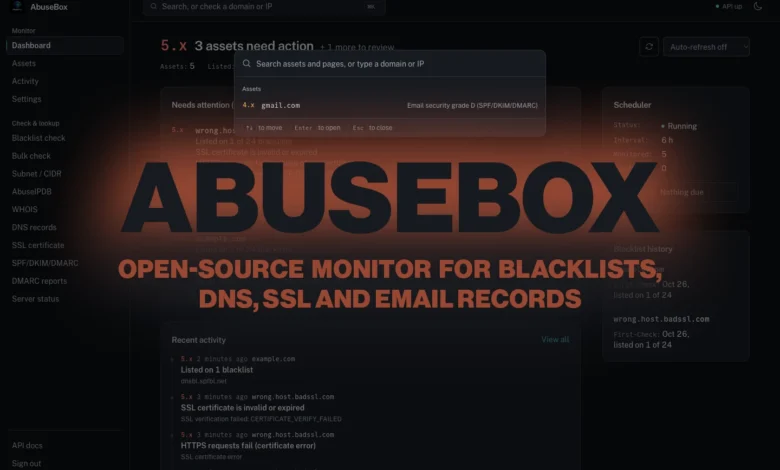
Traditionally, verifying the health of an IP address or domain requires separate queries for blacklist status, certificate validity, and DNS records. AbuseBox consolidates these disparate checks into a single interface. The dashboard highlights critical issues such as blacklist listings, expiring certificates, unreachable servers, and weak email security protocols. By unifying these data points, administrators can prioritize remediation efforts without switching between multiple tools.
Comprehensive Asset Checks
The tool performs detailed scans on registered hosts. A standard check evaluates presence across numerous DNSBL providers and displays the associated AbuseIPDB reputation score. Accessing the reputation data requires a free API key from AbuseIPDB, while other diagnostics like WHOIS lookups, server status tests, and SSL inspections operate without authentication keys.
For email security, AbuseBox validates SPF, DKIM, and DMARC records. These protocols verify sender legitimacy to receiving mail servers. The system assigns a grade ranging from A to F based on the strength of these configurations. Additionally, server-status checks measure DNS resolution times, test connectivity on ports 80 and 443, and evaluate HTTP response speeds to ensure services are performing optimally.
Deployment and Usage Workflow
Users define their assets by registering specific domains and IP addresses. They can then configure which checks apply to each asset. The scheduler defaults to re-evaluating assets every 360 minutes. Notifications regarding new listings, recoveries, outages, or expiration warnings are delivered via email, Slack, Discord, or custom webhooks.
Bulk operations support scanning up to 300 hosts using pasted lists or uploaded files in TXT, CSV, or XLSX formats. Subnet scans are also supported, covering ranges up to a /24 prefix.
Installation relies on Docker Compose. Administrators clone the repository, duplicate the example .env file, and execute `docker compose up –build`. The interface becomes accessible at localhost:3000. New installations initialize with the username admin and password password123, requiring immediate credential changes upon first login. Unauthenticated users may perform quick blacklist checks limited to 10 requests per minute per IP. All other endpoints require an authentication token. The project is licensed under the MIT license and utilizes Python, FastAPI, React, and SQLite for its backend and frontend architecture.
(Source: Help Net Security)