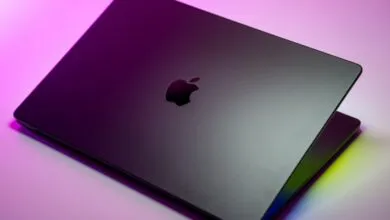
Can Apple Make Touchscreen Laptops Better?

▼ Summary
– Apple is expected to announce a touchscreen MacBook Pro at its upcoming ‘Pro and Tell’ event, marking a shift from its historical stance against such technology.
– The new device is rumored to feature an OLED display for improved visuals, potentially making it more expensive than previous models.
– Speculation suggests the laptop will use M5 Pro and M5 Max chips in 14- and 16-inch sizes, with a Dynamic Island cutout replacing the traditional notch.
– Rumors indicate a thinner and lighter chassis design, raising concerns about potential thermal issues and performance compromises similar to past generations.
– This move contrasts with Steve Jobs’ past criticism of vertical touch surfaces and the limited functionality of the discontinued Touch Bar.
Tim Cook’s infamous 2012 comparison of a touchscreen laptop to merging a fridge with a toaster is about to be put to the test. Apple is widely expected to unveil its first true touchscreen MacBook at its upcoming “Pro and Tell” event, marking a significant pivot from the company’s long-standing resistance to touch interfaces on computers. While touchscreens have been standard on laptops for years, Apple previously dismissed them as ergonomically terrible, with Steve Jobs arguing in 2010 that “Touch surfaces don’t want to be vertical.”
The closest iteration to this concept was the MacBook Pro Touch Bar, which existed from 2016 to 2023. That horizontal strip largely failed to deliver on its promise, sacrificing physical function keys for a non-deterministic interface. A full-screen touch display offers a more established utility, allowing users to take direct action through taps, flicks, or stylus input. The question remains how Apple will integrate this feature without compromising the core experience that defines its professional lineup.
Rumors suggest the new device will feature an OLED display, known for deep blacks and vivid color contrast, paired with M5 Pro and M5 Max chips. This combination promises high performance but likely comes at a steep price. With the current 14-inch M5 Pro model starting at $2,499, adding an OLED touch panel could significantly increase the cost. Additionally, the screen may feature a Dynamic Island cutout for the webcam, replacing the traditional notch. If implemented similarly to iOS devices, this area could facilitate touch-based multitasking for timers and media apps, offering a subtle aesthetic and functional upgrade.
Beyond the display, there are concerns regarding the chassis design. Reports indicate a thinner and lighter build, a move that raises eyebrows given the history of Apple’s design choices. Previous attempts to reduce thickness resulted in thermal issues and the problematic butterfly keyboards. Industry observers are wary of potential performance compromises in pursuit of slimness, questioning whether Apple can maintain raw power and battery life while altering the form factor.
Interaction methods remain speculative. It is unclear if Apple will introduce a convertible hinge similar to Lenovo’s Yoga line or stick to a traditional clamshell design. Furthermore, support for the Apple Pencil is highly anticipated, particularly for creative professionals who require precision tools. However, this device will run a revised version of macOS, specifically macOS 27 Golden Gate, which includes touch-friendly enhancements while retaining its identity as a full desktop operating system rather than shifting to an iPad-like experience. This release appears to be an offshoot rather than a replacement for existing models, representing a major shakeup for a product line that has seen mostly incremental updates since the M1 generation revitalized it in 2021.
(Source: The Verge)