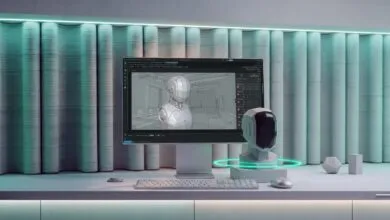
19-Year-Old Founder Raises $11M for Ghost, a $3,499 Personal AI Computer

▼ Summary
– Ghost, a startup founded by Zain Javaid and his team, has emerged from stealth with an $11 million seed round led by Andreessen Horowitz.
– The company’s flagship product is Core, a dedicated personal computer designed to run AI agents continuously without complex user setup.
– Core features an Nvidia RTX Pro 4000 SFF Blackwell GPU and pre-installed models like Qwen and Gemma, priced at $3,499.
– Unlike general-purpose computers such as the Mac Mini, Core offers over-the-air updates for AI models similar to Tesla’s approach.
– Preorders for the first batch of Core devices open immediately with shipping scheduled for late October.
Zain Javaid, a 19-year-old entrepreneur, has successfully closed an $11 million seed funding round for his new venture, Ghost. The investment was led by Andreessen Horowitz, with additional participation from investors including Abstract, Audacious Ventures, SV Angel, and Nova. This capital injection marks the emergence of Ghost from stealth mode after a year of intensive development.
Javaid’s journey to founding Ghost began in quantitative finance, where he applied mathematical models to guide investment decisions. However, he found the work unfulfilling until the release of ChatGPT in 2022 shifted his perspective. He told TechCrunch, “I felt fundamentally excited in a way that I never had been before.” This surge of enthusiasm directed his focus toward personal AI, leading him to assemble a founding team comprising peers Nicholas Chua, 19, Yifei Chen, 24, and Gautam Sharda, 23. Together, they developed Core, a specialized personal computer designed to house AI agents capable of acting on behalf of their users.
A Dedicated Hardware Solution for AI Agents
The centerpiece of Ghost’s offering is Core, priced at $3,499. Unlike general-purpose computers, Core is engineered specifically to run AI agents continuously. It features an Nvidia RTX Pro 4000 SFF Blackwell GPU, which is included in the base price to eliminate the need for separate purchases. The device operates as a “brain in a box” without a physical screen; users interact with it via a smartphone app or voice commands through the dedicated application.
Core comes pre-installed with three specific large language models: Qwen-3.8-Next, Qwen-3.8-27B, and Gemma-4-31B. While these are the default options, the system allows users to install additional models from Hugging Face or upload custom-trained models. Javaid emphasizes that Core distinguishes itself from competitors like the Mac Mini because its entire hardware and software stack is optimized for AI tasks. Where a Mac Mini requires significant configuration to run AI tools, Core arrives ready to process information and execute tasks without constant user prompting.
Local Processing and User Autonomy
A key selling point for Ghost is the emphasis on local data processing and user control. All personal memory, model weights, and logic reside on the device itself. Javaid stated, “All of the source code, logic, and model weights live on the device, not the services.” This architecture ensures that no cloud provider or third party, including Ghost, can access sensitive user data. The company employs encryption to protect this information and has developed a firewall that monitors every outgoing network request. If an agent attempts to perform an unsanctioned action or exfiltrate data, the firewall rejects the request and alerts the user.
The system supports over-the-air updates similar to those used by Tesla, allowing users to receive improvements to existing models or switch to newer generations when available. Users can enable auto-updates to ensure they always have the latest capabilities. Importantly, the device is designed to remain functional even if Ghost ceases operations. “We build this device to not be dependent on having an outside entity maintaining the service,” Javaid explained.
Proactive Assistance and Market Positioning
Ghost envisions Core as a proactive assistant that integrates various data sources to provide contextual insights. For example, the system might notify a user about potential illness by analyzing an elevated resting heart rate, late-night computer activity, and local flu season trends. Javaid argues that while established tech giants possess strong hardware, the true challenge lies in the software layer,how the model reasons over a user’s life, remembers details, and determines when to intervene.
Despite competition from major incumbents, Javaid remains confident in Ghost’s trajectory. He noted that many companies underestimate the complexity of building effective AI software. “If we can’t do that, Apple isn’t the reason we failed,” he said. Preorders for the first batch of Core units opened recently, with shipping scheduled for the last week of October. The units are currently being assembled at Ghost’s facility in San Francisco.
(Source: TechCrunch)