Falcon 9 Scrub: Is Vulcan Ready to Take Over?
▼ Summary
– United Launch Alliance’s Vulcan rocket is approaching its return-to-flight mission scheduled for late October, with subsequent Amazon Leo missions planned for this year.
– South Korea successfully launched its Nuri rocket for the fifth time, deploying five primary satellites and most secondary CubeSats into orbit.
– The successful Nuri launch marks a shift in South Korea’s space strategy from government-led development to a commercially driven industry model.
– German startup HyImpulse has delayed its second SR75 suborbital test flight to spring 2027 due to licensing requirements and weather conditions.
– One of the secondary payloads, PERSAT-02, failed to separate from the Nuri rocket during the recent South Korean launch.
Vulcan’s Return to Flight on the Horizon
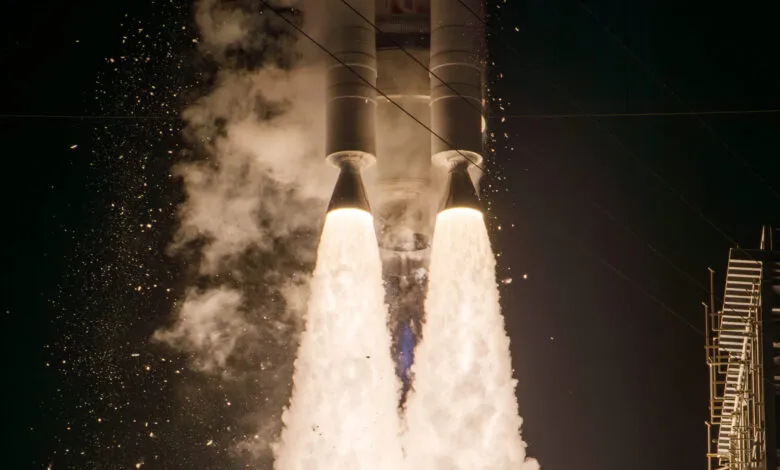
The launch landscape is shifting as United Launch Alliance’s Vulcan rocket edges closer to its next critical milestone. A no-earlier-than October 29 window has been set for a return-to-flight mission carrying an Amazon Leo satellite, signaling that the heavy-lift vehicle is preparing to re-enter active service. This upcoming flight is not an isolated event; another Amazon Leo mission is scheduled later in the year, suggesting a rapid succession of launches if operations proceed smoothly. Industry analysts suggest that with the successful deployment of its solid rocket boosters, Vulcan could achieve significant improvements in launch cadence throughout next year, potentially challenging established competitors in the commercial sector.
South Korea’s Nuri Rocket Achieves Another Milestone
South Korea continues to strengthen its domestic space capabilities with the fifth successful flight of its Nuri rocket. The launch successfully deployed five microsatellites for the New-space Earth Observation Satellite Constellation for National Safety, marking a key step in the nation’s first domestically launched constellation. According to the Korea AeroSpace Administration, nine of the ten secondary CubeSat payloads were also released as planned. However, the mission was not without minor complications; PERSAT-02, developed by the startup Quaternion, failed to separate from the carrier stage. Despite this anomaly, the primary objective was met, reinforcing the reliability of the homegrown launch system.
This success brings Nuri’s overall success rate to 80 percent, following three consecutive wins after its initial failure in 2021. The achievement has prompted strong political backing for the future of the industry. Science Minister Bae Kyung-hoon emphasized the government’s commitment to transitioning away from state-led development toward a market-driven model. He stated:
> “We will continue to support additional launches led by the private sector as South Korea seeks to shift from a government-led space development model toward a more commercially driven industry.”
This pledge underscores a strategic pivot aimed at fostering a robust private space ecosystem within the country.
HyImpulse Delays Suborbital Test to 2027
In Europe, German launch startup HyImpulse has adjusted its timeline for the second test flight of its SR75 suborbital rocket. Originally targeting late 2026, the company has now pushed the launch window to spring 2027. Reports from European Spaceflight indicate that the delay is not due to technical readiness issues but rather logistical and environmental constraints. The new schedule accounts for remaining activities required under the current license framework and the specific seasonal weather conditions at the SaxaVord launch site. This adjustment highlights the complex interplay between regulatory compliance and operational environments in the suborbital market.
(Source: Ars Technica)