NASA Chief Prioritizes ‘Good Deals’ With Global Partners
▼ Summary
– NASA Administrator Jared Isaacman emphasized the need for selective international partnerships as the lunar race shifts from national prestige to competition for resources.
– The lunar south pole is identified as a critical strategic area due to its limited accessible zones with water ice and near-continuous sunlight.
– Water ice in permanently shadowed craters at the south pole is vital for sustaining a permanent base and supporting future missions to Mars.
– Isaacman compared the scarcity of optimal landing sites to limited parking spots in Washington, DC, highlighting the urgency to secure these locations first.
– The United States faces pressure from China and Russia, who are collaborating to establish a presence that could potentially deny America access to this essential training environment.
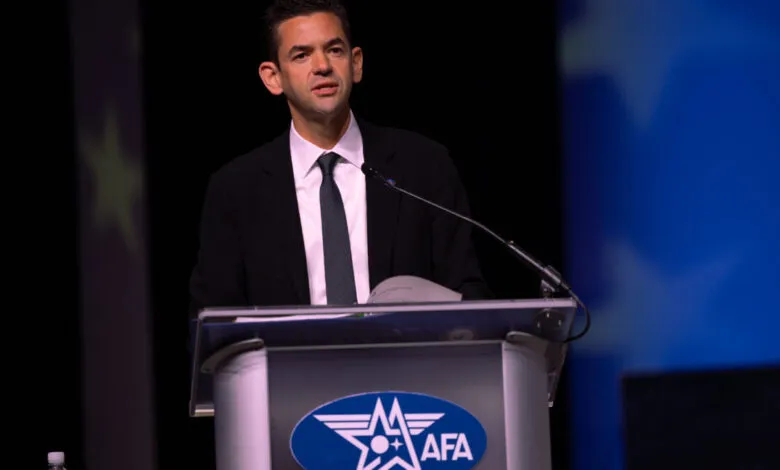
NASA Administrator Jared Isaacman has signaled a strategic shift toward securing high-value international partnerships as the lunar race intensifies. Moving beyond the ideological Cold War dynamics of the past, the agency is now focused on acquiring tangible assets in the extraterrestrial resource market. Speaking to defense leaders and contractors near Washington, DC, Isaacman emphasized that the current competition for the Moon is less about national prestige and more about controlling critical real estate necessary for long-term space exploration.
The focal point of this contention is the lunar south pole, a region small enough to be compared to the geographic footprint of Washington, DC. Within this limited area lies a scarcity of prime locations that offer dual advantages: proximity to water ice and access to continuous sunlight. These “good parking spots” are essential because the ice trapped in permanently shadowed craters can be processed into drinking water, breathable air, and rocket propellant. This infrastructure would not only support a permanent human settlement but also serve as a vital staging ground for future missions to Mars.
Strategic Urgency and Geopolitical Rivalry
Isaacman highlighted the logistical constraints of the lunar surface, noting that while the Moon’s total surface area is comparable to Africa, the number of viable landing sites with optimal resources is extremely limited. The urgency to secure these zones is driven by the rapid advancements of rival nations. China and Russia are actively collaborating on lunar ambitions, with plans to establish a presence at the same south pole locations NASA targets.
The competitive landscape includes significant technological threats. Beijing is reportedly working with Moscow to deploy nuclear reactors on the lunar surface, which could power their operations and potentially block access to key areas. This creates a scenario where American capabilities could be stifled if rivals control the most advantageous terrain.
Addressing the Air & Space Forces Association’s conference, Isaacman underscored the necessity of speed and strategic positioning. He stated, “It’s a big Moon, with the surface area of Africa,” adding that the south pole is “more akin to Washington, DC, when there are only so many roads and so many good parking spots that you’re going to want to occupy.”
The primary goal for NASA is not merely to plant a flag but to develop the technical proficiency required for deep space travel. As Isaacman explained, “We want to go there to master the skills for Mars.” However, the finite nature of these resource-rich sites complicates that objective. He warned, “And when you realize there are only limited parking spots that get us access to that training environment, it creates an urgency, and we must [go fast] because the Chinese are going to the exact same locations. They are partnered with the Russians. They are going to put a nuclear reactor there, and they could potentially deny this training environment that is a necessity for America’s space ambitions.”
(Source: Ars Technica)