SpaceX appoints Sequoia’s Roelof Botha to its board
▼ Summary
– SpaceX appointed Roelof Botha, former Sequoia Capital partner, as an independent director and audit committee member, effective June 16, days after its IPO.
– Elon Musk holds over 82% of SpaceX’s voting power, with IPO terms concentrating control in his hands, limiting shareholder influence.
– Botha has known Musk for 25 years, was hired by Musk to run PayPal’s finances in 2000, and Sequoia owned about 1.5% of SpaceX.
– A member of Botha’s family has worked at SpaceX since January 2025, and Botha has no personal financial stake in the company.
– SpaceX’s non-employee directors receive no cash or equity compensation, and a Danish pension fund has blacklisted the stock over governance concerns.
SpaceX has added its first new board member since going public, and the key term in the announcement is “independent.”
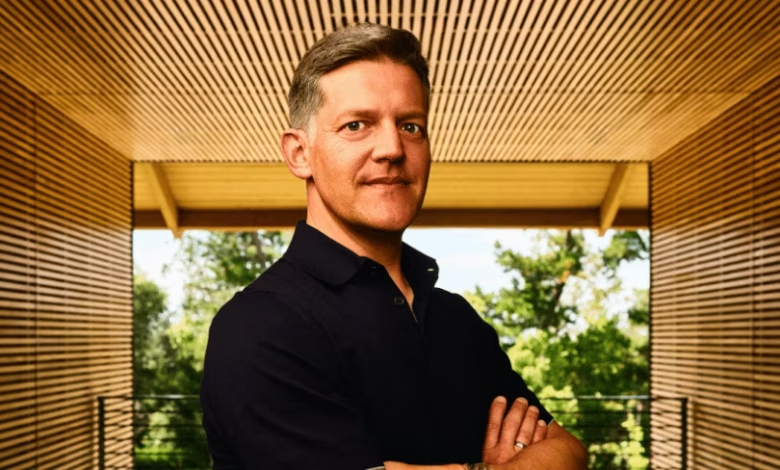
In a regulatory filing on June 17, the company revealed that its board elected Roelof Botha, the former Sequoia Capital leader, as an independent director and a member of its audit committee. The appointment took effect on June 16, just days after SpaceX completed the largest IPO in history.
On the surface, this is a straightforward and even mundane piece of corporate governance. A newly public company needs audit committee members with prior experience, and Botha has served on the boards and audit committees of numerous public companies.
What “independent” really means here
The complication is the company he is joining. Elon Musk controls more than 82 percent of SpaceX’s voting power, dictates every board change, and has left public shareholders with virtually no ability to challenge him. SpaceX’s own IPO terms concentrated power in Musk’s hands, not the market’s.
Against that backdrop, the word “independent” sits awkwardly. Botha has known Musk for 25 years. Musk, a fellow South African, hired him to run PayPal’s finances in 2000, the first job Botha was offered in America.
He then spent more than two decades at Sequoia, which invested in SpaceX in 2019 and owned roughly 1.5 percent of the company. That stake was worth more than $20 billion heading into the listing and around $35 billion after it. The filing also discloses that a member of Botha’s family has worked at SpaceX since January 2025, and that Botha himself has no personal financial stake in the company.
None of this breaches the technical definition of an independent director, and the filing states there was no arrangement behind his selection. But it serves as a reminder that independence on this board is a narrow, legal sort of independence.
A board built of insiders
Botha’s arrival brings the board to nine members. He joins long-time Musk allies including Ira Ehrenpreis, Antonio Gracias, Steve Jurvetson, and Luke Nosek, as well as chief operating officer Gwynne Shotwell, Google’s Donald Harrison, and venture capitalist Randy Glein. Musk serves as chairman.
One detail stands out for a company now valued at around $2.5 trillion: its non-employee directors receive no compensation, neither cash nor equity, for their service. SpaceX governance has already drawn criticism, with a Danish pension fund recently blacklisting the stock over what it called a “catastrophic governance structure.”
The most useful way to interpret the appointment is the least dramatic one. The audit committee is the part of a public-company board with real, regulator-mandated work, and Botha is genuinely qualified to do it. Whether a single experienced director changes the calculus at a company built around one man’s control is a different question entirely.
(Source: The Next Web)