Trump’s top AI adviser Sriram Krishnan to leave White House
▼ Summary
– Sriram Krishnan, White House senior AI policy adviser, is leaving his role at the end of June and plans to start an outside institution focused on AI policy.
– Krishnan helped broker an agreement with Google, Microsoft, and xAI granting the US government early access to their AI models for a 30-day security review.
– White House officials credited Krishnan with advancing “American AI dominance” through policy initiatives and international diplomacy.
– Trump signed an executive order on voluntary cybersecurity guidelines for AI and directed national security agencies to work with multiple AI providers.
– Krishnan’s departure raises questions about Andreessen Horowitz’s continued influence on AI policy within the administration.
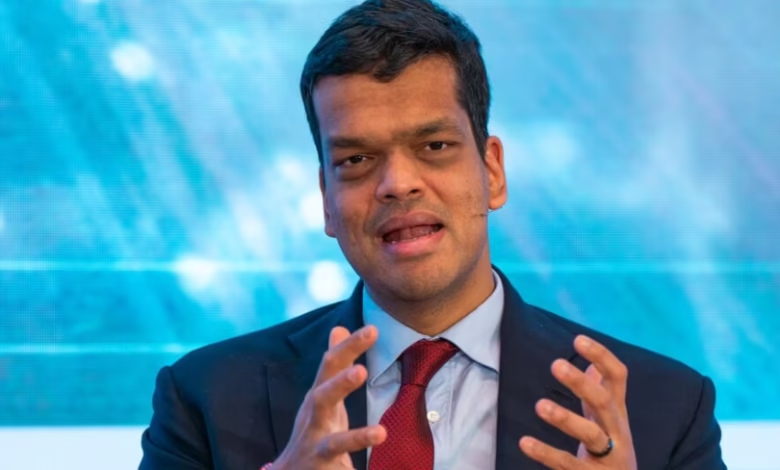
The White House is losing one of its key architects of artificial intelligence policy. Sriram Krishnan, the senior policy adviser on AI for the Trump administration, is set to depart at the end of June. According to the Washington Post, the former Andreessen Horowitz partner, who was brought in by President Donald Trump to guide the administration’s second-term AI strategy, will step down from his official role.
Krishnan was instrumental in crafting the administration’s AI action plan. Notably, in May, he facilitated a landmark agreement with tech giants Google, Microsoft, and xAI. This deal grants the U. S. government early access to their AI models prior to public release, allowing for a 30-day review period to evaluate capabilities and potential security risks.
David Sacks, the White House’s AI and crypto czar, praised Krishnan for his contributions to “policy initiatives and international diplomacy,” framing them as critical to securing “American AI dominance.” White House spokesperson Kush Desai echoed this sentiment, describing Krishnan as “a critical asset for President Trump’s push to cement American dominance in technology and innovation.”
Krishnan has indicated he will remain involved, serving as an outside adviser to the White House. He is reportedly laying the groundwork for a new institution focused entirely on AI policy. In a post on X, he stated, “After a break, I’ll be working on helping tackle some of the large challenges facing America on AI.”
This departure comes on the heels of a particularly active period in AI governance. On Tuesday, Trump signed an executive order establishing a voluntary framework for addressing cybersecurity threats linked to AI, notably stopping short of requiring mandatory testing. Just days earlier, on Friday, he directed national security agencies to diversify their AI providers. This directive followed a public dispute between the Pentagon and Anthropic over contract terms.
Anthropic had been the sole vendor approved for classified military use until the Defense Department blacklisted it as a supply chain risk. The company had refused to allow its models to be used for autonomous weapons or mass surveillance. In response, the administration has since inked classified AI agreements with Nvidia, Microsoft, and AWS.
Krishnan’s exit also casts a spotlight on the influence of Andreessen Horowitz within the administration’s tech policy circles. The venture capital firm has been a powerful force in shaping the White House’s approach to AI, with Bloomberg previously highlighting its growing role in Trump-era decisions. Whether Krishnan’s new institution will maintain that direct line of influence remains an open question.
(Source: The Next Web)