Samsung Galaxy Z Fold 8 Is Built for Endless Scrolling
▼ Summary
– Samsung’s Galaxy Z Fold 8 is a $1,900 book-style foldable designed for entertainment, with a 4:3 aspect ratio that optimizes video, multitasking, and vertical app browsing.
– The phone is compact and passport-sized when folded, lighter than previous models at 201 grams, and features a hinge that requires less force to open.
– The Z Fold 8 includes a 4,800 mAh silicon-carbon battery with 45-watt wired charging and 20-watt wireless charging, improving battery life and charging speed over the Z Fold 7.
– It has two rear cameras (50-megapixel wide and ultrawide) without a telephoto lens, plus AI features like My FanCam for tracking subjects in videos and Photo Assist for text-prompt image edits.
– The device launches ahead of a rumored foldable iPhone, positioning Samsung to define the format, with global foldable shipments expected to grow 21% in 2026 and Samsung holding a projected 32% market share.
Samsung has finally designed a book-style foldable that prioritizes entertainment over productivity, acknowledging that many users simply want a superior device for scrolling and binge-watching. The $1,900 Galaxy Z Fold 8 now serves as the company’s baseline foldable, positioned between the $1,200 clamshell Z Flip 8 and the premium $2,100 Z Fold 8 Ultra, which carries forward last year’s Z Fold 7 design. Unveiled at Samsung’s Galaxy Unpacked event on Wednesday, the phone is available for preorder now and launches on Aug. 7.
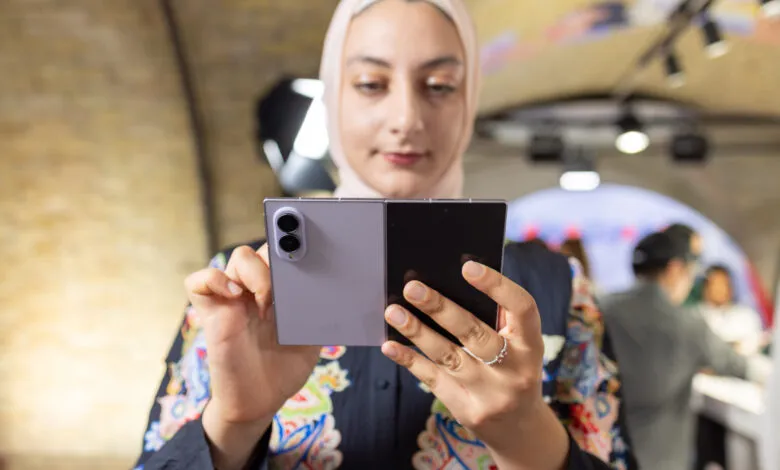
Built around a 4:3 aspect ratio and a passport-sized form factor, the Z Fold 8 feels equally at home playing horizontal videos, multitasking in landscape mode, or scrolling vertically through apps. This versatility and compactness make it one of the most enjoyable phones I’ve used this year, though I still have questions to address in my full review.
The boldly reimagined Z Fold 8 arrives at a pivotal moment, as Apple is reportedly preparing its first foldable iPhone for a fall launch. Rumors suggest that device could also feature a squarish 4:3 aspect ratio, similar to some iPad models, making this Samsung’s bid to stay ahead of the curve. While Apple’s entry will bring fresh competition, Samsung benefits from years of foldable development and consumer feedback.
“This is Samsung going on the offensive,” said Francisco Jeronimo, IDC’s vice president of client devices. “By bringing a wider, passport-style foldable to market ahead of Apple, Samsung gets to define the new format on its own terms rather than reacting to it later.” He added, “With Apple’s announcement less than two months away, this is the first Unpacked where Samsung has to defend the category it created, and that’s why it cannot play it safe.”
What makes the Z Fold 8’s design different
I first handled the Z Fold 8 during a visit to Samsung’s Korea headquarters last month, and I was eager to spend more time with it at this week’s Unpacked event in London. The phone feels compact and palm-sized when folded, a welcome departure from the monotony of today’s smartphones, including Samsung’s other foldables, which haven’t changed much from last year.
The Z Fold 8 fits snugly in my hand, reminiscent of a small pocket notebook for jotting down quick notes. It’s simply a fun phone to use because of its size and design. It’s not much thicker than the ultra-slim Z Fold 8 Ultra, measuring 4.5mm when open and 9.7mm when closed. It’s also the lightest Z Fold device, weighing just 201 grams.
Samsung EVP Kihwan Kim told me the Z Fold 8 is “very well suited for people who really enjoy media and social networks.” He noted that the company “collected a lot of feedback from different types of users” to better understand the needs of media-focused consumers. I can see myself using the Z Fold 8 in landscape mode for movies or multitasking, then rotating it vertically for Instagram or reading ebooks.
Customer feedback also led Samsung to make the new foldables easier to open by reducing hinge tension, causing the phone to spring open. Unlike the Z Fold 7, you won’t be able to unfold it partway, but it takes noticeably less force to pry it open.
One key spec remains unchanged: the IP48 rating, meaning it can withstand submersion in up to 1.5 meters of water for 30 minutes and is protected against solid objects larger than 1mm, but not dust or sand. That aligns with most foldables, though last year’s Google Pixel 10 Pro Fold boasts an IP68 rating, matching premium non-folding phones.
Display upgrades on the Galaxy Z Fold 8
The Z Fold 8 features a 5.5-inch cover screen and a 7.6-inch inside display, both with an anti-reflective coating that Samsung says reduces glare by up to 50%. Combined with 3,000-nit peak brightness, it should be easier to use apps and watch shows outdoors. I noticed the reduced reflections even while filming the phones indoors before Unpacked.
The Z Fold 8 uses a new display technology called Flex Titanium, which combines a titanium-alloy film with a titanium plate to create a thinner, more durable structure that should better withstand drops. I watched Samsung put these displays through rigorous testing at its headquarters, offering reassurance that the screen is designed for everyday use and hundreds of thousands of folds.
Flex Titanium also reduces the display’s crease, a longtime criticism of foldables. While I found the crease in last year’s Z Fold 7 negligible, the Z Fold 8’s is even harder to notice during use. This could be another way Samsung hopes to beat Apple to the punch, as rumors suggest the foldable iPhone could have a creaseless screen , potentially made by Samsung Display.
The Z Fold 8’s 4:3 aspect ratio follows other wider foldables like the Microsoft Surface Duo, the first Google Pixel Fold, and the Huawei Pura X Max. Notably, the Galaxy Z TriFold also uses a 4:3 ratio, though with a larger 10-inch main display. The Z Fold 8 condenses that into a compact design better suited for people who don’t want a miniature laptop.
Still, it’ll be an adjustment for those used to bar-style phones. The Z Fold 7 was one of my favorite devices last year because its cover screen felt like a standard slab phone. I’m curious whether the Z Fold 8’s squarish cover screen will encourage me to unfold it more often , something I didn’t do much with the more conventional Z Fold 7.
Battery life gets a boost on the Galaxy Z Fold 8
Samsung has equipped its foldables with a higher-capacity silicon-carbon battery. The Z Fold 7 had a 4,400-mAh battery that lasted a day but not much longer, while the Z Fold 8 bumps that to 4,800 mAh, which should reduce the urge to check battery levels anxiously.
The Z Fold 8 also supports 45-watt wired charging, promising a 0% to 63% charge in 30 minutes. That’s a notable upgrade from the 25-watt charging on the Z Fold 7, one of its weak points. The Z Fold 8 also supports 20-watt wireless charging, up from 15 watts last year. I look forward to testing these faster speeds, especially given the high price tag.
Cameras on the Galaxy Z Fold 8
One compromise with the Z Fold 8 over the Z Fold 8 Ultra is its more scaled-back camera system. The Z Fold 8 has just two rear cameras: a 50-megapixel wide-angle and a 50-megapixel ultrawide. There’s also a 10-megapixel selfie camera on the cover screen and another 10-megapixel camera on the inside screen.
That should suffice for most people, but the lack of a telephoto lens may leave some wanting more. I’m no professional photographer, but I take many photos, so I’m curious whether I’ll miss a dedicated zoom lens. Hopefully, sensor cropping at 2x and 4x will feel adequate.
AI and processor on the Galaxy Z Fold 8
The Z Fold 8 includes several AI camera updates, such as My FanCam. In videos with multiple moving people, like a ballet recital or soccer match, you can select one person for AI to track. You can also choose the aspect ratio to crop a horizontal video for social platforms. It’s a fun feature, though video quality will suffer as My FanCam zooms in.
As debuted in this year’s Galaxy S26 series, Photo Assist now lets you enter a text prompt for AI to alter an image. I tested it on a photo with cloudy skies, asking Galaxy AI to make them sunny instead. I was impressed by how it even adjusted shadows on the building to reflect the fake reality, though brick detail became grainier. Unlike Generative Edit, which can erase someone in the background, this feature feels more misleading, so I’m not sure I’ll use it often.
The Z Fold 8 is powered by a Snapdragon 8 Elite Gen 5 chip for Galaxy, which should make AI features, endless scrolling, and multitasking effortless.
A new foldable design at a critical time
Beyond its whimsical look, the Z Fold 8 underscores Samsung’s efforts to stay ahead in a category it has dominated for years. But competition is heating up. Earlier this year, Motorola debuted its first book-style foldable, the Razr Fold.
Apple’s expected entry could boost the overall foldable market. Global foldable phone shipments are projected to grow 21% year-over-year in 2026, according to Counterpoint Research. Samsung is expected to maintain the top spot with 32% share, compared to Apple’s anticipated 25% share. But the Korean phone maker must keep innovating to maintain its lead, and the Z Fold 8 feels like a deliberate effort to stand out in an increasingly crowded space.
“Competition is good, actually,” Kim told me. “For the last seven generations, we’ve already experienced a lot of things [and received] a lot of feedback from users and the market, and we’ve evolved for those needs. We’re pretty confident about what we’ve done.”
Now that I’ve spent time with the Z Fold 8, I’m eager to take it into the real world to see how it fits into my media habits , and whether it pushes the foldable category forward.
(Source: CNET)