Tencent to sell up to $1.6B stake in Kuaishou
▼ Summary
– Tencent is selling about 273 million Kuaishou shares (a 7.5% stake) in a block trade worth up to $1.55-1.6bn, reducing its holding from 15.68% to roughly 9.37%.
– The shares are offered at a 3.2% to 6.2% discount to Monday’s Hong Kong close, priced between HK$43.15 and HK$44.53 each.
– The selldown follows Tencent’s participation in a $2.8bn financing for Kuaishou’s Kling AI spinoff, signaling a rotation from mature short video into generative AI.
– Tencent has previously trimmed stakes in JD.com and Meituan, reflecting a pattern of reducing holdings in mature assets.
– Kuaishou confirmed the off-market disposal in an exchange filing and has continued its own share buyback program.
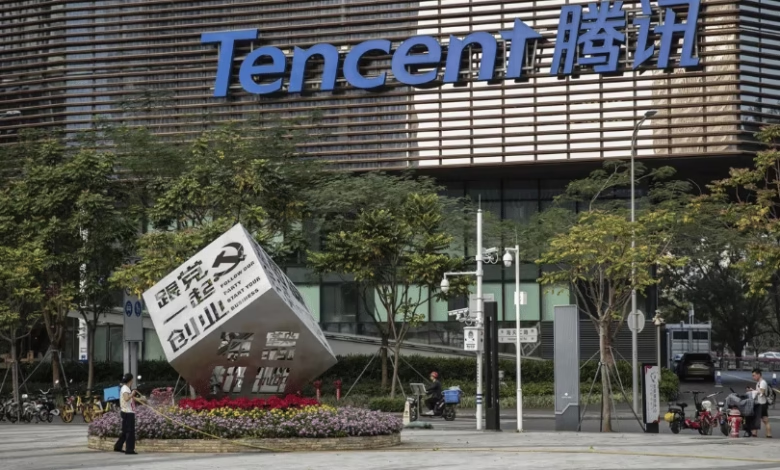
Tencent is moving to offload up to $1.6 billion worth of shares in Kuaishou, the Chinese short-video platform, according to a Bloomberg report. A term sheet reviewed by Reuters places the block trade at roughly $1.55 billion.
The transaction involves approximately 273 million shares, representing a 7.5% stake, with pricing set between HK$43.15 and HK$44.53 per share. That reflects a discount of 3.2% to 6.2% from Monday’s closing price in Hong Kong.
Following the sale, Tencent’s ownership in its longtime partner will drop from 15.68% to about 9.37%. Kuaishou confirmed the off-market disposal in a regulatory filing and has simultaneously continued its own share buyback program.
Tencent has a history of trimming stakes in mature holdings. In recent years, it reduced or distributed positions in JD.com and Meituan when it judged those investments had run their course. The company remains one of the most influential balance sheets in Chinese technology.
The timing of this selldown is noteworthy. It comes shortly after Tencent participated in a $2.8 billion financing round for Kling AI, Kuaishou’s generative video unit. Kling raised an initial $2 billion when Kuaishou spun it off at a valuation of roughly $18 billion.
That fundraising round became a geopolitical flashpoint. General Atlantic initially sought to lead the deal, but Beijing pushed its AI firms to reject U. S. capital. Chinese investors, including Tencent, stepped in to fill the void.
The move reads as a capital rotation out of the mature short-video business and into the AI infrastructure layered on top of it. Kuaishou’s domestic market offers fertile ground. China’s $16.5 billion micro-drama industry is emerging as the first large-scale application of AI-generated video.
Tencent’s relationship with Kuaishou runs deep, forged over years of jointly competing against ByteDance for short-video dominance. The company also has other demands on its capital, including a reported $3 billion domestic memory chip deal with CXMT as it builds out AI infrastructure.
For Kuaishou, losing a major anchor investor stings less when that same investor is simultaneously funding its future. Tencent is not leaving the table. It is simply changing seats.
(Source: The Next Web)