GM Deploys Robots at EV Plant After Cutting 1,300 Jobs
▼ Summary
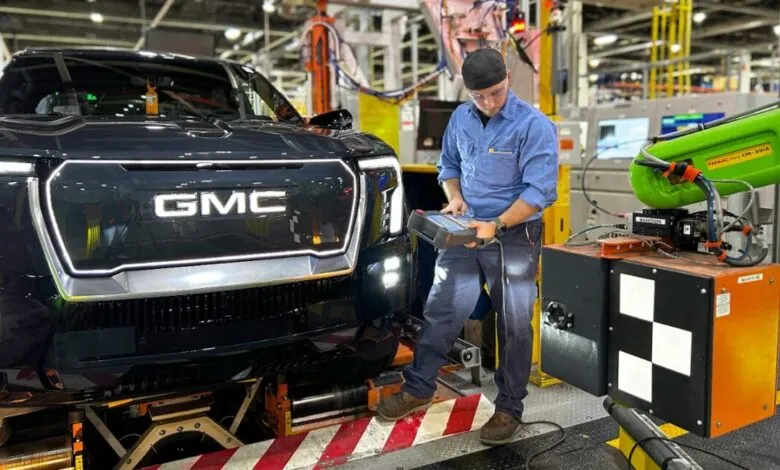
– GM installed about 50 FANUC robot arms at its Factory Zero plant in Detroit while over 1,000 workers remain on indefinite layoff since March.
– UAW leaders condemned the new robots, arguing GM could recall laid-off workers instead of adding automation.
– The temporary layoffs followed permanent layoffs of 1,200 workers at the same plant in October 2025.
– Automakers are increasing automation, with Hyundai planning to deploy humanoid robots at its Georgia EV plant by 2028.
– Union officials warned automation threatens jobs and wages, while corporate leaders highlighted robots’ potential to boost manufacturing.
Dozens of new robotic arms are now operating on the assembly line at General Motors’ flagship electric vehicle plant in Detroit, even as 1,300 workers remain on indefinite layoff following what was originally described as a temporary cut. This latest wave of automation has reignited tensions between the automaker and the United Auto Workers (UAW) over a question that strikes at the heart of the industry’s future: how to balance technological progress with job security.
According to reporting from Crain’s Detroit Business, GM has installed roughly 50 robot arms at its Factory Zero facility. Manufactured by Japanese robotics firm FANUC, these machines are designed to assist in attaching various components to vehicles during the assembly process. But union leaders were quick to voice frustration, noting that none of the workers laid off in March,supposedly on a temporary basis,have been called back.
“More than 1,000 union members are still laid off indefinitely,” James Cotton, president of UAW Local 22, told The Detroit News. He argued that GM could easily bring some of those workers back rather than deploying the 50 new robots.
The March layoffs followed a separate round of permanent cuts affecting 1,200 workers at the same plant in October 2025.
Automakers across the board are accelerating their use of assembly-line robotics. Stellantis NV and Ford Motor Company have both deployed similar FANUC arms, while Hyundai Motor Company plans to introduce Atlas humanoid robots,built by Boston Dynamics, which Hyundai acquired in 2020,at its flagship EV facility in Georgia by 2028.
Andrew Bergman, a Local 22 member and union organizer who was among those laid off by GM, accused corporate leadership of prioritizing profits over people.
“Technological development has the capability of making work safer for the working class and enabling workers to have a shorter work week without losing pay,” Bergman told The Detroit News. “But in the bosses’ and billionaires’ hands it’s used to pad profits and lay off workers.”
The divide between corporate and labor perspectives was on full display during the same week in June, when two separate gatherings in Detroit offered strikingly different messages about automation. At the Reindustrialize Summit, startup founders spoke enthusiastically about how robots could “empower our industrial base with superhuman manufacturing.” Meanwhile, at the UAW Constitutional Convention, union president Shawn Fain warned against “the threat of humanoid robotics and mass automation,” arguing that such technologies undermine worker employment and wages at a time when wealth inequality continues to widen.
(Source: Ars Technica)