Anthropic’s Claude Tag is an always-on AI teammate for Slack
▼ Summary
– Anthropic launched Claude Tag, an always-on AI that lives inside Slack and can be tagged for insights and task assignments, available to Claude Enterprise and Team customers.
– Claude Tag maintains persistent context and memory across conversations, learning institutional knowledge over time rather than starting fresh each interaction.
– The feature includes an ambient mode that proactively monitors channels and intervenes with reminders, summaries, or relevant information from other parts of the organization.
– System administrators control which channels, tools, and information each Claude identity can access, ensuring scoping between different teams like legal and engineering.
– The always-on nature raises privacy concerns, with Anthropic relying on admin-scoping controls to address employee and compliance scrutiny.
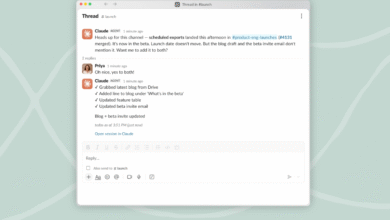
Anthropic is rolling out Claude Tag in research preview, an “always-on Claude” embedded directly inside Slack that functions as a persistent, context-aware AI teammate. Users can now tag @Claude within conversations to surface insights, assign tasks, and receive proactive updates. The feature is available immediately for Claude Enterprise and Claude Team customers.
This latest tool builds on Anthropic’s existing Slack integrations, which previously allowed users to direct-message Claude or tag it in channels for on-demand assistance. Claude Code in Slack could also route coding tasks from channel mentions to full web-based coding sessions, posting results back into the thread. But Claude Tag takes a significant step forward by adding a layer of persistent context and memory that earlier tools could not sustain.
“As Claude follows along with its channel, it learns ever more about the work,” Anthropic explained in a statement. With permission to read other channels, Claude can also automatically gather facts from across the organization. The result is an AI that accumulates institutional knowledge over time, rather than starting from scratch with each new interaction.
Everyone in a given Slack channel shares access to a single Claude identity, meaning any team member can see what Claude has been working on and pick up where the last person left off. System administrators define which tools, information, and channels each Claude identity can access, and each identity remains strictly scoped to those channels. For instance, a Claude set up for legal work cannot seed memories into the engineering channel.
When assigned a task, Claude Tag breaks it down into stages and works through them using whatever tools it has available, responding in a Slack thread with the output it creates. However, the more distinguishing feature is its ambient mode, which proactively jumps into conversations to keep teams updated, flag relevant information from across the organization, and follow up on threads or tasks that have been overlooked.
This ambient mode is what truly sets Claude Tag apart from a conventional chatbot. Instead of waiting to be asked, Claude monitors the channels it has been assigned to and intervenes when it determines a team would benefit from a reminder, a summary, or a piece of context pulled from another part of the company. Anthropic says this makes the experience feel like “working with a real colleague, one that can produce work in public view, with far greater context and understanding than before.”
Organizational context is increasingly the central battleground for enterprise AI. Microsoft has been developing Work IQ, an intelligence layer expressed through Copilot that draws on Microsoft Graph to understand roles, collaboration patterns, and organizational structure. Startups like Viktor have raised tens of millions to embed AI coworkers directly inside Slack and Teams. Glean, which recently surpassed $300 million in annual recurring revenue at a $7 billion valuation, is building a permissions-aware knowledge graph that sits between the model and enterprise data.
Claude Tag is Anthropic’s answer to the same challenge, but its approach is narrower and arguably more disciplined. Rather than constructing a horizontal intelligence layer across every enterprise application, it plants the AI inside the one surface where most knowledge work already happens: the team chat. The bet is that persistent presence in Slack, combined with cross-channel memory and admin-controlled scoping, is sufficient to accumulate the institutional context that makes an AI agent genuinely useful.
The privacy implications are substantial. An always-on AI that follows workplace conversations and autonomously decides when to intervene will face scrutiny from both employees and compliance teams. Anthropic’s admin-scoping controls are the structural answer to that concern, but the real test will come when enterprise customers deploy it at scale and discover how workers respond to an AI that is always listening.
Anthropic says it is working to bring Claude Tag to other platforms in the coming weeks. For now, Slack is the only surface, which limits the feature’s reach but also constrains its complexity, a deliberate trade-off for a research preview.
(Source: The Next Web)