Robot.com bets on wheeled humanoids for kitchens, warehouses
▼ Summary
– Robot.com launched R-noid, a wheeled humanoid robot for kitchens and warehouses, powered by Physical Intelligence’s AI model.
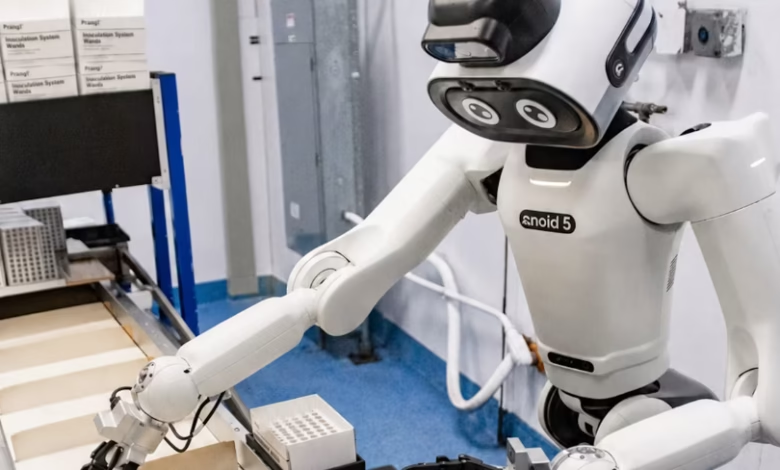
– R-noid uses a holonomic wheeled base instead of legs, with dual seven-degree-of-freedom arms and an articulated torso reaching nearly two meters.
– The robot runs on Physical Intelligence’s vision-language-action model, which interprets natural-language instructions to control arm and hand movements.
– Fewer than 40 R-noids have been commercially deployed across about a dozen customers, including at Harbor Links Golf Course in New York.
– Deployment takes 8 to 12 weeks, requiring 50 hours of data collection per task, with 70 percent autonomy expected during initial rollouts.
Robot.com, the San Francisco startup previously operating as Kiwibot, is making a strategic leap from campus delivery bots to wheeled humanoid robots designed for kitchens and warehouses. The company confirmed to Business Insider that it will launch R-noid, a humanoid on wheels engineered to handle order packaging, box loading and unloading, and workstation preparation across food service, logistics, and healthcare environments.
CEO Felipe Chavez revealed that this pivot has been in development for nearly two years. “We already have a foot in the door with our delivery robots,” he noted, emphasizing that adding manipulation capabilities was a logical progression for a company with over 500 robots deployed and more than two and a half million tasks completed.
R-noid does not attempt to walk. Instead, it moves on a holonomic wheeled base, equipped with dual seven-degree-of-freedom arms and an articulated torso that extends its vertical reach to nearly two meters. This design places the robot among a growing cohort of robotics firms betting that wheels outperform legs in practical workplace settings, sacrificing stair-climbing for enhanced stability, lower costs, and faster market readiness.
The robot’s dexterity is powered by Physical Intelligence, a leading AI lab in robotics. According to the company’s official announcement, R-noid operates using Physical Intelligence’s vision-language-action model, which interprets natural-language commands, analyzes the environment, and generates precise arm and hand movements to execute tasks. Chavez stated that Robot.com has been developing custom models with Physical Intelligence since last year.
A separate partnership with FieldAI supplies the navigation and autonomy systems. So far, the startup has commercially deployed fewer than 40 R-noids across roughly a dozen customers. One known deployment is at Harbor Links Golf Course in New York, where the robot assists with loading food into delivery bots and helps staff pack orders.
Deployment typically requires eight to 12 weeks, a process that includes visiting the customer’s facility, identifying tasks for automation, and collecting hours of robot data to fine-tune the model before onsite operations begin. Chavez explained that some tasks demand up to 50 hours of data collection before the robot can function independently. Teleoperation and remote support remain essential during initial rollouts, with the startup expecting about 70 percent autonomy at launch. The near-term goal, he said, is not to replace workers but to prepare businesses for robotics and boost worker satisfaction by offloading repetitive physical tasks.
R-noid launches across five initial categories: restaurant assistant, packer, picker, folder, and host. The broader humanoid market remains volatile, with over 150 companies chasing commercialization and buyer satisfaction rates as low as 23 percent in surveyed enterprise deployments.
Robot.com is positioning R-noid as a practical, task-specific tool rather than a general-purpose humanoid, a distinction that could prove critical as the industry separates commercially viable solutions from venture-funded spectacles. Founded in 2017 as Kiwibot, the company rebranded in October 2025 and has secured funding from investors including Headline, Sodexo VC, and UC Berkeley SkyDeck Fund. It will showcase R-noid at Automate 2026 in Chicago this week.
(Source: The Next Web)