Meta AI overhaul lead departs after just two months
▼ Summary
– Emily Dalton Smith is leaving Meta after two months as the executive leading the company’s internal AI agent tooling reorganization, including the Metamate assistant.
– Her departure comes as Meta’s “AI for work” overhaul, which aims to put AI agents at the center of operations, was meant to accelerate.
– The exit creates an awkward contrast with Meta’s heavy AI investment narrative and adds to a year of senior-level churn amid broader job cuts.
– Meta is shifting from an open-source Llama model strategy to a proprietary next-generation model, codenamed “Avocado,” which Dalton Smith’s unit was to help execute internally.
– The company has not named her replacement, disclosed the reasons for her departure, or clarified whether the internal tooling timeline will slip during the handover.
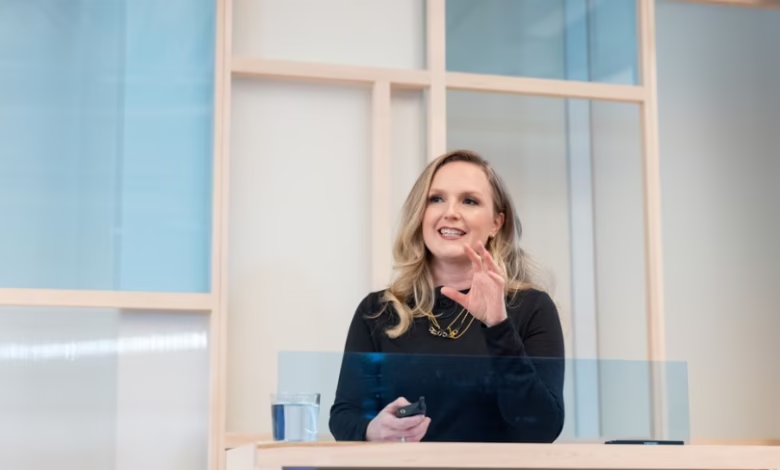
The memo was framed as a transition, not a departure. But the result is the same: Emily Dalton Smith, the Meta executive tasked with leading the company’s push to reorganize around AI agents, is leaving after just two months on the job. Dalton Smith joined Meta in 2015, and her exit comes precisely as the work she was hired to oversee was supposed to accelerate.
Timing is everything here. In April, Meta informed employees that Dalton Smith would take charge of product efforts to consolidate and improve the company’s internal AI tooling. This was part of a sweeping, company-wide overhaul designed to place AI agents at the core of Meta’s operations. Her unit owned Metamate, the firm’s primary internal enterprise assistant. Now, roughly two months later, she is departing, according to people familiar with the situation.
Dalton Smith has said she will remain to work with Andrew Bosworth, Meta’s chief technology officer, until a replacement is found and the handover is complete. Meta has not named that successor, nor has it disclosed where Dalton Smith is headed next. The company’s ‘AI for work’ transformation , the official name for this restructuring , continues, but without the executive who was just placed in charge of a central component.
This creates an awkward appearance for a company that has spent the past year insisting AI is the organizing principle of its future. Mark Zuckerberg, Meta’s chief executive, has committed enormous sums to this vision. The company is pouring money into infrastructure and into a Superintelligence Labs unit assembled partly through acquisitions. Against that backdrop, losing the person steering the internal-tooling effort two months in looks less like a routine reshuffle and more like a wrinkle in a plan presented as inevitable.
The departure also lands during a year of significant churn at Meta. The company cut 8,000 jobs in May, even as it reported record quarterly revenue. That kind of move has become a pattern across Big Tech, as firms convert payroll into AI capital expenditure. But senior-level staff turnover , voluntary or not , is harder to fold into that narrative.
Meta’s ambitions for AI agents extend well beyond internal tools. The company has been building out Superintelligence Labs through acquisitions, most recently buying Moltbook, an AI-agent ‘social network’ whose founders joined the lab directly. It has also been shifting away from the open-source approach that defined its Llama era, working instead on a proprietary next-generation model. Each of those moves depends on the same thing the ‘AI for work’ effort does: people who can ship.
That strategic shift is itself a notable break from Meta’s recent past. For years, the company positioned Llama as the open alternative to closed models from OpenAI and Anthropic, releasing weights that thousands of developers built upon. Its next-generation model, codenamed ‘Avocado’, is reported to be proprietary, meaning outside developers will no longer be able to freely download and run it. Reorganizing the company around agents while closing off the model layer is a large bet , and it is the bet Dalton Smith’s unit was meant to help execute internally.
The internal-tooling work she led is less glamorous than the model race, but arguably more consequential to how Meta actually operates day to day. Metamate and the consolidated assistant layer are what tens of thousands of Meta employees would use to do their jobs in the agent-centric company Zuckerberg has described. Putting one executive in charge of that, then losing her two months later, raises the practical question of continuity: who now owns the roadmap, and whether the timeline slips while the handover plays out.
What Dalton Smith’s exit means for the timeline of Meta’s internal overhaul is not yet clear. The company has not disclosed whether the transition will slow the rollout of consolidated AI tooling, and it has said nothing about the reasons behind the move. For now, the most concrete fact is the one in the memo: the person Meta chose to lead a flagship part of its AI reorganisation is leaving it, two months after she started.
(Source: The Next Web)