London Tech Week 2026: AI Billions and a Royal First
▼ Summary
– London Tech Week 2026 drew over 30,000 people from 130+ countries, with AI dominating roughly half the sessions as a technology now requiring practical implementation.
– The UK government pledged £1.1bn for an AI Hardware Plan, including £750m for a national supercomputer by 2030, alongside a £200m adoption package for skills and diffusion.
– American firms AMD and Nebius committed up to £2bn and £1.7bn respectively to UK AI capacity, highlighting tension between British build-out and reliance on US silicon.
– The Prince of Wales chaired a panel on data-driven homelessness prevention, launching the Homelessness Data Lab with over 25 organizations, though it remains a convening effort without disclosed funding.
– UK AI startups raised over £8.2bn in venture capital in early 2026, with London ranking third globally for VC, while open questions remain about whether pledged investments yield lasting British companies.
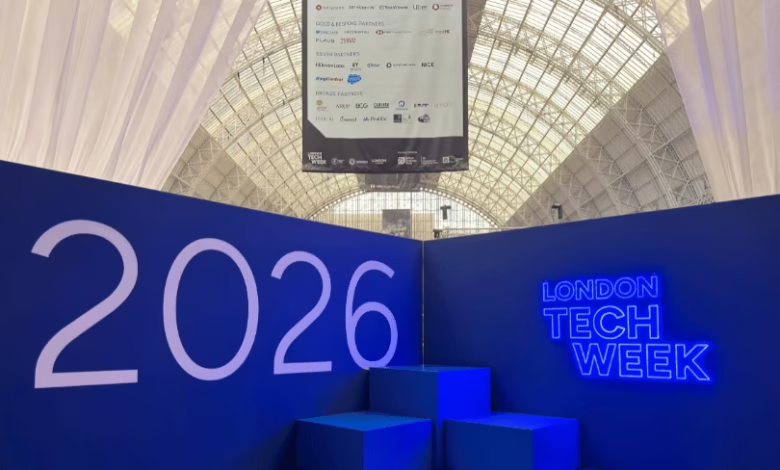
London Tech Week closed its 12th edition this week, wrapping three days of main-stage programming at Olympia from 8 to 10 June, with fringe events continuing across the capital through Friday. The festival drew over 30,000 attendees from more than 130 countries and featured 600-plus speakers.
One theme dominated everything else: AI appeared in roughly half of all sessions, and the consistent message was that the technology has shifted from “conceptual” to an operational necessity for every business.
The atmosphere was energetic and well-funded, despite broader market turbulence. The week kicked off shortly after the Nasdaq 100 posted its worst session in over a year. Inside the halls, queues stretched longer than last year, a Williams F1 car drew crowds, and AWS operated both a robot and a smoothie bar.
Here is what the week actually delivered across the four most significant threads.
The government opened its wallet
Prime Minister Keir Starmer set the tone on day one with a national compute push, including £400 million to purchase specialist AI chips, framed around ensuring British firms can “start here, scale here, and stay here.” That announcement was part of a broader package of day-one pledges unveiled throughout the week by Technology Secretary Liz Kendall.
The plan’s centerpiece is a £1.1 billion AI Hardware Plan, built around a £750 million national supercomputer due by 2030, £150 million of next-generation inference chips to be bought from British firms this summer, £120 million for chip design, and £45 million for training engineers. The strategy targets 5% of the global chip market and is explicitly designed to prevent the UK from losing its chipmakers after Graphcore went to SoftBank and Alphawave to Qualcomm.
A separate £200 million adoption package focused on diffusion rather than hardware, with an expanded Bridge AI scheme, a skills programme claiming 1.7 million course completions, and a new AI Economics Institute chaired by Nobel laureate Simon Johnson. Deputy Prime Minister David Lammy integrated AI into the justice system.
London Mayor Sadiq Khan added £12 million to help the capital’s small businesses adopt the technology. The government also launched an “AI Work Assistant” for jobseekers and tech training for up to 400,000 pupils.
The big cheques came from American firms
The largest financial commitments came from industry. AMD committed up to £2 billion over five years, with chief executive Lisa Su appearing on the AI Arena stage, backing high-performance computing with Cambridge and Imperial, taking stakes in UK startups, and establishing a Sovereign AI Innovation Lab with Dell.
The same stage drew Microsoft UK chief Darren Hardman and Perplexity co-founder Aravind Srinivas. Cloud provider Nebius pledged approximately £1.7 billion to build UK AI capacity, funding three Nvidia deployments that will reach 65 megawatts by 2027.
That captures the week’s central tension in one sentence: much of the British build-out runs on American silicon, with AMD’s chips and Nvidia’s hardware inside Nebius’s data centres. The UK’s home-grown “Lumen Sovereign” frontier-model effort is meant to chip away at that dependence, but it remains early-stage.
Building capacity in Britain is not the same as owning the stack.
London’s pull on the US AI industry was hard to miss. Anthropic, OpenAI, and fast-growing names such as Lovable, Cursor, Legora, and ElevenLabs all flagged London expansions around the event, drawn by the city’s deep talent pool. The same magnetism cuts both ways: investors on the floor warned that British startups, less well capitalised than US rivals, keep losing staff across the Atlantic.
A muscular state, and its limits
Kendall’s answer to the funding gap, floated on Bloomberg TV, was a plan to channel pension-fund money into UK firms through legal reform, building on a voluntary accord that could unlock around £25 billion. She framed it as part of a “more active, more muscular government that takes bets on where we think Britain is great.”
American firms, meanwhile, keep winning the biggest public contracts. Anthropic is building an assistant for GOV. UK, and Palantir holds major defence and health deals, even as lawmakers push to break its £330 million NHS contract.
Not every government message was about spending. Starmer also handed tech firms a three-month ultimatum to block children from viewing nude images by default, a demand that encrypted-messaging app Signal called dangerous and unworkable.
The deals kept coming
The backdrop was a UK tech sector that Tech Nation values at £1.2 trillion, with British AI startups raising more than £8.2 billion in venture capital in the first half of 2026, by the government’s reckoning close to half of all European tech investment. London ranks third globally for venture capital, behind the Bay Area and New York, and has minted a dozen new unicorns this year.
Individual stories filled in the picture. UK enterprise-AI startup Deliverance AI came out of stealth with £6 million in annual recurring revenue, three months after incorporation. UCL spinout Oriole Networks landed a marquee deployment with AMD, running an AI system on a pure photonic network as part of a £50 million national testbed.
Vinted’s marketplace chief Adam Jay used the stage to talk up a US push for the €8 billion secondhand platform.
A debut Deep Tech Stage gave space, robotics, quantum, and life sciences their own billing, with a space strand featuring UK Space Agency astronaut Meganne Christian and the Science Museum’s Libby Jackson. The momentum stretched beyond Britain.
A sizeable Turkish delegation touted a 423% jump in startup investment back home, and a Startup Coalition party with Atomico drew Chancellor Rachel Reeves to toast “$7 billion of investment success so far this year.”
A strong marketing thread ran in parallel: HubSpot and Dentsu told packed rooms that AI assistants are becoming the “front door” to brands, with most searches now ending in zero clicks.
A people-first thread, and a royal first
For all the compute talk, the week made room for a softer agenda. The Prince of Wales attended London Tech Week for the first time, chairing a panel on using data to prevent homelessness, the first time the subject had appeared on the programme. His Homewards initiative launched the UK’s first Homelessness Data Lab with LandAid and Salesforce, bringing together more than 25 organisations including Bloomberg, NatWest, and Accenture.
The thesis is that the warning signs of housing loss, rent arrears, benefit changes, and family breakdown show up in data long before someone reaches the street, and that the analytics tools businesses already use could be turned to prevention. It is, for now, a convening exercise rather than a set of signed contracts. Rough sleeping in England rose 27% in 2024, and the country spends an estimated £2.1 billion a year on homelessness, most of it on crisis response.
That human note echoed across the halls. Notion co-founder Ivan Zhao likened today’s AI to an early steam engine, still bolted onto old workflows before anyone redesigns the factory, and argued the durable human edge is taste, judgment, and teamwork. Several speakers made versions of the same point: the technology is racing ahead, but the bottleneck is organisational and human.
The questions the week left open
The harder questions were audible too. Much of the government’s headline £1.1 billion is spread across years and programmes, and the flagship supercomputer is four years away. The 1.7 million “AI skills” figure measures course completions, not outcomes. The Homelessness Data Lab has 25-plus members but no disclosed budget or metrics. And the sovereignty pitch still leans on US chips.
None of that dimmed the week’s energy, where the Prime Minister, the Mayor, and the future King all appeared within days of each other. But the recurring question, as it has been for years, is whether the billions pledged at Olympia turn into companies, jobs, and breakthroughs that stay in Britain, or simply more rented compute.
London Tech Week returns from 7 to 11 June 2027 to find out.
(Source: The Next Web)