Google NotebookLM Adds Gemini 3.5 and Antigravity

▼ Summary
– Google’s NotebookLM is receiving a major update, moving to the Gemini 3.5 model with support for more file types and streamlined web source integration.
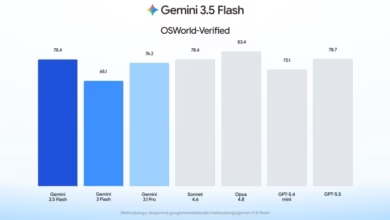
– Gemini 3.5 Flash offers faster, more efficient processing with lower token costs and similar or better output quality compared to previous models.
– In side-by-side tests, the upgraded NotebookLM achieved a 65 percent win rate over the old Gemini 3.1 model across five core evaluation dimensions.
– NotebookLM now has its own “cloud computer” that uses Antigravity to write and run code to support research goals.
– The update includes over 100 software skills that enable users to build workflows within notebooks without switching between apps.
Google’s NotebookLM originally marked the company’s initial push into generative AI, and unusually for Google, the product has not only survived but is now receiving its most significant upgrade to date. The tool is transitioning to the latest Gemini 3.5 model, expanding its file type compatibility, and improving how it handles web source integration. Additionally, Google has announced that NotebookLM will leverage embedded Antigravity support to deliver more advanced functionality across user queries.
The Gemini 3.5 Flash model was first unveiled at Google I/O earlier this year, with promises of dramatically faster and more efficient processing. According to Google, businesses concerned about token expenses can achieve substantial savings by migrating to this new Flash model while maintaining output quality that matches or exceeds previous versions. These enhancements are now reaching other Google services. NotebookLM, which debuted in 2023 during the early stages of the AI surge, enables users to examine specific materials such as documents and webpages using Google’s cutting-edge AI.
Google ran direct comparisons between NotebookLM operating on the older Gemini 3.1 branch and the updated 3.5 version. While the company remains somewhat unclear about the test methodology, it categorizes results into five primary core evaluation dimensions: Accuracy and Quality, Multilingual Support, Large Document Analysis, Document Creation, and Advanced Research. Across these metrics, Google reports that NotebookLM achieved an average 65 percent win rate against its predecessor.
Furthermore, NotebookLM now possesses its own dedicated cloud computer, which allows it to utilize Antigravity for writing and executing code to support research tasks. Google states that NotebookLM will include a library of more than 100 built-in software skills, enabling users to construct workflows within their notebooks that previously would have required switching between different applications.
(Source: Ars Technica)