ASRock RX 9070 GRE Steel Legend Review
▼ Summary
– The AMD Radeon RX 9070 GRE, based on RDNA 4 architecture, targets the mainstream gaming market with a cut-down Navi 48 GPU featuring 3,072 stream processors and 12 GB of GDDR6 memory.
– RDNA 4 introduces dedicated AI accelerators, enabling FSR 4, AMD’s first machine learning-based upscaling technology, which is supported in over 300 games.
– The RX 9070 GRE is priced at $550, positioned between the RTX 5060 Ti and RTX 5070, and uses a 192-bit memory bus with 432 GB/s bandwidth.
– The card features PCI-Express 5.0 x16, DisplayPort 2.1a UHBR13.5, and dual VCN media engines for AV1, H.265, and H.264 encoding/decoding.
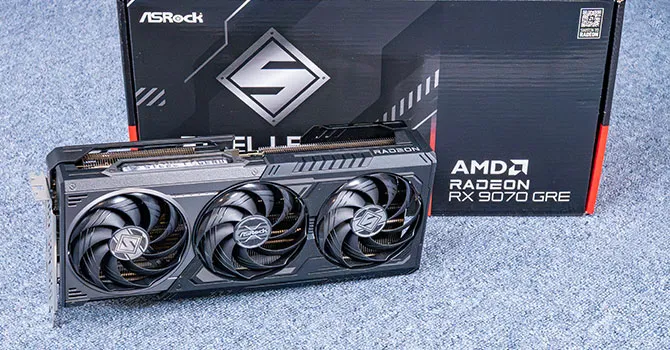
– ASRock’s Steel Legend version includes a triple-fan cooler and a robust PCB design powered by two 8-pin PCIe connectors.
ASRock’s latest addition to the Radeon lineup, the RX 9070 GRE Steel Legend, is built on AMD’s RDNA 4 architecture and aimed squarely at the mainstream gaming market. ASRock, long respected for its motherboards, has also carved out a steady reputation in the graphics card space. Originally launched as a China-exclusive model around May 2025, the RX 9070 GRE now sits between the RX 9060 XT and the RX 9070, powered by a trimmed-down Navi 48 GPU.
At its core, the RX 9070 GRE employs the Navi 48 XL die, which features 3,072 stream processors spread across 48 RDNA 4 compute units. It pairs this with 12 GB of GDDR6 memory on a 192-bit bus, delivering 432 GB/s of memory bandwidth. The “GRE” in its name stands for “Golden Rabbit Edition,” a label AMD first used with the RX 7900 GRE. RDNA 4 brings meaningful advances in ray tracing performance, with AMD claiming up to double the RT performance per compute unit compared to RDNA 3. For the first time, dedicated AI accelerators are integrated directly into the compute units. These accelerators are crucial to AMD’s value proposition, powering FSR 4, the company’s first machine-learning-based upscaling technology. Earlier FSR versions ran on any GPU but relied on shader-based algorithms, which limited image quality.
FSR 4 aims to narrow the gap with NVIDIA’s DLSS, and AMD says both FSR 4 and its frame generation features are already supported in over 300 games.
Priced at $550 starting MSRP, AMD positions the RX 9070 GRE as a bridge between the RTX 5060 Ti and the RTX 5070. The card connects via PCI-Express 5.0 x16 and includes DisplayPort 2.1a UHBR13.5 support for high-refresh-rate displays. Its dual VCN media engine provides hardware acceleration for AV1, H.265, and H.264 encoding and decoding.
ASRock’s Steel Legend implementation features a triple-fan cooler on a robust PCB, powered by two 8-pin PCIe connectors. This design ensures the card runs cool and stable under load, making it a solid choice for gamers looking to upgrade within this price bracket.
(Source: Techpowerup.com)